FIFA World Cup 2010: Spain’s Golden Generation, South Africa’s Historic Stage and a Final for the Ages
When tiki-taka met destiny, Spain finally touched the trophy, while South Africa gave the world a World Cup it would never forget.
The 2010 FIFA World Cup was more than another tournament on football’s calendar. It was a World Cup of firsts, surprises, heartbreaks, tactical battles and unforgettable characters.
For the first time, football’s greatest tournament travelled to Africa. South Africa became the first African nation to host the FIFA World Cup, and from the opening whistle to the dramatic final in Johannesburg, the tournament carried a different energy.
There were vuvuzelas buzzing through the stadiums, giant saves, spectacular counterattacks and enough late drama to keep fans glued to their screens.
And then there was Spain. Vicente del Bosque’s side arrived with a generation of players who had already conquered Europe. Xavi Hernández controlled games like a conductor, Andrés Iniesta floated between the lines, David Villa provided the finishing touch, while Sergio Ramos, CarlesPuyol and Iker Casillas gave the team its backbone. Yet Spain did not have an easy ride. They lost their opening match to Switzerland. That was the warning shot.
The eventual champions responded by winning their next six matches, each of them by a single goal. Portugal, Paraguay and Germany all discovered the same frustrating truth: Spain could dominate possession, move the ball endlessly and then strike when the smallest opening appeared.
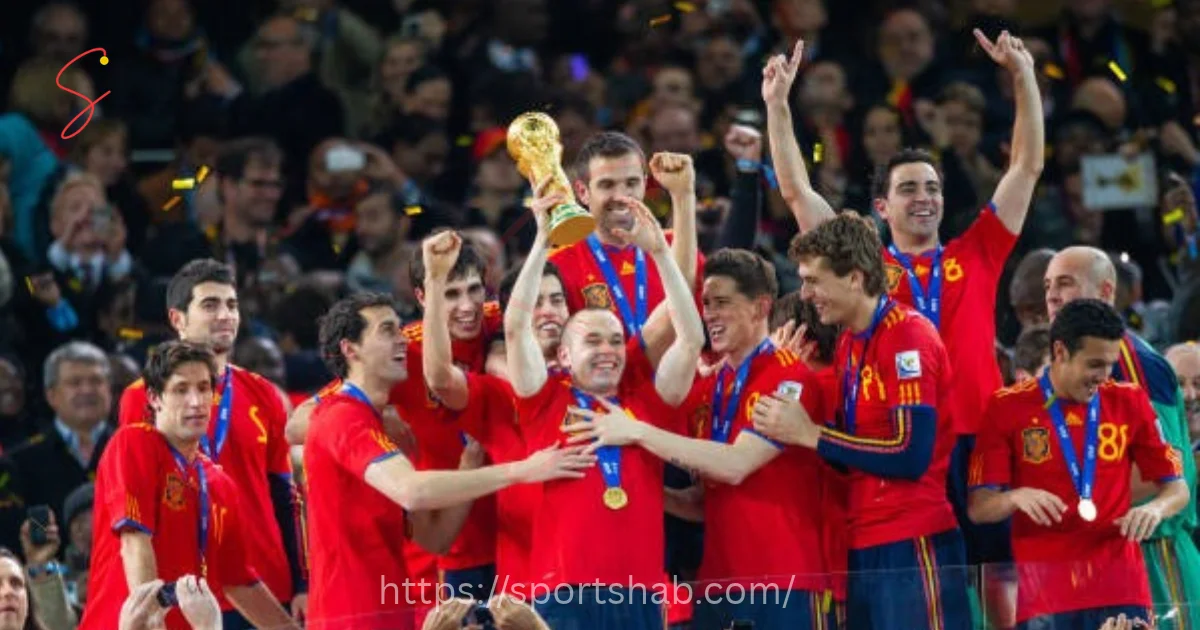
The final against the Netherlands became the perfect ending. Ninety minutes were not enough. The game went into extra time. Tempers boiled. Yellow cards flew. The tension became almost unbearable. Then, in the 116th minute, Andrés Iniesta changed Spanish football forever.
One swing of the right boot. One unforgettable goal. spain 1–0 Netherlands. The world champions had finally arrived.
FIFA World Cup 2010 Winner
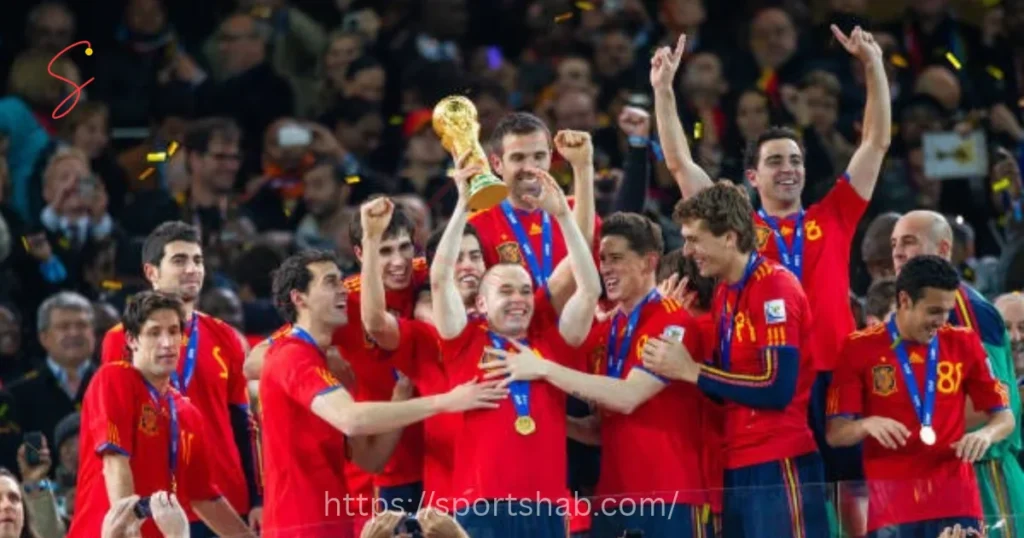
Spain won the 2010 FIFA World Cup, defeating the Netherlands 1–0 after extra time in the final at Soccer City in Johannesburg.
Andrés Iniesta scored the decisive goal in the 116th minute, giving Spain its first-ever World Cup title. FIFA records the victory as a landmark achievement: Spain became the eighth nation to win the World Cup and the first European nation to win the tournament outside Europe.
Spain’s victory was particularly remarkable because the team had lost its opening match against Switzerland.
Instead of collapsing, La Roja responded with six consecutive victories.
That is championship mentality.
Lose the first game, hear the criticism, then answer every question on the pitch.
FIFA World Cup 2010 Organized By
The tournament was organized by FIFA, the international governing body for association football.
The 2010 edition was the 19th FIFA World Cup and was staged from 11 June to 11 July 2010. Thirty-two national teams competed across 64 matches.
The competition was one of FIFA’s biggest organizational projects at the time, involving ten stadiums across nine host cities.
The tournament also carried enormous historical significance because it was the first FIFA World Cup held on African soil.
FIFA World Cup 2010 Host Country
South Africa hosted the 2010 FIFA World Cup.
The decision was historic. South Africa became the first African country to host football’s biggest international tournament.
The matches were played in ten stadiums spread across nine cities, with Johannesburg receiving the opening and final spotlight at Soccer City.
The tournament brought together football and South African culture in a way that made the event instantly recognizable.
And, of course, there was the vuvuzela.
Love it or hate it, you could not escape it.
That constant buzzing sound became one of the defining audio signatures of South Africa 2010.
FIFA World Cup 2010 Participants
Thirty-two teams qualified for the final tournament.
They were divided into eight groups of four:
Group A: South Africa, Mexico, Uruguay and France.
Group B: Argentina, Nigeria, South Korea and Greece.
Group C: England, United States, Algeria and Slovenia.
Group D: Germany, Australia, Serbia and Ghana.
Group E: Netherlands, Denmark, Japan and Cameroon.
Group F: Italy, Paraguay, New Zealand and Slovakia.
Group G: Brazil, Portugal, Ivory Coast and North Korea.
Group H: Spain, Switzerland, Chile and Honduras.
The tournament contained an interesting mixture of traditional giants, emerging nations and surprise packages.
Brazil arrived as five-time champions. Italy were defending champions. Argentina had Lionel Messi and Diego Maradona in the dugout. Germany had a young, exciting squad. The Netherlands remained desperate to finally win their first World Cup.
And then there was New Zealand.
Nobody expected the All Whites to rewrite the tournament record book.
They did not qualify for the knockout stage, but they finished unbeaten after drawing all three group matches.
Sometimes football laughs at your predictions.
FIFA World Cup 2010 Format
2010 World Cup followed the traditional 32 team structure.
The tournament began with eight groups containing four teams each. Every team played three group matches.
A victory earned three points, a draw one point and a defeat zero.
The top two teams from each group advanced to the knockout stage.
That created a field of 16 teams for the Round of 16.
From there, the tournament became survival football.
Lose once and you were going home.
The knockout route consisted of the Round of 16, quarter-finals, semi-finals, third-place play-off and final.
A draw in the knockout rounds after 90 minutes led to extra time, followed if necessary by a penalty shootout.
In other words: no second chances.
FIFA World Cup 2010 Group Stage Overview
The group stage immediately produced drama.
Group A
Uruguay topped Group A without conceding a goal, while Mexico joined them in the knockout stage.
Host nation South Africa finished third despite beating France 2–1 in their final match.
France’s campaign was a disaster, both on and off the pitch. The finalists from 2006 exited at the group stage.
Group B
Argentina swept through the group with three victories.
Diego Maradona’s team scored seven goals and looked dangerous going forward, with Gonzalo Higuaín becoming a key attacking figure.
South Korea finished second, while Greece and Nigeria were eliminated.
Group C
England struggled badly.
Fabio Capello’s team drew with the United States, drew with Algeria and finally defeated Slovenia 1–0 to scrape through.
The United States topped the group ahead of England.
Slovenia and Algeria were eliminated.
Group D
Germany announced themselves in style.
Joachim Löw’s young team demolished Australia 4–0, but later suffered a surprise defeat against Serbia.
Ghana finished second and became the only African nation to reach the quarter-finals.
Group E
The Netherlands were perfect.
Three matches.
Three wins.
Japan also progressed after producing disciplined football and dangerous set pieces.
Denmark and Cameroon were eliminated.
Group F
Italy, the defending champions, never looked like the team that had conquered Germany four years earlier.
They drew with Paraguay and New Zealand before losing 3–2 to Slovakia.
Slovakia and Paraguay advanced.
New Zealand’s three draws were not enough to qualify, but they left the tournament undefeated.
Group G
Brazil finished top, with Portugal second.
Ivory Coast played entertaining football but could not escape the group.
North Korea struggled badly and finished bottom.
Group H
Spain’s opening defeat to Switzerland immediately changed the tournament narrative.
Suddenly, the pre-tournament favourites were under pressure.
But Spain defeated Honduras and Chile to finish first.
Chile also qualified.
The group stage proved one thing: reputation gets you into the tournament, but it does not get you through it.
FIFA World Cup 2010 Knockout Stage
The knockout stage delivered a mixture of expected victories, spectacular upsets and painful exits.
Uruguay defeated South Korea 2–1.
Ghana eliminated the United States 2–1 after extra time.
Germany destroyed England 4–1.
Argentina beat Mexico 3–1.
The Netherlands overcame Slovakia 2–1.
Brazil defeated Chile 3–0.
Paraguay survived Japan on penalties after a goalless draw.
Spain defeated Portugal 1–0.
And just like that, 16 became eight.
FIFA World Cup 2010 Quarter Finals
The quarter-finals began with one of the tournament’s biggest shocks.
Netherlands 2–1 Brazil
Brazil looked comfortable after Robinho opened the scoring.
Then the Dutch fought back.
Wesley Sneijder became the central figure as the Netherlands turned the match around and eliminated the five-time champions.
Brazil were out.
The Netherlands were rolling.
Uruguay 1–1 Ghana
This was pure World Cup theatre.
Uruguay and Ghana battled through 120 minutes and finished level.
Then came the extraordinary ending.
In the final seconds of extra time, Luis Suárez deliberately handled the ball on the goal line to prevent a certain Ghanaian winner.
He was sent off.
Ghana received a penalty.
Asamoah Gyan stepped forward.
He missed.
The match went to penalties, and Uruguay won 4–2.
Ghana had been seconds away from becoming the first African team to reach a World Cup semi-final.
Football can be brutally cruel.
Germany 4–0 Argentina
Germany were magnificent.
Thomas Müller scored early, Miroslav Klose struck twice and Arne Friedrich added another.
Argentina were overwhelmed.
The German counterattack was ruthless, fast and devastating.
Paraguay 0–1 Spain
Spain dominated possession but had to work incredibly hard for the breakthrough.
David Villa eventually found the winning goal.
Spain were into the semi-finals.
The dream was still alive.
FIFA World Cup 2010 Semi Finals
The FIFA World Cup 2010 semi final stage delivered two very different battles.
Netherlands 3–2 Uruguay
The Netherlands reached the final after defeating Uruguay 3–2.
Giovanni van Bronckhorst produced one of the tournament’s great goals, firing a long-range strike into the top corner.
Diego Forlán responded for Uruguay.
But Wesley Sneijder and Arjen Robben restored Dutch control.
Maxi Pereira scored late for Uruguay, but the Netherlands survived.
The Dutch were heading to their third World Cup final.
Still no trophy.
Not yet.
Germany 0–1 Spain
This was arguably Spain’s most impressive performance of the tournament.
Germany had destroyed England and Argentina with explosive attacking football.
Spain simply refused to be intimidated.
The midfield controlled the rhythm.
The pressure increased.
Then came Carles Puyol.
The Barcelona defender rose above the German defence and headed Spain into the final.
One goal.
One clean sheet.
One ticket to Johannesburg.
FIFA World Cup 2010 Final
The world cup 2010 final match was played on 11 July 2010 at Soccer City in Johannesburg.
Spain faced the Netherlands in a final that quickly became one of the most fiercely contested championship matches in World Cup history.
The Netherlands arrived unbeaten and had won all six of their previous matches.
Spain had lost their opening game but had won their next five.
Neither side was willing to blink.
The match became increasingly physical, with both teams committing tactical fouls to stop dangerous attacks. Referee Howard Webb produced a record number of yellow cards for a World Cup final and eventually sent off Dutch defender John Heitinga in extra time.
Then, in the 116th minute, Andrés Iniesta received the ball inside the Dutch penalty area.
The finish was clean.
The celebration was emotional.
Iniesta removed his shirt to reveal a message honouring Dani Jarque, his former Spain Under-21 colleague who had died the previous year.
Spain had won 1–0.
The 2010 FIFA World Cup final scorecard looked simple.
Spain 1–0 Netherlands.
But behind that score was 116 minutes of pressure, frustration, tactical chess and nerves.
Spain were world champions.
FIFA World Cup 2010 Interesting Facts
South Africa 2010 produced enough stories to fill several football books.
The biggest was obvious: it was the first World Cup held in Africa.
Spain also created history by becoming the first European nation to win a World Cup outside Europe.
Spain were also the first team to win the World Cup after losing their opening match since 1978.
The defending champions Italy and 2006 finalists France both went home in the group stage.
That was a remarkable fall from grace.
New Zealand were the only unbeaten team in the tournament, despite failing to reach the knockout stage.
The tournament also produced an unusual family story.
Honduras selected three brothers: Jerry, Johnny and Wilson Palacios.
Even stranger, Germany and Ghana featured brothers playing against one another. Jérôme Boateng represented Germany, while his half-brother Kevin-Prince Boateng played for Ghana.
And there was one more unforgettable character: Paul the octopus.
The famous oracle became a global celebrity after correctly predicting Germany’s results and eventually Spain’s victory.
Football had officially gone bonkers.
Tournament Innovations and Firsts
The biggest innovation was not a tactical system or a new rule.
It was geographical.
South Africa became the first African host of the FIFA World Cup.
The tournament also saw the goalkeeper award officially renamed the Golden Glove. FIFA notes that the goalkeeper prize had previously been known as the Lev Yashin Award before the 2010 name change. Iker Casillas won the newly named award.
Spain’s success also represented a tactical revolution.
Their possession-based football became one of the defining styles of the era.
Xavi, Iniesta, Busquets and Xabi Alonso helped Spain dominate matches through short passing, positional movement and relentless ball retention.
It was not simply about keeping the ball.
It was about making the opponent chase it.
The Spanish message was simple:
If you have the ball, they cannot score.
FIFA World Cup 2010 Statistics
The 2010 tournament produced 145 goals across 64 matches, with 32 teams and 599 players taking part.
Germany were the tournament’s highest-scoring team with 16 goals.
Their attacking football was one of the defining features of the competition.
Thomas Müller, David Villa, Wesley Sneijder and Diego Forlán all scored five goals.
Müller won the Golden Boot because his three assists gave him the tiebreaker advantage.
Golden Ball 2010 FIFA World Cup
Diego Forlán, Uruguay
Forlán scored five goals in seven matches and played a central role in Uruguay’s unexpected run to the semi-finals.
FIFA awarded him the adidas Golden Ball as the tournament’s best player.
Golden Boot 2010 FIFA World Cup
Thomas Müller, Germany, 5 goals
Müller finished level on five goals with Villa, Sneijder and Forlán but won the award because he had three assists.
Golden Glove 2010 FIFA World Cup
Iker Casillas, Spain
Casillas was one of the quiet heroes of Spain’s championship campaign.
His saves against Paraguay and especially Arjen Robben in the final helped keep Spain alive when one mistake could have changed everything.
FIFA officially lists Casillas as the 2010 Golden Glove winner.
Top Scorers
Thomas Müller, David Villa, Wesley Sneijder and Diego Forlán all finished with five goals.
The difference was that Müller had three assists, which broke the tie for the Golden Boot.
Most Clean Sheets
Spain’s defence and Iker Casillas were central to the champions’ success.
Spain conceded only two goals in the entire tournament.
That defensive record was extraordinary considering the quality of opponents they faced in the knockout stage.
FIFA World Cup 2010 Squads: All 32 Teams
Every team registered a 23-player squad for South Africa 2010. The final squads had to be confirmed by 1 June, with injury replacements permitted under FIFA’s tournament regulations.
Below are the complete squads, organized by goalkeepers, defenders, midfielders and attackers, with the head coach listed for each nation.
Group A Squads
South Africa
Goalkeepers: Moeneeb Josephs, Itumeleng Khune, Shu-Aib Walters.
Defenders: Siboniso Gaxa, Tsepo Masilela, Aaron Mokoena, Anele Ngcongca, Matthew Booth, Lucas Thwala, Bongani Khumalo, Siyabonga Sangweni.
Midfielders: MacBeth Sibaya, Lance Davids, Siphiwe Tshabalala, Steven Pienaar, Teko Modise, Reneilwe Letsholonyane, Kagisho Dikgacoi, Surprise Moriri, Thanduyise Khuboni.
Attackers: Katlego Mphela, Bernard Parker, Siyabonga Nomvethe.
Coach: Carlos Alberto Parreira.
Mexico
Goalkeepers: Óscar Pérez, Guillermo Ochoa, Luis Ernesto Michel.
Defenders: Francisco Javier Rodríguez, Carlos Salcido, Rafael Márquez, Ricardo Osorio, Paul Aguilar, Héctor Moreno, Efraín Juárez, Jonny Magallón, Jorge Torres Nilo.
Midfielders: Gerardo Torrado, Pablo Barrera, Israel Castro, Andrés Guardado, Alberto Medina.
Attackers: Guillermo Franco, Cuauhtémoc Blanco, Carlos Vela, Javier Hernández, Giovani dos Santos, Adolfo Bautista.
Coach: Javier Aguirre.
Uruguay
Goalkeepers: Fernando Muslera, Juan Castillo, Martín Silva.
Defenders: Diego Lugano, Diego Godín, Jorge Fucile, Mauricio Victorino, Maximiliano Pereira, Andrés Scotti, Martín Cáceres.
Midfielders: Walter Gargano, Sebastián Eguren, Diego Pérez, Álvaro Pereira, Nicolás Lodeiro, Egidio Arévalo Ríos, Ignacio González, Álvaro Fernández.
Attackers: Edinson Cavani, Luis Suárez, Diego Forlán, Sebastián Abreu, Sebastián Fernández.
Coach: Óscar Tabárez.
France
Goalkeepers: Hugo Lloris, Steve Mandanda, Cédric Carrasso.
Defenders: Bacary Sagna, Eric Abidal, Anthony Réveillère, William Gallas, Marc Planus, Patrice Evra, Sébastien Squillaci, Gaël Clichy.
Midfielders: Franck Ribéry, Yoann Gourcuff, Jérémy Toulalan, Florent Malouda, Alou Diarra, Abou Diaby, Mathieu Valbuena.
Attackers: Djibril Cissé, Sidney Govou, André-Pierre Gignac, Thierry Henry, Nicolas Anelka.
Coach: Raymond Domenech.
Group B Squads
Argentina
Goalkeepers: Diego Pozo, Sergio Romero, Mariano Andújar.
Defenders: Martín Demichelis, Clemente Rodríguez, Nicolás Burdisso, Gabriel Heinze, Walter Samuel, Nicolás Otamendi.
Midfielders: Mario Bolatti, Ángel Di María, Juan Sebastián Verón, Javier Mascherano, Jonás Gutiérrez, Maxi Rodríguez, Javier Pastore, Sebastián Blanco.
Attackers: Lionel Messi, Gonzalo Higuaín, Carlos Tévez, Sergio Agüero, Diego Milito, Martín Palermo.
Coach: Diego Maradona.
Nigeria
Goalkeepers: Vincent Enyeama, Austin Ejide, Dele Aiyenugba.
Defenders: Joseph Yobo, Chidi Odiah, Taye Taiwo, Rabiu Afolabi, Elderson Echiejile, Danny Shittu, Uwa Echiejile.
Midfielders: Dickson Etuhu, John Obi Mikel, Kalu Uche, Lukman Haruna, Sani Kaita, Yusuf Ayila.
Attackers: Yakubu, Obafemi Martins, Peter Odemwingie, Chinedu Obasi, Victor Obinna, Nwankwo Kanu, Ikechukwu Uche.
Coach: Lars Lagerbäck.
South Korea
Goalkeepers: Jung Sung-ryong, Kim Young-kwang, Lee Woon-jae.
Defenders: Lee Young-pyo, Cho Yong-hyung, Lee Jung-soo, Kim Hyung-il, Kang Min-soo, Oh Beom-seok.
Midfielders: Park Ji-sung, Kim Jung-woo, Ki Sung-yong, Lee Chung-yong, Kim Nam-il, Kim Bo-kyung, Kim Jae-sung.
Attackers: Park Chu-young, Lee Keun-ho, Lee Dong-gook, Yeom Ki-hun.
Coach: Huh Jung-moo.
Greece
Goalkeepers: Alexandros Tzorvas, Michalis Sifakis, Kostas Chalkias.
Defenders: Loukas Vyntra, Sotirios Kyrgiakos, Avraam Papadopoulos, Vasilis Torosidis, Stelios Malezas, Nikos Spyropoulos, Giorgos Seitaridis.
Midfielders: Giorgos Karagounis, Kostas Katsouranis, Alexandros Tziolis, Sotiris Ninis, Pantelis Kafes, Sakis Prittas.
Attackers: Giorgos Samaras, Theofanis Gekas, Angelos Charisteas, Dimitris Salpingidis, Pantelis Kapetanos.
Coach: Otto Rehhagel.
Group C Squads
England
Goalkeepers: David James, Robert Green, Joe Hart.
Defenders: John Terry, Rio Ferdinand, Ashley Cole, Glen Johnson, Matthew Upson, Jamie Carragher, Stephen Warnock, Ledley King.
Midfielders: Frank Lampard, Steven Gerrard, Gareth Barry, James Milner, Shaun Wright-Phillips, Michael Carrick, Joe Cole.
Attackers: Wayne Rooney, Jermain Defoe, Emile Heskey, Peter Crouch.
Coach: Fabio Capello.
United States
Goalkeepers: Tim Howard, Brad Guzan, Marcus Hahnemann.
Defenders: Carlos Bocanegra, Oguchi Onyewu, Jay DeMerit, Jonathan Spector, Steve Cherundolo, Jonathan Bornstein, Clarence Goodson.
Midfielders: Michael Bradley, Landon Donovan, Clint Dempsey, DaMarcus Beasley, Benny Feilhaber, Ricardo Clark, Maurice Edu, Stuart Holden.
Attackers: Jozy Altidore, Herculez Gomez, Edson Buddle, Robbie Findley.
Coach: Bob Bradley.
Slovenia
Goalkeepers: Samir Handanović, Jasmin Handanović, Aleksander Šeliga.
Defenders: Mišo Brečko, Elvedin Džinić, Marko Šuler, Boštjan Cesar, Branko Ilić, Bojan Jokić.
Midfielders: Robert Koren, Rene Krhin, Andrej Komac, Valter Birsa, Aleksander Radosavljević.
Attackers: Nejc Pečnik, Zlatan Ljubijankić, Milivoje Novaković, Zlatko Dedić.
Coach: Matjaž Kek.
Algeria
Goalkeepers: Faouzi Chaouchi, Lounès Gaouaoui, Rais M’Bolhi.
Defenders: Madjid Bougherra, Rafik Halliche, Antar Yahia, Nadir Belhadj, Abdelkader Laïfaoui, Habib Bellaïd, Carl Medjani.
Midfielders: Karim Ziani, Hassan Yebda, Mehdi Lacen, Foued Kadir, Adlène Guedioura, Djamel Abdoun.
Attackers: Rafik Saïfi, Karim Matmour, Abdelmalek Ziaya, Rafik Djebbour, Karim Ziani.
Coach: Rabah Saâdane.
Group D Squads
Germany
Goalkeepers: Manuel Neuer, Hans-Jörg Butt, Tim Wiese.
Defenders: Philipp Lahm, Per Mertesacker, Arne Friedrich, Holger Badstuber, Jérôme Boateng, Serdar Tasci, Dennis Aogo.
Midfielders: Bastian Schweinsteiger, Mesut Özil, Sami Khedira, Piotr Trochowski, Marko Marin, Toni Kroos.
Attackers: Miroslav Klose, Lukas Podolski, Thomas Müller, Cacau, Stefan Kiessling.
Coach: Joachim Löw.
Ghana
Goalkeepers: Richard Kingson, Daniel Agyei, Stephen Ahorlu.
Defenders: John Pantsil, Hans Sarpei, Samuel Inkoom, Jonathan Mensah, Isaac Vorsah, Lee Addy.
Midfielders: Michael Essien, Anthony Annan, Sulley Muntari, Stephen Appiah, Kevin-Prince Boateng, André Ayew, Kwadwo Asamoah, Quincy Owusu-Abeyie.
Attackers: Asamoah Gyan, Matthew Amoah, Dominic Adiyiah, Prince Tagoe.
Coach: Milovan Rajevac.
Serbia
Goalkeepers: Vladimir Stojković, Bojan Isailović, Anđelko Đuričić.
Defenders: Branislav Ivanović, Nemanja Vidić, Neven Subotić, Aleksandar Luković, Ivan Obradović, Antonio Rukavina.
Midfielders: Dejan Stanković, Miloš Krasić, Zdravko Kuzmanović, Nenad Milijaš, Radosav Petrović, Gojko Kačar, Miloš Ninković.
Attackers: Nikola Žigić, Marko Pantelić, Milan Jovanović, Danko Lazović, Dragan Mrđa.
Coach: Radomir Antić.
Australia
Goalkeepers: Mark Schwarzer, Adam Federici, Brad Jones.
Defenders: Lucas Neill, Craig Moore, Sasa Ognenovski, Luke Wilkshire, David Carney, Mark Milligan, Rhys Williams.
Midfielders: Tim Cahill, Brett Emerton, Jason Culina, Vince Grella, Carl Valeri, Mile Jedinak, Dario Vidošić, Richard Garcia.
Attackers: Harry Kewell, Joshua Kennedy, Mark Bresciano, Nikita Rukavytsya.
Coach: Pim Verbeek.
Group E Squads
Netherlands
Goalkeepers: Maarten Stekelenburg, Michel Vorm, Sander Boschker.
Defenders: John Heitinga, Joris Mathijsen, André Ooijer, Gregory van der Wiel, Edson Braafheid, Khalid Boulahrouz.
Midfielders: Mark van Bommel, Nigel de Jong, Wesley Sneijder, Rafael van der Vaart, Ibrahim Afellay, Stijn Schaars, Arjen Robben, Eljero Elia.
Attackers: Robin van Persie, Dirk Kuyt, Klaas-Jan Huntelaar, Ryan Babel.
Coach: Bert van Marwijk.
Japan
Goalkeepers: Eiji Kawashima, Seigo Narazaki, Yoshikatsu Kawaguchi.
Defenders: Yuji Nakazawa, Marcus Tulio Tanaka, Atsuto Uchida, Yuto Nagatomo, Daiki Iwamasa, Yuichi Komano, Yasuyuki Konno.
Midfielders: Makoto Hasebe, Yasuhito Endō, Daisuke Matsui, Keisuke Honda, Shinji Okazaki, Kengo Nakamura, Junichi Inamoto, Shunsuke Nakamura.
Attackers: Yoshito Ōkubo, Shinji Kagawa, Takayuki Morimoto.
Coach: Takeshi Okada.
Denmark
Goalkeepers: Thomas Sørensen, Jesper Christiansen, Stephan Andersen.
Defenders: Daniel Agger, Simon Kjær, Per Krøldrup, Lars Jacobsen, Patrick Mtiliga, William Kvist, Leon Andreasen.
Midfielders: Christian Poulsen, Thomas Kahlenberg, Dennis Rommedahl, Martin Jørgensen, Jakob Poulsen, Christian Eriksen.
Attackers: Jon Dahl Tomasson, Nicklas Bendtner, Søren Larsen, Mikkel Beckmann.
Coach: Morten Olsen.
Cameroon
Goalkeepers: Carlos Kameni, Souleymanou Hamidou, Guy N’Dy Assembé.
Defenders: Benoît Assou-Ekotto, Nicolas Nkoulou, Rigobert Song, Sébastien Bassong, Gaëtan Bong, Aurélien Chedjou, Stéphane Mbia, Geremi.
Midfielders: Alex Song, Landry N’Guémo, Achille Emana, Jean Makoun, Eyong Enoh, Georges Mandjeck, Joël Matip.
Attackers: Samuel Eto’o, Eric Maxim Choupo-Moting, Pierre Webó, Mohammadou Idrissou, Vincent Aboubakar.
Coach: Paul Le Guen.
Group F Squads
Italy
Goalkeepers: Gianluigi Buffon, Federico Marchetti, Morgan De Sanctis.
Defenders: Fabio Cannavaro, Giorgio Chiellini, Gianluca Zambrotta, Marco Materazzi, Domenico Criscito, Leonardo Bonucci, Salvatore Bocchetti.
Midfielders: Daniele De Rossi, Andrea Pirlo, Gennaro Gattuso, Claudio Marchisio, Mauro Camoranesi, Angelo Palombo, Antonio Candreva.
Attackers: Alberto Gilardino, Vincenzo Iaquinta, Antonio Di Natale, Giampaolo Pazzini, Fabio Quagliarella.
Coach: Marcello Lippi.
Paraguay
Goalkeepers: Justo Villar, Diego Barreto, Aldo Bobadilla.
Defenders: Carlos Bonet, Paulo da Silva, Antolín Alcaraz, Darío Verón, Denis Caniza.
Midfielders: Edgar Barreto, Enrique Vera, Víctor Cáceres, Cristian Riveros, Aureliano Torres, Néstor Ortigoza.
Attackers: Roque Santa Cruz, Nelson Haedo Valdez, Lucas Barrios, Óscar Cardozo, Rodolfo Gamarra.
Coach: Gerardo Martino.
New Zealand
Goalkeepers: Mark Paston, Glen Moss, James Bannatyne.
Defenders: Ryan Nelsen, Winston Reid, Tommy Smith, Ben Sigmund, Tony Lochhead, Ivan Vicelich, Andrew Boyens.
Midfielders: Leo Bertos, Simon Elliott, Michael McGlinchey, Jeremy Christie, Tim Brown, David Mulligan, Chris Wood.
Attackers: Shane Smeltz, Rory Fallon, Chris Killen, Chris Wood.
Coach: Ricki Herbert.
Slovakia
Goalkeepers: Ján Mucha, Dušan Perniš, Ján Novota.
Defenders: Peter Pekarík, Martin Škrtel, Marek Čech, Radoslav Zabavník, Kornel Saláta, Martin Petráš.
Midfielders: Zdeno Štrba, Vladimír Weiss Jr., Ján Kozák Jr., Marek Sapara, Miroslav Stoch, Kamil Kopúnek.
Attackers: Róbert Vittek, Filip Hološko, Martin Jakubko, Erik Jendrišek, Stanislav Šesták.
Coach: Vladimír Weiss Sr.
Group G Squads
Brazil
Goalkeepers: Júlio César, Gomes, Doni.
Defenders: Maicon, Daniel Alves, Lúcio, Juan, Luisão, Thiago Silva, Michel Bastos.
Midfielders: Gilberto Silva, Felipe Melo, Elano, Kaká, Ramires, Josué, Júlio Baptista, Kleberson.
Attackers: Robinho, Luís Fabiano, Nilmar, Grafite.
Coach: Dunga.
Brazil had a squad packed with experience and power, but the tournament ended sooner than expected when the Netherlands came from behind to defeat them in the quarter-finals.
Portugal
Goalkeepers: Eduardo, Beto, Daniel Fernandes.
Defenders: Ricardo Carvalho, Pepe, Bruno Alves, Paulo Ferreira, José Bosingwa, Rolando, Miguel.
Midfielders: Deco, Tiago, Raul Meireles, Simão, Nani, Danny, Duda, Miguel Veloso.
Attackers: Cristiano Ronaldo, Hugo Almeida, Liedson, Liédson, Ricardo Quaresma.
Coach: Carlos Queiroz.
Ivory Coast
Goalkeepers: Boubacar Barry, Daniel Yeboah, Aristide Zogbo.
Defenders: Didier Zokora, Kolo Touré, Emmanuel Eboué, Arthur Boka, Siaka Tiéné, Souleymane Bamba, Steve Gohouri.
Midfielders: Yaya Touré, Didier Drogba, Romaric, Cheick Tioté, Abdul Kader Keïta, Salomon Kalou, Emerse Faé.
Attackers: Gervinho, Seydou Doumbia, Aruna Dindane, Bakary Koné.
Coach: Sven-Göran Eriksson.
North Korea
Goalkeepers: Ri Myong-guk, Kim Myong-gil, Kim Myong-won.
Defenders: Ri Jun-il, Pak Nam-chol, Cha Jong-hyok, Nam Song-chol, Pak Chol-min, Ri Kwang-chon, Ji Yun-nam.
Midfielders: Kim Yong-jun, An Yong-hak, Mun In-guk, Pak Nam-chol, Kim Kyong-il.
Attackers: Jong Tae-se, Hong Yong-jo, Pak Kwang-ryong, Kim Kum-il.
Coach: Kim Jong-hun.
Group H Squads
Spain
Goalkeepers: Iker Casillas, Pepe Reina, Víctor Valdés.
Defenders: Sergio Ramos, Carles Puyol, Gerard Piqué, Raúl Albiol, Joan Capdevila, Álvaro Arbeloa, Carlos Marchena.
Midfielders: Xavi Hernández, Andrés Iniesta, Xabi Alonso, Sergio Busquets, Cesc Fàbregas, David Silva, Javi Martínez, Jesús Navas.
Attackers: David Villa, Fernando Torres, Pedro Rodríguez, Juan Mata, Fernando Llorente.
Coach: Vicente del Bosque.
This was the squad that delivered Spain’s first World Cup.
The names alone tell the story.
Casillas.
Puyol.
Ramos.
Xavi.
Iniesta.
Busquets.
Villa.
Torres.
A golden generation.
Chile
Goalkeepers: Claudio Bravo, Miguel Pinto, Luis Marín.
Defenders: Gary Medel, Gonzalo Jara, Pablo Contreras, Ismael Fuentes, Waldo Ponce, Arturo Vidal, Mauricio Isla.
Midfielders: Carlos Carmona, Rodrigo Millar, Jorge Valdivia, Matías Fernández, Mark González, Jean Beausejour, Rodrigo Tello.
Attackers: Alexis Sánchez, Humberto Suazo, Esteban Paredes, Fabián Orellana.
Coach: Marcelo Bielsa.
Chile’s aggressive approach made them one of the most entertaining sides of the group stage.
Switzerland
Goalkeepers: Diego Benaglio, Johnny Leoni, Marco Wölfli.
Defenders: Philippe Senderos, Stéphane Grichting, Steve von Bergen, Stephan Lichtsteiner, Mario Eggimann, Reto Ziegler.
Midfielders: Gökhan Inler, Tranquillo Barnetta, Gelson Fernandes, Valon Behrami, Benjamin Huggel, Pirmin Schwegler, Xherdan Shaqiri.
Attackers: Alexander Frei, Eren Derdiyok, Blaise Nkufo, Hakan Yakin, Marco Streller.
Coach: Ottmar Hitzfeld.
Switzerland produced one of the tournament’s biggest shocks by defeating Spain 1–0 in their opening game.
Honduras
Goalkeepers: Noel Valladares, Donis Escober, Ricardo Canales.
Defenders: Maynor Figueroa, Víctor Bernárdez, Johnny Palacios, Emilio Izaguirre, Mauricio Sabillón, Sergio Mendoza.
Midfielders: Wilson Palacios, Hendry Thomas, Amado Guevara, Ramón Núñez, Danilo Turcios, Édgar Álvarez, Roger Espinoza.
Attackers: Carlos Pavón, David Suazo, Jerry Palacios, Georgie Welcome, Walter Martínez, Boniek García.
Coach: Reinaldo Rueda.
The complete squad records confirm that all 32 teams entered the tournament with 23 players, creating a total player pool of 736 footballers.
Why Spain Won the 2010 World Cup
Spain did not win because they scored the most goals.
They did not win because they produced the most spectacular attacking numbers.
They won because they controlled matches.
The midfield was the engine.
Xavi dictated tempo.
Iniesta found spaces.
Busquets protected the defence.
Xabi Alonso switched play.
David Villa attacked gaps.
And when everything else failed, Casillas stood between Spain and disaster.
Their knockout results tell the story.
Portugal: 1–0.
Paraguay: 1–0.
Germany: 1–0.
Netherlands: 1–0.
Four knockout victories.
Four goals.
Four clean sheets.
That is not luck.
That is control.
The Legacy of the 2010 FIFA World Cup
South Africa 2010 changed the perception of what a World Cup could look and sound like.
It brought the tournament to Africa for the first time and gave millions of fans across the continent a chance to watch the world’s biggest football event on home soil.
It also produced one of the strongest international teams of the modern era.
Spain’s victory completed a remarkable sequence.
European Championship in 2008.
World Cup in 2010.
European Championship again in 2012.
The core of that team would go on to dominate international football.
And the 2010 tournament gave the world one of football’s most iconic images: Andrés Iniesta running toward the corner after scoring the goal that changed Spanish history.
For Spain, it was the moment generations had waited for.
For the Netherlands, it was another painful final defeat.
For Uruguay, it was an unexpected return to the global elite.
For Germany, it was the arrival of a thrilling young generation.
And for South Africa, it was a historic celebration.
That is why the fifa world cup 2010 remains such an important chapter in football history.
It was not simply about who lifted the trophy.
It was about a continent hosting the world, a generation announcing itself and a final that needed 116 minutes to find its hero.