FIFA World Cup 2002: Brazil’s Perfect Run, Ronaldo’s Redemption and a Tournament Full of Surprises
A tournament of shocks, heroes and unforgettable comebacks, and the night Brazil finally claimed the fifth star.
FIFA World Cup 2002 at a Glance
The FIFA World Cup 2002 was not your ordinary football tournament. It was a World Cup of firsts, surprises and redemption stories, played across two countries and on a continent hosting the competition for the first time.
From 31 May to 30 June 2002, the world’s best national teams travelled to South Korea and Japan for the 17th edition of the FIFA World Cup. Thirty-two nations competed across 64 matches, with 161 goals scored.
And when the dust finally settled, there was only one team standing.
Brazil were champions.
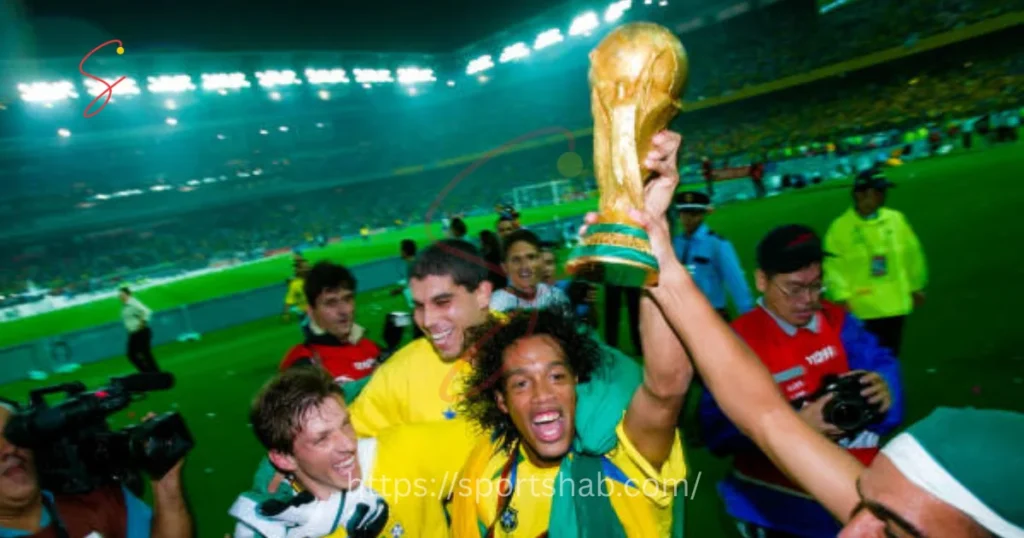
They defeated Germany 2–0 in the final at Yokohama, with Ronaldo scoring both goals and completing one of the greatest redemption stories in World Cup history. The victory gave Brazil a record fifth World Cup title.
But Brazil’s trophy was only one chapter.
France, the reigning world champions, crashed out without scoring a single goal. Argentina suffered an equally painful group-stage exit. Senegal announced themselves with a stunning opening day victory over France. South Korea went all the way to the semi-finals. Turkey reached the last four too.
And then there was Ronaldo.
Four years after his mysterious illness and disappointing final in 1998, the Brazilian striker returned to the biggest stage and produced eight goals.
The Fenômeno was back.
FIFA World Cup 2002 Winner Brazil
Brazil won the 2002 FIFA World Cup, defeating Germany 2-0 in the final on 30 June 2002.
The victory was Brazil’s fifth World Cup championship, extending their record as the competition’s most successful nation. They also became the first team to win every match at a World Cup since the tournament’s modern 32-team format began. FIFA records Brazil’s 2002 campaign as seven victories from seven matches.
The numbers tell part of the story: Brazil scored 18 goals and conceded only four throughout the tournament. They beat Turkey twice, China, Costa Rica, Belgium, England and finally Germany.
That was not simply a championship run.
That was a statement.
Organized By
The 2002 FIFA World Cup was organized by FIFA, football’s global governing body.
The tournament was jointly hosted by South Korea and Japan, making it the first FIFA World Cup held in Asia and the first edition jointly hosted by two nations. It was also the first World Cup staged outside Europe and the Americas.
The co-hosting arrangement itself was historic. Two countries, one tournament, 20 venues and a footballing event that introduced the World Cup to a completely new regional audience.
Host Nations: South Korea and Japan
South Korea and Japan shared hosting responsibilities for the 2002 World Cup.
Matches were played across cities in both countries, creating a tournament that stretched across East Asia. The final was played at the International Stadium in Yokohama, Japan.
For South Korea, the tournament became even more extraordinary. The home side went from being viewed as outsiders to reaching the semi-finals.
Japan also made history by progressing beyond the group stage for the first time.
The atmosphere was electric, and the home support added another layer of drama to a tournament already packed with surprises.
FIFA World Cup 2002 Participants
Thirty-two national teams qualified for the 2002 World Cup.
The tournament included traditional powers such as Brazil, Germany, Italy, Argentina, England, France and Spain alongside emerging football nations.
The 32 participants were:
Group A: Denmark, France, Senegal and Uruguay.
Group B: Spain, Paraguay, South Africa and Slovenia.
Group C: Brazil, Turkey, Costa Rica and China PR.
Group D: South Korea, Portugal, Poland and the United States.
Group E: Germany, Republic of Ireland, Cameroon and Saudi Arabia.
Group F: Sweden, England, Argentina and Nigeria.
Group G: Mexico, Italy, Croatia and Ecuador.
Group H: Japan, Belgium, Russia and Tunisia.
Four countries, China PR, Ecuador, Senegal and Slovenia, made their World Cup debuts.
Senegal were the standout debutants, reaching the quarter-finals.
FIFA World Cup 2002 Format
The tournament featured 32 teams divided into eight groups of four.
Each team played three group-stage matches. Three points were awarded for a victory, one for a draw and none for a defeat.
The top two teams from each group advanced to the Round of 16.
From there, the competition switched to a straight knockout format:
Round of 16 → Quarter-finals → Semi-finals → Final
A third-place play-off was also held between the two losing semi-finalists.
In total, the tournament consisted of 64 matches and produced 161 goals.
The knockout stage also featured the controversial golden-goal rule. The 2002 tournament was the second and final World Cup to use it after its introduction at France 1998.
FIFA World Cup 2002 Group Stage Overview
The group stage immediately reminded football fans that reputations mean very little once the whistle blows.
Group A: Denmark Lead, France Collapse
Denmark topped Group A with seven points, while Senegal finished second with five.
But the real headline was France.
The defending champions arrived with an extraordinary squad and plenty of expectation, yet they failed to win a single match and, remarkably, did not score a single goal.
Senegal stunned France 1–0 in the opening game, Denmark defeated France 2–0, and France drew 0–0 with Uruguay.
For the reigning champions, the World Cup was over before it had properly started.
Senegal, meanwhile, were through to the knockout stage in their first-ever World Cup.
What an entrance.
Group B: Spain Set the Pace
Spain were perfect in Group B, winning all three matches and collecting nine points.
Paraguay finished second with four points, narrowly edging South Africa.
Spain scored nine goals during the group stage and looked like a serious contender heading into the knockout rounds.
Group C: Brazil Turn Up the Heat
Brazil looked every inch the tournament favourite.
They defeated Turkey 2–1, China PR 4–0 and Costa Rica 5–2.
Three games.
Three victories.
Eleven goals.
Nine points.
That was the warning shot.
Brazil topped Group C with a perfect record while Turkey also advanced.
Group D: South Korea Shock Portugal
South Korea topped Group D with seven points.
The United States finished second with four.
Portugal, despite having a talented squad featuring Luís Figo, were eliminated after losing 1–0 to the hosts in their final group game.
South Korea were beginning to believe.
And once belief enters football, anything can happen.
Group E: Germany Recover
Germany won Group E with seven points.
The Republic of Ireland finished second with five.
Germany’s campaign included an extraordinary 8–0 victory over Saudi Arabia, with Miroslav Klose scoring three times.
It was a brutal introduction to the tournament for Saudi Arabia and an early glimpse of Klose’s goal-scoring instincts.
Group F: The Group of Death Delivers
Argentina, England, Sweden and Nigeria made Group F one of the tournament’s most anticipated groups.
Yet Argentina were eliminated.
Sweden topped the group with five points, while England finished second with five.
Argentina’s 1–0 defeat to England became one of the defining matches of their campaign.
The pre-tournament favourites were heading home.
Group G: Italy Survive
Mexico topped Group G with seven points, while Italy advanced with four.
Croatia and Ecuador were eliminated.
Italy’s tournament was already beginning to develop its own controversy, with refereeing decisions becoming a major talking point as the competition moved forward.
Group H: Japan Make History
Japan topped Group H with seven points.
Belgium finished second with five.
The hosts progressed beyond the group stage for the first time, giving Japanese football fans a knockout-stage adventure to remember.
FIFA World Cup 2002 Knockout Stage
Once the group stage ended, the tournament became a completely different beast.
There was no room for a bad afternoon.
Lose and go home.
Round of 16
Brazil defeated Belgium 2–0.
Germany edged Paraguay 1–0.
England comfortably defeated Denmark 3–0.
Spain survived the Republic of Ireland on penalties after a 1–1 draw.
Senegal continued their magical run by defeating Sweden 2–1 after extra time.
Turkey defeated Japan 1–0.
South Korea defeated Italy 2–1 after extra time in one of the tournament’s most controversial matches.
And the United States defeated Mexico 2–0 in a memorable CONCACAF clash.
The quarter-final lineup was complete.
Brazil.
England.
Germany.
United States.
Spain.
South Korea.
Senegal.
Turkey.
FIFA World Cup 2002 Quarter finals
Germany vs United States
Germany defeated the United States 1–0.
Michael Ballack scored the decisive goal in the 38th minute.
The Americans pushed hard and created chances, but Oliver Kahn and the German defence held firm.
Germany were not always spectacular.
But they were still standing.
And at a World Cup, that matters.
Brazil vs England
Brazil faced England in a heavyweight quarter-final.
Michael Owen put England ahead, but Rivaldo equalised before Ronaldinho produced the moment that changed the match.
His free-kick from distance sailed over David Seaman and into the net.
England had no answer.
Brazil won 2–1 and advanced to the semi-finals.
South Korea vs Spain
South Korea and Spain finished 0–0 after extra time.
South Korea won the penalty shootout 5–3.
Another upset.
Another controversy.
And another historic achievement for the hosts.
South Korea were now in the last four.
Senegal vs Turkey
Senegal’s fairy-tale campaign finally ended against Turkey.
Ilhan Mansız scored the golden goal in extra time, sending Turkey into the semi-finals.
Senegal’s dream was over.
But their legacy had already been secured.
FIFA World Cup 2002 Semi finals
Germany vs South Korea
The first semi-final took place in Seoul.
South Korea had already defeated Portugal, Italy and Spain. One more victory would send them into a World Cup final on home soil.
Germany had other plans.
Michael Ballack scored the only goal of the match in the 75th minute.
Germany won 1–0 and reached the final.
South Korea’s extraordinary run had ended, but they had already achieved something no Asian team had done before: reaching the World Cup semi-finals.
Brazil vs Turkey
Brazil and Turkey met again, having already faced each other in the group stage.
The semi-final was tight.
Ronaldo eventually broke the deadlock, scoring the only goal of the match.
Brazil won 1–0.
The final was set.
Brazil vs Germany.
FIFA World Cup 2002 Final: Brazil vs Germany
On 30 June 2002, Brazil and Germany met at the International Stadium in Yokohama.
It was a final worthy of the occasion.
Germany had Oliver Kahn, the tournament’s outstanding goalkeeper.
Brazil had Ronaldo, Rivaldo and Ronaldinho.
The first half ended goalless.
Then came Ronaldo.
In the 67th minute, Rivaldo’s shot was spilled by Kahn. Ronaldo reacted instantly, sliding the ball into the net.
Brazil 1–0 Germany.
The Brazilian attack smelled blood.
Twelve minutes later, Ronaldo struck again.
He collected the ball, exchanged passes with Rivaldo and calmly finished beyond Kahn.
Brazil 2–0 Germany.
That was it.
Brazil had their fifth World Cup.
Ronaldo had his redemption.
Kahn had his Golden Ball.
And football had another unforgettable final.
FIFA records Brazil’s victory as a 2–0 win, with Ronaldo scoring both goals.
FIFA World Cup 2002 Interesting Facts
Brazil Won Every Match
Brazil played seven matches and won all seven.
They scored 18 goals and conceded only four.
It was one of the most complete championship campaigns in World Cup history.
France Were Eliminated Without Scoring
The defending champions finished their campaign with one draw, two defeats and zero goals scored.
It remains one of the most dramatic title-defence collapses in World Cup history.
The World Cup Came to Asia for the First Time
South Korea and Japan became the first Asian hosts of the men’s FIFA World Cup.
The tournament was also the first jointly hosted World Cup.
Four Nations Made Their World Cup Debuts
China PR, Ecuador, Senegal and Slovenia all played at their first World Cup.
Senegal went furthest, reaching the quarter-finals.
South Korea Reached the Semi-finals
The hosts became the first team from outside UEFA, CONMEBOL and CONCACAF to reach the World Cup semi-finals.
Turkey Reached the Last Four
Turkey reached the semi-finals and eventually defeated South Korea 3–2 in the third-place match.
That gave Turkey their best-ever World Cup finish.
The Fastest World Cup Goal Came in the Third-place Match
Hakan Şükür scored for Turkey against South Korea after just 10.8 seconds, establishing what was then the fastest goal in World Cup history.
Tournament Innovations and Firsts
The 2002 FIFA World Cup was filled with historical firsts.
It was the first World Cup held in Asia.
It was the first World Cup jointly hosted by two nations.
It was also the final World Cup to use the golden-goal rule. FIFA records the golden goal as having been used only at France 1998 and Korea/Japan 2002.
The tournament also demonstrated how dramatically football’s geographical landscape was changing.
South Korea’s semi-final run was particularly significant. Asian football was no longer simply participating in the global game — it was challenging the established powers.
Japan’s progression from Group H also marked an important step in the development of the country’s football culture.
FIFA World Cup 2002 Statistics
The 2002 World Cup produced 161 goals across 64 matches, an average of roughly 2.52 goals per match.
Brazil finished the tournament with 18 goals scored and four conceded.
Germany scored 14 and conceded only three.
Turkey scored 10 and conceded six.
South Korea scored eight and conceded six.
FIFA World Cup 2002 Top Scorer, Ronaldo, Brazil, 8 goals
Ronaldo finished as the tournament’s leading scorer and won the adidas Golden Boot.
His eight goals came across seven matches, including both goals in the final against Germany.
FIFA World Cup 2002 Golden Ball winner Oliver Kahn, Germany
Kahn won the adidas Golden Ball as the tournament’s best player.
His achievement was historic because he became the first goalkeeper to win the Golden Ball.
Think about that for a second.
A goalkeeper winning the award normally associated with attacking superstars tells you just how influential Kahn was throughout the tournament.
FIFA World Cup 2002 Golden Boot winner, Ronaldo, 8 goals
Ronaldo finished three goals ahead of his nearest challengers and claimed the Golden Boot.
FIFA World Cup 2002 Golden Glove winner Oliver Kahn, Germany
Kahn was also recognised as the tournament’s outstanding goalkeeper, making him the only player to combine the Golden Ball and Golden Glove awards at the 2002 tournament.
Most Clean Sheets
Germany’s defensive record was outstanding, with the team conceding only three goals across seven matches.
Oliver Kahn was at the centre of that defensive strength.
Brazil, meanwhile, conceded four goals across their seven victories.
FIFA World Cup 2002 Squads: All 32 Teams and Their Players
The 2002 World Cup featured 32 nations, squads had 23 players per team and 736 players. England supplied the largest number of players playing in the tournament through its domestic and premier league, while the players represented 43 national leagues in total.
Group A
Denmark Squad
Denmark arrived in South Korea and Japan with a balanced squad led by experienced veterans and technically gifted attackers. Morten Olsen’s team topped Group A and showed plenty of composure before eventually falling to England in the Round of 16.
Goalkeepers: Thomas Sørensen, Peter Kjær, Jesper Christiansen.
Defenders: René Henriksen, Martin Laursen, Jan Heintze, Thomas Helveg, Niclas Jensen, Kasper Bøgelund.
Midfielders: Stig Tøfting, Thomas Gravesen, Martin Jørgensen, Claus Jensen, Jan Michaelsen, Christian Poulsen, Brian Steen Nielsen.
Attackers: Jon Dahl Tomasson, Jesper Grønkjær, Ebbe Sand, Peter Løvenkrands, Dennis Rommedahl, Peter Madsen, Steven Lustü.
Coach: Morten Olsen.
This was a disciplined Danish side, with Tomasson providing the finishing touch in attack.
France Squad
France entered the tournament as defending champions, carrying one of the most star-studded squads in the competition. Yet their campaign became one of the biggest disappointments in World Cup history.
Goalkeepers: Fabien Barthez, Ulrich Ramé, Grégory Coupet.
Defenders: Lilian Thuram, Marcel Desailly, Frank Leboeuf, Bixente Lizarazu, Vincent Candela, Mikaël Silvestre, Willy Sagnol, Philippe Christanval.
Midfielders: Patrick Vieira, Claude Makélélé, Emmanuel Petit, Zinedine Zidane, Youri Djorkaeff, Johan Micoud, Alain Boghossian.
Attackers: Thierry Henry, David Trezeguet, Sylvain Wiltord, Christophe Dugarry, Djibril Cissé.
Coach: Roger Lemerre.
The names were enormous. The results were anything but. France exited the tournament without scoring a single goal.
Senegal Squad
Senegal were one of the tournament’s great surprise packages. Making their World Cup debut, Bruno Metsu’s side defeated defending champions France and eventually reached the quarter-finals.
Goalkeepers: Tony Sylva, Kalidou Cissokho.
Defenders: Omar Daf, Lamine Diatta, Ferdinand Coly, Habib Bèye, Aliou Cissé, Papa Malick Diop, Pape Sarr.
Midfielders: Salif Diao, Khalilou Fadiga, Amdy Faye, Alassane Ndour, Sylvain Ndiaye, Makthar Ndiaye.
Attackers: El Hadji Diouf, Henri Camara, Papa Bouba Diop, Moussa Ndiaye, Souleymane Camara, Amara Traoré, Pape Thiaw, Omar Diallo.
Coach: Bruno Metsu.
El-Hadji Diouf, Fadiga and Papa Bouba Diop became some of the faces of Senegal’s unforgettable run.
Uruguay Squad
Uruguay returned to the World Cup with a squad blending experienced defenders, creative midfielders and dangerous forwards.
Goalkeepers: Fabián Carini, Gustavo Munúa, Federico Elduayen.
Defenders: Paolo Montero, Alejandro Lembo, Gonzalo Sorondo, Darío Rodríguez, Joe Bizera, Gustavo Méndez.
Midfielders: Pablo García, Gianni Guigou, Gustavo Varela, Fabián O’Neill, Marcelo Romero, Mario Regueiro, Gonzalo De los Santos.
Attackers: Álvaro Recoba, Darío Silva, Sebastián Abreu, Richard Morales, Federico Magallanes, Diego Forlán, Nicolás Olivera.
Coach: Víctor Púa.
Recoba, Forlán, Abreu and Montero gave Uruguay plenty of quality, but the team could not escape Group A.
Group B
Spain Squad
Spain arrived with a talented generation featuring Raúl, Fernando Hierro, Luis Enrique and a young Iker Casillas. They won all three group matches before their controversial quarter-final elimination against South Korea.
Goalkeepers: Iker Casillas, Ricardo López, Santiago Cañizares.
Defenders: Fernando Hierro, Carles Puyol, Juanfran, Curro Torres, Iván Helguera, Miguel Ángel Nadal, Sergio.
Midfielders: Rubén Baraja, Gaizka Mendieta, Valerón, Xavi, Luis Enrique, Albert Celades, Sergio González.
Attackers: Raúl, Fernando Morientes, Diego Tristán, Pedro Munitis, Albert Luque, Joaquín Sánchez.
Coach: José Antonio Camacho.
Spain’s squad had technique, experience and youth — but the quarter-final defeat left them wondering what might have been.
Paraguay Squad
Paraguay were built around one of the most famous goalkeepers in South American football, José Luis Chilavert.
Goalkeepers: José Luis Chilavert, Justo Villar, Ricardo Tavarelli.
Defenders: Carlos Gamarra, Celso Ayala, Francisco Arce, Pedro Sarabia, Denis Caniza, Julio César Cáceres, Juan Carlos Franco, Daniel Sanabria.
Midfielders: Estanislao Struway, Guido Alvarenga, Roberto Acuña, Carlos Paredes, Diego Gavilán, Gustavo Morínigo, Carlos Bonet.
Attackers: Roque Santa Cruz, José Cardozo, Nelson Cuevas, Richard Báez, Jorge Campos.
Coach: Cesare Maldini.
Chilavert’s leadership and the attacking threat of Cardozo and Santa Cruz helped Paraguay reach the Round of 16.
South Africa Squad
South Africa’s squad included several players who had already established themselves as major figures in African football.
Goalkeepers: Andre Arendse, Hans Vonk, Calvin Marlin.
Defenders: Lucas Radebe, Cyril Nzama, Bradley Carnell, Aaron Mokoena, Pierre Issa, Jacob Lekgetho.
Midfielders: Quinton Fortune, MacBeth Sibaya, Teboho Mokoena, Thabo Mngomeni, Jabu Pule, Delron Buckley, Steven Pienaar.
Attackers: Benedict McCarthy, Sibusiso Zuma, Siyabonga Nomvethe, George Koumantarakis, MacDonald Mukasi, Bennett Mnguni, Thabang Molefe.
Coach: Jomo Sono.
South Africa narrowly missed the knockout stage after finishing third in Group B.
Slovenia Squad
Slovenia were appearing at their first World Cup and possessed several technically gifted players, particularly Zlatko Zahovič.
Goalkeepers: Marko Simeunovič, Mladen Dabanovič, Dejan Nemec.
Defenders: Željko Milinovič, Muamer Vugdalič, Marinko Galič, Aleksander Knavs, Rajko Tavčar, Spasoje Bulajič.
Midfielders: Goran Sankovič, Đoni Novak, Aleš Čeh, Miran Pavlin, Milan Osterc, Senad Tiganj, Zoran Pavlovič, Milenko Ačimovič, Nastja Čeh.
Attackers: Zlatko Zahovič, Mladen Rudonja, Amir Karič, Sebastjan Cimirotič.
Coach: Srečko Katanec.
The debutants struggled against Spain, Paraguay and South Africa and finished bottom of the group.
Group C
Brazil Squad
Brazil’s squad was the jewel of the 2002 tournament. Luiz Felipe Scolari had an extraordinary attacking trio in Ronaldo, Rivaldo and Ronaldinho, supported by Cafu, Roberto Carlos, Lúcio and Gilberto Silva.
Goalkeepers: Marcos, Dida, Rogério Ceni.
Defenders: Cafu, Lúcio, Roque Júnior, Edmílson, Roberto Carlos, Belletti, Ânderson Polga, Júnior.
Midfielders: Ricardinho, Gilberto Silva, Rivaldo, Ronaldinho, Kléberson, Denílson, Vampeta, Juninho Paulista, Kaká.
Attackers: Ronaldo, Edílson, Luizão.
Coach: Luiz Felipe Scolari.
And that famous attacking trio? RRR
Ronaldo. Rivaldo. Ronaldinho.
Three names. One nightmare for defenders.
Brazil won all seven matches and lifted their fifth World Cup title.
China PR Squad
China made their World Cup debut under experienced coach Bora Milutinović.
Goalkeepers: An Qi, Jiang Jin, Ou Chuliang.
Defenders: Zhang Enhua, Wu Chengying, Fan Zhiyi, Sun Jihai, Li Weifeng, Du Wei, Xu Yunlong.
Midfielders: Shao Jiayi, Li Tie, Ma Mingyu, Zhao Junzhe, Li Xiaopeng, Qi Hong, Yang Pu.
Attackers: Hao Haidong, Yu Genwei, Su Maozhen, Qu Bo, Yang Chen, Gao Yao.
Coach: Bora Milutinović.
China were eliminated without scoring a goal, but simply reaching the World Cup finals was a historic achievement.
Costa Rica Squad
Costa Rica brought an entertaining attacking team led by Paulo Wanchope and Ronald Gómez.
Goalkeepers: Erick Lonnis, Álvaro Mesén, Lester Morgan.
Defenders: Jervis Drummond, Luis Marín, Mauricio Wright, Gilberto Martínez, Harold Wallace, Pablo Chinchilla, Carlos Castro, Daniel Vallejos, Juan José Rodríguez.
Midfielders: Wílmer López, Mauricio Solís, Wálter Centeno, Steven Bryce, Hernán Medford, Rodrigo Cordero.
Attackers: Rolando Fonseca, Paulo Wanchope, Ronald Gómez, Winston Parks, Wílliam Sunsing.
Coach: Alexandre Guimarães.
Costa Rica scored five goals but narrowly missed the knockout stage.
Turkey Squad
Turkey’s squad produced one of the tournament’s biggest stories, finishing third after reaching the semi-finals.
Goalkeepers: Rüştü Reçber, Ömer Çatkıç, Zafer Özgültekin.
Defenders: Bülent Korkmaz, Fatih Akyel, Alpay Özalan, Hakan Ünsal, Ergün Penbe, Ümit Özat.
Midfielders: Tugay Kerimoğlu, Yıldıray Baştürk, Emre Belözoğlu, Hasan Şaş, Ümit Davala, Okan Buruk, Tayfur Havutçu, Mustafa İzzet.
Attackers: Hakan Şükür, Arif Erdem, İlhan Mansız, Nihat Kahveci.
Coach: Şenol Güneş.
Rüştü, Hasan Şaş and İlhan Mansız became key figures in Turkey’s historic campaign.
Group D
South Korea Squad
South Korea’s squad became the face of the tournament’s surprise revolution. Guus Hiddink’s team reached the semi-finals and captured the imagination of the football world.
Goalkeepers: Lee Woon-Jae, Kim Byung-Ji, Choi Eun-Sung.
Defenders: Choi Jin-Cheol, Kim Tae-Young, Hong Myung-Bo, Lee Young-Pyo, Song Jong-Gook, Choi Sung-Yong, Hyun Young-Min.
Midfielders: Kim Nam-Il, Yoo Sang-Cheol, Lee Eul-Yong, Lee Cheon-Soo, Yoon Jong-Hwan, Park Ji-Sung, Choi Tae-Uk.
Attackers: Hwang Seon-Hong, Ahn Jung-Hwan, Seol Ki-Hyun, Cha Doo-Ri, Choi Yong-Soo.
Coach: Guus Hiddink.
Park Ji-Sung, Hong Myung-Bo, Ahn Jung-Hwan and Lee Young-Pyo became household names during the run.
Poland Squad
Poland’s team contained several experienced European players but could not survive Group D.
Goalkeepers: Jerzy Dudek, Radosław Majdan, Adam Matysek.
Defenders: Tomasz Kłos, Jacek Zieliński, Michał Żewłakow, Tomasz Hajto, Tomasz Wałdoch, Jacek Bąk, Marek Koźmiński, Arkadiusz Głowacki.
Midfielders: Piotr Świerczewski, Radosław Kałużny, Maciej Murawski, Arkadiusz Bąk, Jacek Krzynówek, Maciej Żurawski, Paweł Sibik.
Attackers: Emmanuel Olisadebe, Paweł Kryszałowicz, Marcin Żewłakow, Cezary Kucharski.
Coach: Jerzy Engel.
Portugal Squad
Portugal arrived with the so-called Golden Generation, featuring Luís Figo, Rui Costa, João Pinto and Pauleta.
Goalkeepers: Vítor Baía, Ricardo.
Defenders: Jorge Costa, Abel Xavier, Fernando Couto, Jorge Andrade, Rui Jorge, Nélson, Caneira, Beto.
Midfielders: Paulo Sousa, Luís Figo, João Pinto, Rui Costa, Sérgio Conceição, Hugo Viana, Pedro Barbosa, Paulo Bento, Frechaut, Petit.
Attackers: Pauleta, Capucho, Nuno Gomes.
Coach: António Oliveira.
Despite their individual quality, Portugal suffered a shocking group-stage exit.
United States Squad
The United States arrived with a mixture of experienced veterans and emerging talents such as Landon Donovan and DaMarcus Beasley.
Goalkeepers: Brad Friedel, Kasey Keller, Tony Meola.
Defenders: Frankie Hejduk, Gregg Berhalter, Pablo Mastroeni, David Regis, Jeff Agoos, Steve Cherundolo, Carlos Llamosa, Tony Sanneh, Eddie Pope.
Midfielders: John O’Brien, Eddie Lewis, Earnie Stewart, Claudio Reyna, Cobi Jones, DaMarcus Beasley.
Attackers: Joe-Max Moore, Clint Mathis, Josh Wolff, Brian McBride, Landon Donovan.
Coach: Bruce Arena.
The USA advanced from the group and famously reached the quarter-finals.
Group E
Germany Squad
Germany’s squad was built around the extraordinary goalkeeping of Oliver Kahn and the midfield influence of Michael Ballack.
Goalkeepers: Oliver Kahn, Jens Lehmann, Hans-Jörg Butt.
Defenders: Thomas Linke, Marko Rehmer, Frank Baumann, Christoph Metzelder, Torsten Frings.
Midfielders: Carsten Ramelow, Christian Ziege, Dietmar Hamann, Michael Ballack, Sebastian Kehl, Jens Jeremies, Marco Bode, Jörg Böhme, Bernd Schneider.
Attackers: Oliver Neuville, Carsten Jancker, Lars Ricken, Miroslav Klose, Gerald Asamoah, Oliver Bierhoff.
Coach: Rudi Völler.
Kahn won the Golden Ball, while Klose scored five goals. Germany eventually reached the final.
Republic of Ireland Squad
Ireland’s squad contained Roy Keane, Robbie Keane, Damien Duff and veteran defender Steve Staunton. Roy Keane, however, was sent home before the tournament began.
Goalkeepers: Shay Given, Dean Kiely, Alan Kelly.
Defenders: Steve Finnan, Ian Harte, Kenny Cunningham, Steve Staunton, Gary Breen, Richard Dunne, Gary Kelly, Andy O’Brien.
Midfielders: Jason McAteer, Roy Keane, Matt Holland, Damien Duff, Kevin Kilbane, Mark Kinsella, Steven Reid, Lee Carsley.
Attackers: Robbie Keane, David Connolly, Niall Quinn, Clinton Morrison.
Coach: Mick McCarthy.
Ireland reached the Round of 16 before losing to Spain on penalties.
Cameroon Squad
Cameroon possessed a powerful squad featuring Samuel Eto’o, Patrick Mboma, Rigobert Song and Geremi.
Goalkeepers: Boukar Alioum, Jacques Songo’o, Idriss Carlos Kameni.
Defenders: Bill Tchato, Pierre Womé, Rigobert Song, Raymond Kalla, Pierre Njanka, Lucien Mettomo.
Midfielders: Joseph Ndo, Geremi, Lauren, Joël Epalle, Nicolas Alnoudji, Marc-Vivien Foé, Eric Djemba-Djemba, Salomon Olembé, Daniel Ngom Kome.
Attackers: Samuel Eto’o, Patrick Mboma, Pius N’Diefi, Patrick Suffo, Joseph-Désiré Job.
Coach: Winfried Schäfer.
Saudi Arabia Squad
Saudi Arabia’s team included experienced goalkeeper Mohammed Al-Deayea and captain Sami Al-Jaber.
Goalkeepers: Mohammed Al-Deayea, Mabrouk Zaid, Mohammed Khojali.
Defenders: Mohammed Al-Jahani, Redha Tukar, Abdullah Sulaiman, Mohsin Harthi, Hussein Sulimani, Abdulaziz Al-Khathran.
Midfielders: Fouzi Al-Shehri, Ibrahim Al-Shahrani, Mohammed Noor, Mohammed Al-Shlhoub, Ahmed Al-Dossary, Khamis Al-Owairan, Abdullah Alwaked, Nawaf Al-Temyat, Omar Al-Ghamdi.
Attackers: Sami Al-Jaber, Obeid Al-Dossary, Abdullah Jumaan Al-Dosary, Al Hassan Al-Yami.
Coach: Nasser Al-Johar.
Group F
Argentina Squad
Argentina entered the 2002 World Cup as one of the tournament favourites but suffered a stunning group-stage elimination.
Goalkeepers: Germán Burgos, Pablo Cavallero, Roberto Bonano.
Defenders: Roberto Ayala, Mauricio Pochettino, Walter Samuel, Diego Placente, José Chamot.
Midfielders: Juan Pablo Sorín, Matías Almeyda, Javier Zanetti, Juan Sebastián Verón, Diego Simeone, Claudio Husaín, Pablo Aimar, Gustavo López, Cristian González, Marcelo Gallardo, Ariel Ortega.
Attackers: Claudio López, Gabriel Batistuta, Hernán Crespo, Claudio Caniggia.
Coach: Marcelo Bielsa.
The squad was stacked with world-class names. But football doesn’t care about reputations — Argentina were eliminated in the group stage.
England Squad
England’s team contained David Beckham, Michael Owen, Paul Scholes, Rio Ferdinand, Sol Campbell and David Seaman.
Goalkeepers: David Seaman, Nigel Martyn, David James.
Defenders: Danny Mills, Ashley Cole, Rio Ferdinand, Sol Campbell, Wes Brown, Wayne Bridge, Martin Keown, Gareth Southgate.
Midfielders: David Beckham, Paul Scholes, Danny Murphy, Owen Hargreaves, Joe Cole, Nicky Butt, Kieron Dyer.
Attackers: Robbie Fowler, Michael Owen, Emile Heskey, Teddy Sheringham, Darius Vassell.
Coach: Sven-Göran Eriksson.
England reached the quarter-finals before Brazil ended their campaign.
Nigeria Squad
Nigeria’s squad featured stars such as Jay-Jay Okocha, Nwankwo Kanu, Taribo West and Julius Aghahowa.
Goalkeepers: Ike Shorunmu, Austin Ejide, Vincent Enyeama.
Defenders: Joseph Yobo, Celestine Babayaro, Isaac Okoronkwo, Taribo West, Ifeanyi Udeze, Efetobore Sodje, Eric Ejiofor.
Midfielders: Mutiu Adepoju, Jay-Jay Okocha, Garba Lawal, Pius Ikedia, Rabiu Afolabi, Justice Christopher.
Attackers: Nwankwo Kanu, Bartholomew Ogbeche, Julius Aghahowa, Benedict Akwuegbu, James Obiorah, John Utaka, Femi Opabunmi.
Coach: Festus Onigbinde.
Sweden Squad
Sweden topped Group F ahead of England and Argentina.
Goalkeepers: Magnus Hedman, Magnus Kihlstedt, Andreas Isaksson.
Defenders: Olof Mellberg, Patrik Andersson, Johan Mjällby, Michael Svensson, Erik Edman, Andreas Jakobsson, Teddy Lučić, Tomas Antonelius.
Midfielders: Tobias Linderoth, Niclas Alexandersson, Anders Svensson, Fredrik Ljungberg, Magnus Svensson, Pontus Farnerud, Daniel Andersson.
Attackers: Marcus Allbäck, Henrik Larsson, Mattias Jonson, Zlatan Ibrahimović, Andreas Andersson.
Coaches: Lars Lagerbäck and Tommy Söderberg.
Group G
Croatia Squad
Croatia’s squad included World Cup veterans such as Davor Šuker, Robert Prosinečki and Robert Jarni.
Goalkeepers: Stipe Pletikosa, Tomislav Butina, Vladimir Vasilj.
Defenders: Josip Šimunić, Stjepan Tomas, Boris Živković, Robert Kovač, Dario Šimić, Robert Jarni, Anthony Šerić, Daniel Šarić.
Midfielders: Milan Rapaić, Niko Kovač, Zvonimir Soldo, Jurica Vranješ, Mario Stanić.
Attackers: Davor Šuker, Alen Bokšić, Davor Vugrinec, Ivica Olić, Goran Vlaović, Boško Balaban, Robert Prosinečki.
Coach: Mirko Jozić.
Ecuador Squad
Ecuador made its World Cup debut with players such as Alex Aguinaga and Agustín Delgado leading the charge.
Goalkeepers: José Francisco Cevallos, Oswaldo Ibarra, Daniel Viteri.
Defenders: Augusto Porozo, Iván Hurtado, Ulises de la Cruz, Marlon Ayoví, Geovanny Espinoza, Walter Ayoví.
Midfielders: Alfonso Obregón, Raúl Guerrón, Luis Gómez, Alex Aguinaga, Ángel Fernández, Juan Carlos Burbano, Kléber Chalá, Edison Méndez, Edwin Tenorio, Wellington Sánchez.
Attackers: Iván Kaviedes, Agustín Delgado, Nicolás Asencio, Carlos Tenorio.
Coach: Hernán Darío Gómez.
Italy Squad
Italy’s squad contained an incredible collection of talent, including Paolo Maldini, Fabio Cannavaro, Alessandro Nesta, Francesco Totti, Alessandro Del Piero and Christian Vieri.
Goalkeepers: Gianluigi Buffon, Christian Abbiati, Francesco Toldo.
Defenders: Paolo Maldini, Fabio Cannavaro, Alessandro Nesta, Christian Panucci, Francesco Coco, Mark Iuliano, Gianluca Zambrotta, Marco Materazzi.
Midfielders: Cristiano Zanetti, Gennaro Gattuso, Luigi Di Biagio, Angelo Di Livio, Damiano Tommasi, Cristiano Doni.
Attackers: Alessandro Del Piero, Filippo Inzaghi, Francesco Totti, Marco Delvecchio, Vincenzo Montella, Christian Vieri.
Coach: Giovanni Trapattoni.
Italy reached the Round of 16 but were eliminated by South Korea in extra time.
Mexico Squad
Mexico’s squad featured Rafael Márquez, Cuauhtémoc Blanco, Jared Borgetti and Jorge Campos.
Goalkeepers: Óscar Pérez, Oswaldo Sánchez, Jorge Campos.
Defenders: Francisco Gabriel de Anda, Rafael Márquez, Manuel Vidrio, Sigifredo Mercado, Salvador Carmona, Melvin Brown, Alberto Rodríguez.
Midfielders: Rafael García, Gerardo Torrado, Ramón Morales, Alberto García Aspe, Braulio Luna, Germán Villa, Gabriel Caballero, Johan Rodríguez, Jesús Arellano.
Attackers: Jared Borgetti, Cuauhtémoc Blanco, Luis Hernández, Juan Francisco Palencia.
Coach: Javier Aguirre.
Group H
Belgium Squad
Belgium’s experienced squad included Marc Wilmots, Bart Goor, Daniel Van Buyten and Mbo Mpenza.
Goalkeepers: Geert de Vlieger, Franky Vandendriessche, Frédéric Herpoël.
Defenders: Eric Deflandre, Glen de Boeck, Eric Van Meir, Nico Van Kerckhoven, Peter Van der Heyden, Jacky Peeters, Daniel Van Buyten.
Midfielders: Timmy Simons, Bart Goor, Johan Walem, Sven Vermant, Gaetan Englebert, Yves Vanderhaeghe, Bernd Thijs, Danny Boffin.
Attackers: Marc Wilmots, Wesley Sonck, Gert Verheyen, Branko Strupar, Mbo Mpenza.
Coach: Robert Waseige.
Japan Squad
Japan’s first World Cup knockout-stage squad featured Hidetoshi Nakata, Shinji Ono and Junichi Inamoto.
Goalkeepers: Yoshikatsu Kawaguchi, Seigo Narazaki, Hitoshi Sogahata.
Defenders: Yutaka Akita, Naoki Matsuda, Ryuzo Morioka, Tsuneyasu Miyamoto, Koji Nakata, Alex, Daisuke Ichikawa.
Midfielders: Junichi Inamoto, Toshihiro Hattori, Hidetoshi Nakata, Hiroaki Morishima, Takashi Fukunishi, Shinji Ono, Mitsuo Ogasawara, Tomokazu Myojin, Kazuyuki Toda.
Attackers: Akinori Nishizawa, Masashi Nakayama, Takayuki Suzuki, Atsushi Yanagisawa.
Coach: Philippe Troussier.
Japan reached the Round of 16 before Turkey ended their historic home tournament.
Russia Squad
Russia brought an experienced midfield led by Valery Karpin, Viktor Onopko and Aleksandr Mostovoi.
Goalkeepers: Ruslan Nigmatullin, Stanislav Cherchesov, Aleksander Filimonov.
Defenders: Yuri Kovtun, Yuri Nikiforov, Andrei Solomatin, Viacheslav Daev, Igor Chugainov, Dmitri Sennikov.
Midfielders: Alexei Smertin, Igor Semshov, Viktor Onopko, Valery Karpin, Egor Titov, Dmitry Alenichev, Sergei Semak, Marat Izmailov, Dmitry Khokhlov.
Attackers: Alexandr Mostovoi, Vladimir Beschastnykh, Alexander Kerzhakov, Ruslan Pimenov, Dmitri Sychev.
Coach: Oleg Romantsev.
Tunisia Squad
Tunisia’s squad featured veteran goalkeeper Ali Boumnijel, captain Riadh Bouazizi and attacking players such as Zied Jaziri and Adel Sellimi.
Goalkeepers: Ali Boumnijel, Hassen Bejaoui, Ahmed Jaouachi.
Defenders: Khaled Badra, Mohamed Mkacher, Hatem Trabelsi, Radhi Jaïdi, Tarek Thabet, Hamdi Marzouki.
Midfielders: Zoubeir Beya, Imed Mhadhebi, Hassen Gabsi, Kaies Ghodhbane, Riadh Bouazizi, Raouf Bouzaiène, Slim Ben Achour, Emir Mkademi, Mourad Melki.
Attackers: Zied Jaziri, Riadh Jelassi, Adel Sellimi, Ali Zitouni, José Clayton.
FIFA World Cup 2002 Legacy
The 2002 World Cup changed the way many football fans viewed the global game.
Brazil confirmed their status as the world’s most successful national team.
Ronaldo turned personal heartbreak into sporting redemption.
Germany demonstrated that tournament football could be won through defensive organisation and resilience.
South Korea and Turkey broke through into the semi-finals.
Senegal announced a new generation of African football.
Japan stepped onto the knockout-stage stage.
And France learned perhaps the harshest lesson of all: being the defending champion means absolutely nothing once the tournament begins.
The 2002 World Cup also proved that football’s centre of gravity was expanding.
For decades, the biggest tournaments had largely belonged to Europe and the Americas. Then came South Korea and Japan.
Suddenly, the world was watching football from East Asia.