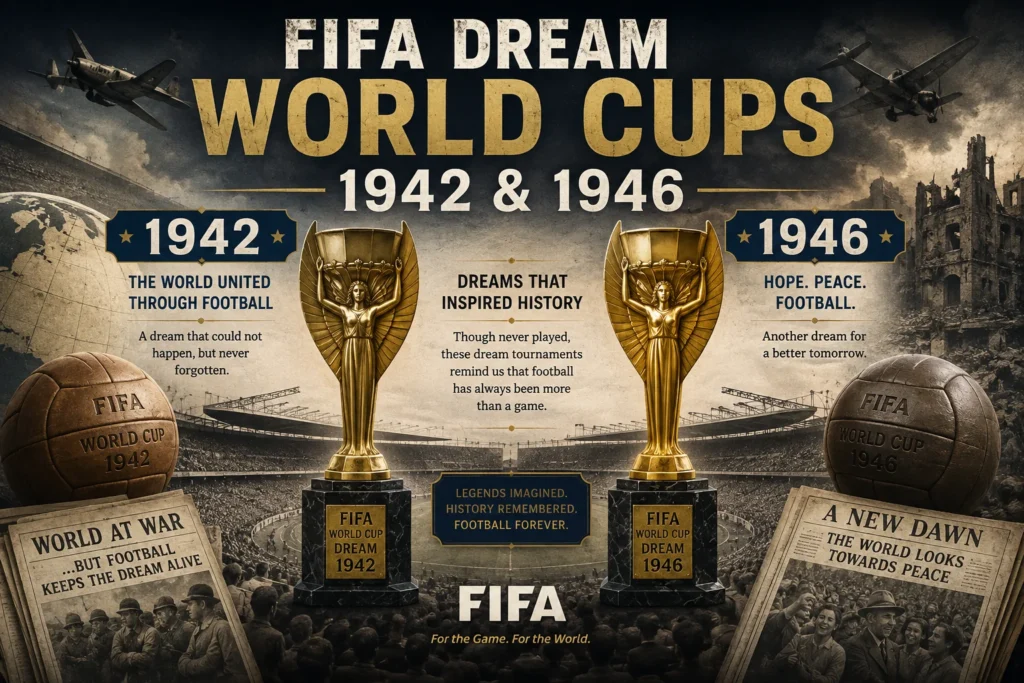
FIFA Dream World Cups 1942 & 1946: The Tournaments Football Never Got to See
Two World Cups vanished before the opening whistle. No champions, no finals, no golden boots just a generation of footballers left wondering what might have been.
The historical angle is strong because FIFA confirms that the World Cup returned in 1950 after a 12-year break caused by World War II. The 1950 tournament then introduced a very different format, with group winners entering a final round-robin stage.
FIFA Dream World Cups 1942 & 1946: Who Would Have Won?
Two missing World Cups. Four completed tournaments. One question: which footballing nation was truly ready to rule the early 1940s?
To predict the winners of the FIFA Dream World Cups 1942 & 1946, I would not simply carry Italy’s 1938 crown forward. That would ignore how quickly football was changing.
Instead, I would examine four completed World Cups 1930, 1934, 1938 and 1950 then combine their World Cup performance with the strongest international and club evidence immediately surrounding the two missing tournaments.
There is an important limitation: World Cup data from this era is relatively small, and international football during the war years was severely disrupted. So this is best viewed as a historical football model, not a mathematically precise simulation.
1942 Dream World Cup Champion: Argentina
1946 Dream World Cup Champion: Argentina
And there is a very good reason why Argentina edges Italy, Uruguay and Brazil in both dream tournaments.
What Did the 1930s Tell Us?
The first three World Cups created three clear footballing superpowers: Uruguay, Italy and Argentina, with Brazil beginning to emerge as a major force.
Uruguay won the inaugural 1930 tournament with a perfect 4-0 record, scoring 15 goals and conceding only three. In the final, La Celeste came from behind to defeat Argentina 4-2. Pedro Cea scored five times during the tournament, while Guillermo Stábile led Argentina with eight goals.
Argentina’s 1930 campaign is particularly important for our prediction. They scored 18 goals in five matches, averaging 3.6 per game, and Stábile produced eight goals in only four appearances at an extraordinary 2.00 goals per game rate.
Then came Italy.
Vittorio Pozzo’s Azzurri won the 1934 and 1938 World Cups, becoming the first nation to win consecutive editions. Italy’s 1938 team defeated Hungary 4-2 in the final, with Gino Colaussi and Silvio Piola scoring twice each.
Italy’s dominance was not a fluke. From the 1934 quarter-final replay through the 1938 final, Italy won seven consecutive World Cup matches, a record that stood for 68 years.
So, entering our hypothetical 1942 tournament, Italy had the strongest proven World Cup résumé.
But here’s where the story gets interesting.
Dream World Cup 1942: Why Argentina Gets My Vote
If the 1942 World Cup had actually been played, my money would be on Argentina.
Not because Argentina had the strongest World Cup record at that exact moment they didn’t. Italy had the better recent tournament pedigree.
Argentina wins this prediction because the quality and depth of Argentine football around 1941, 42 was extraordinary.
The biggest clue is River Plate’s legendary La Máquina.
The attacking unit associated with Juan Carlos Muñoz, José Manuel Moreno, Adolfo Pedernera, Ángel Labruna and Félix Loustau became one of the most celebrated attacking combinations in South American football. River won the Argentine championship in 1941 and 1942, and the club’s 1942 title campaign produced 79 goals in 30 matches, with Pedernera scoring 23.
That is serious attacking firepower.
And these weren’t isolated individual talents. The beauty of La Máquina was its movement, passing and understanding.
Imagine taking that chemistry and surrounding it with Argentina’s other elite players.
That’s when the hypothetical becomes dangerous.
Argentina’s 1942 Case: The Attack Was Loaded
Argentina’s national team had players such as José Manuel Moreno, Adolfo Pedernera, Juan Carlos Muñoz and Herminio Masantonio available around this period.
The 1942 South American Championship also demonstrated the depth of the region’s football. Uruguay won the tournament, but Argentina remained a major contender and fielded Moreno and Pedernera together.
And there is another reason I would not dismiss Argentina:
Their football was producing attacking combinations rather than relying on one superstar.
That’s crucial in a World Cup.
Stábile had been Argentina’s 1930 scoring machine. By the early 1940s, the country had developed another generation capable of carrying that attacking tradition forward.
If a hypothetical 1942 tournament required four or five matches to win the trophy, Argentina’s attacking depth could have become devastating.
But What About Uruguay?
This is where the debate gets spicy.
Uruguay would probably be my No. 2 pick for 1942.
And unlike Argentina, Uruguay had a very strong piece of actual evidence immediately before the hypothetical tournament: Uruguay won the 1942 South American Championship.
Their squad included players such as Obdulio Varela, Schubert Gambetta, Roberto Porta and Severino Varela, with Pedro Cea as coach.
Uruguay also had the psychological advantage of knowing how to win World Cups.
They had already conquered the inaugural tournament in 1930, beating Argentina 4-2 in the final.
So if you’re asking me:
Argentina or Uruguay in a 1942 final?
I’d say Argentina by the narrowest of margins.
Perhaps 3-2.
That’s a prediction, obviously—not a historical result.
And Italy?
Italy is the biggest threat to this prediction.
The Azzurri entered the hypothetical 1942 tournament as back-to-back World Cup champions.
They had won in 1934.
They had won again in 1938.
And they had Vittorio Pozzo, the only coach to win two World Cups.
Italy also had experienced stars such as Giuseppe Meazza and Silvio Piola. Piola scored five goals in 1938, while Gino Colaussi averaged an astonishing 1.3 goals per game for Italy during that tournament.
But there is one problem for the 1942 prediction:
Age and continuity.
Some of Italy’s 1934 heroes were already veterans by 1938, and only four players appeared in both the 1934 and 1938 Italian squads: Giovanni Ferrari, Guido Masetti, Giuseppe Meazza and Eraldo Monzeglio.
By 1942, that generation would be even older.
So Italy’s experience is a massive advantage—but Argentina’s emerging attacking generation gives them the edge.
Brazil: The Dangerous Dark Horse
Brazil would be my fourth major contender for 1942.
The country had not yet won a World Cup, but Brazilian football was rapidly developing.
And the talent that would become so important in 1950 was already emerging.
By the 1950 World Cup, Brazil possessed Zizinho, Ademir de Menezes, Jair and Chico, forming one of the most frightening attacks of the tournament. FIFA notes that Brazil had entered the decisive 1950 match as overwhelming favorites after demolishing Sweden 7-1 and Spain 6-1.
The problem is timing.
Some of Brazil’s greatest 1950 stars were still developing in 1942.
So I would rate Brazil as a dangerous outsider rather than my favorite.
FIFA Dream World Cup 1942 Ranking
Based on World Cup pedigree, contemporary strength, attacking quality, squad depth and the football being produced around the period:
1. Argentina Predicted Champion
2. Uruguay Finalist
3. Italy Semi final contender
4. Brazil Dark horse
The biggest reason Argentina wins the hypothetical tournament is simple:
The timing was perfect for Argentina’s golden attacking generation.
La Máquina was coming alive, and the country had an extraordinary collection of technically gifted forwards.
Dream World Cup 1946: Argentina Goes Back to Back
Now the prediction becomes even stronger.
Predicted Winner: Argentina
If I had to choose between Argentina, Brazil, Uruguay and Italy for a hypothetical 1946 World Cup, Argentina would be my clearest selection.
Why?
Because unlike 1942, we have actual 1945 and 1946 international tournament evidence pointing directly toward Argentina.
Argentina won the 1945 South American Championship with five victories and one draw, scoring 22 goals and conceding only five. The Argentine Football Association highlights players including Norberto Méndez, Mario Boyé, Rinaldo Martino, Félix Loustau, Vicente De la Mata and René Pontoni.
And then Argentina did it again.
In the 1946 South American Championship, Argentina finished with a perfect 5 wins from 5 matches, scoring 17 goals and conceding only three. Brazil finished second with 13 goals scored and seven conceded.
Now that’s not imagination.
That’s evidence.
Argentina’s 1946 Statistical Advantage
Here’s the number that really makes the argument:
Argentina 1946
5 matches 5 wins 17 goals scored 3 conceded
That’s a goal difference of +14.
Brazil 1946
3 wins, 1 draw, 1 defeat, 13 scored, 7 conceded.
Argentina also defeated Brazil 2-0 in the tournament.That is exactly the kind of result that strengthens a hypothetical World Cup prediction.And the attack wasn’t dependent on one player. Argentina had a collection of elite forwards and creative players who could hurt opponents in different ways.
Norberto Méndez eventually became one of the defining South American attackers of the era, while players such as Loustau, Martino, Boyé and Pontoni gave Argentina remarkable depth.So if the referee blew the whistle on a fictional 1946 World Cup final? Argentina would walk onto the pitch as my favorite.
Brazil Was Coming for the Crown
Brazil would probably be Argentina’s biggest challenger. And there’s an interesting clue from the 1946 South American Championship.
Brazil defeated Uruguay 4-3, with goals from Jair Rosa Pinto, Heleno de Freitas and Chico. The Brazilian lineup also included Zizinho, while Ademir de Menezes appeared from the bench.
That attacking talent would become extremely important in the years that followed. By 1950, Brazil had developed into an offensive monster. Their tournament attack produced huge victories, including 7-1 against Sweden and 6-1 against Spain. So here’s the fascinating “what if”:
Argentina looked stronger in 1946. Brazil may have had the higher attacking ceiling by 1950. That’s why I would give Argentina the edge in the hypothetical 1946 tournament, but I would not expect an easy final.
What Happened to Uruguay?
Uruguay remained dangerous but was no longer the overwhelming force of 1930. They finished fourth in the 1946 South American Championship, winning two and losing three. They did beat Chile 1-0 and Bolivia 5-0, but suffered defeats against Brazil, Argentina and Paraguay.
That is a significant statistical decline compared with Uruguay’s perfect 1930 World Cup campaign. In 1930, Uruguay went 4-0, scored 15 and conceded only three. By 1946, Argentina’s form had clearly moved ahead.
Italy’s Problem in 1946
Italy is the hardest team to evaluate because the war completely disrupted European international football. The 1938 champions had extraordinary pedigree, but the six-year gap between their last World Cup and the hypothetical 1946 tournament makes any projection uncertain.
The players who had conquered France in 1938 were no longer at the same stages of their careers. Meanwhile, Argentina’s football infrastructure and South American competition had continued producing elite players during the period when European international football was heavily disrupted. That gives Argentina another advantage in our hypothetical model
FIFA Dream World Cup 1946 Ranking
Taking the evidence from 1945, 1946 and the surrounding World Cup performances:
1. Argentina Predicted Champion
2. Brazil Finalist
3. Uruguay Semi final contender
4. Italy Semi final, quarter final contender
Argentina 3-2 Brazil
A wild South American classic. Méndez pulling the strings. Loustau causing problems from the flank. Brazil responding with Zizinho and Heleno. And Argentina finding one last punch. this score is my hypothetical simulation, not a historical result.
Final Verdict: The Two Dream Champions
After comparing the four real World Cups around the missing editions and adding contemporary international evidence, my prediction is:
FIFA Dream World Cup 1942
Argentina
Why?
The rise of La Máquina, exceptional attacking depth, elite Argentine domestic football and a generation of players entering their prime.
FIFA Dream World Cup 1946
Argentina
Why?
The evidence becomes even stronger. Argentina won the 1945 South American Championship with a 5-1-0 record and then swept the 1946 tournament 5-0-0, scoring 17 and conceding only three.
The most interesting part?
Argentina’s hypothetical double would not be built on the 1930 generation. It would be built on a completely new golden generation.
That’s what makes this “Dream World Cup” concept so fascinating. The 1930s belonged to Uruguay and Italy. The early 1940s may have belonged to Argentina. And by 1950, Brazil was knocking loudly on the door.
Football history never gave us the chance to find out. But if we reconstruct the missing tournaments using the numbers and performances available to us, Argentina is the strongest answer for both 1942 and 1946.
FIFA Dream World Cups 1942 & 1946 Organized By
For a dream or reconstructed World Cup, the organizer should remain FIFA (Fédération Internationale de Football Association), just as it was for the actual World Cup tournaments before and after the war.
However, there is an important distinction: neither the 1942 nor 1946 World Cup was actually organized as a completed tournament. The 1942 edition was cancelled after the outbreak of World War II, while FIFA could not realistically stage a 1946 tournament in the immediate aftermath of the conflict. FIFA’s post-war meeting did not take place until July 1946, around the time the 1946 finals would normally have been played.
FIFA Dream World Cup 1942 Organized By
FIFA (Fédération Internationale de Football Association)
For our hypothetical 1942 edition, FIFA would have remained the governing and organizing body. The tournament was originally planned before the war, with Germany and Brazil among the countries that had submitted bids to host it. However, FIFA never selected an official host before the tournament was cancelled.
For the Dream 1942 World Cup, therefore, we can reasonably retain:
Organizer: FIFA
Competition: FIFA World Cup
Year: 1942
Status: Hypothetical reconstruction
Actual historical status: Cancelled
FIFA Dream World Cup 1946 Organized By
FIFA (Fédération Internationale de Football Association)
The 1946 edition presents a slightly different situation. There was no completed host-selection process or tournament organization because FIFA was still rebuilding after World War II. The first post-war FIFA meeting took place on 1 July 1946, making it impossible to realistically organize a full World Cup that year.
For our Dream 1946 World Cup, we therefore retain FIFA as the hypothetical organizer:
Organizer: FIFA
Competition: FIFA World Cup
Year: 1946
Status: Hypothetical reconstruction
Actual historical status: Cancelled
The Historical Twist
Interestingly, the story eventually came full circle.
At the FIFA Congress in July 1946, Brazil was selected to host the next World Cup. The tournament was subsequently moved to 1950, giving football its first World Cup after a 12-year interruption.
So, for your Dream World Cup series, the cleanest wording is:
Organized By: FIFA (Fédération Internationale de Football Association)
And then clearly label 1942 and 1946 as hypothetical reconstructed tournaments, so readers never confuse your predictions with official FIFA history.
FIFA Dream World Cups 1942 & 1946 Host Nation
Because 1942 and 1946 were never actually played, there were no officially appointed host nations for either tournament. For your Dream World Cup reconstruction, however, we can make a historically sensible prediction based on the bids and the circumstances of the era.
FIFA Dream World Cup 1942 Host Nation: Brazil
Predicted Host: Brazil
For the hypothetical 1942 FIFA Dream World Cup, I would select Brazil as the host.
Brazil had already expressed interest in hosting the 1942 tournament, alongside Germany. The outbreak of World War II prevented FIFA from completing the hosting process, so neither country ultimately received the official tournament.
Brazil makes the stronger choice for our reconstructed tournament for several reasons.
First, South America offered greater political and logistical stability than war-torn Europe. By 1939, the situation in Europe was deteriorating rapidly, while Brazil remained capable of staging a major international sporting event.
Second, South America had already demonstrated that it could successfully host the World Cup. Uruguay had staged the inaugural tournament in 1930, proving that the competition did not need to remain centered in Europe.
Third, FIFA’s eventual post-war decision strongly supports Brazil’s suitability. When the World Cup finally returned after the war, Brazil was selected to host the 1950 edition.
So, if history had given FIFA the opportunity to stage the 1942 tournament peacefully, Brazil would be my logical Dream World Cup host.
Dream 1942 Host Details
Host Nation: Brazil
Host Continent: South America
Organizer: FIFA
Historical Status: Cancelled
Dream Status: Hypothetical reconstruction
And there’s a beautiful footballing twist here: Brazil would have hosted the tournament before becoming a World Cup champion. That could have given the country’s emerging football culture an even earlier opportunity to announce itself on the world stage.
FIFA Dream World Cup 1946 Host Nation: Brazil
Host: Brazil
For the 1946 Dream World Cup, I would again choose Brazil.
This prediction is even stronger than the 1942 case because Brazil eventually became the actual host when FIFA revived the World Cup in 1950.
The post-war situation made a 1946 tournament extremely difficult. Europe was still recovering from enormous destruction, while FIFA itself was rebuilding its international structure. FIFA’s post-war Congress was held in July 1946, around the time the World Cup would have been played, making a 1946 finals tournament unrealistic.
Brazil, meanwhile, was in a much stronger position to host an international football tournament.
The country already had a passionate football culture, major stadiums and a rapidly developing national team. Most importantly, FIFA eventually entrusted Brazil with the 1950 World Cup.
Therefore, in our hypothetical timeline:
1942 Brazil hosts the Dream World Cup.
1946 Brazil hosts the Dream World Cup again.
This creates an interesting alternative-history scenario in which Brazil becomes the first country to host two consecutive World Cups.
Why Not Germany for 1942?
Germany was one of the countries interested in hosting the 1942 tournament, so it deserves serious consideration.
But for a Dream World Cup, I would reject Germany as the final choice because the political and military situation in Europe made it increasingly unsuitable as the tournament approached.
The 1936 Berlin Olympics had demonstrated Germany’s ability to stage a massive international sporting event. However, the outbreak of World War II in September 1939 changed everything.
A hypothetical peaceful 1942 World Cup in Germany would require us to alter the wider historical circumstances surrounding the tournament.
Choosing Brazil requires far fewer assumptions.
The Final Dream World Cup Hosting Decision
FIFA Dream World Cup 1942
Host Nation: Brazil
Brazil was a genuine 1942 hosting candidate and offered a more stable South American alternative to Europe.
FIFA Dream World Cup 1946
Host Nation: Brazil
Brazil is the logical reconstruction because it ultimately received the hosting rights for the first post-war World Cup in 1950.
My Dream Timeline
1938 France
1942 Brazil (Dream World Cup)
1946 Brazil (Dream World Cup)
1950 Brazil (Actual World Cup)
That gives your FIFA Dream World Cup series a strong historical narrative: Brazil was ready to host, missed out because of war, and eventually got its chance in 1950.
One important editorial note for your article: label the 1942 and 1946 hosts as “Dream/Hypothetical Host”, not official FIFA hosts. This keeps the article engaging without presenting an alternate-history prediction as a historical fact.
FIFA Dream World Cup 1942 Participants
16 Team Dream Field
Europe
- Italy Defending World Cup champions and the strongest European team of the late 1930s. Italy had won back-to-back World Cups in 1934 and 1938.
- Hungary A technically gifted Central European powerhouse and 1938 World Cup finalist. Hungary lost 4-2 to Italy in the 1938 final.
- Czechoslovakia 1934 World Cup finalists and one of Central Europe’s established football powers.
- Sweden A strong Scandinavian side with World Cup experience and a place among Europe’s leading teams.
- Germany A major European football power and one of the countries associated with the proposed 1942 hosting race.
- Spain A major football nation whose development had been severely disrupted by the Spanish Civil War.
- Switzerland Experienced World Cup participants with a reputation for disciplined defensive football.
- France hosted the 1938 World Cup and was an established European participant.
South America
- Argentina Our predicted 1942 Dream World Cup champion. Argentina had already reached the 1930 final and possessed an outstanding generation of attacking talent.
- Uruguay 1930 World Cup champions and one of the strongest South American nations.
- Brazil A rapidly developing football power and the eventual host of the 1950 World Cup.
- Paraguay A competitive South American side with strong regional credentials.
North / Central America
- Mexico One of the leading football nations in the CONCACAF region.
- Cuba The only Caribbean nation to have reached the 1938 World Cup, making them a fascinating inclusion in a 16-team reconstruction.
Europe / British Isles
- England is a special case. England was not participating in the early FIFA World Cups, but its return to international FIFA competition would have been a major possibility in an alternate 1942 football timeline.
- Scotland Another British football powerhouse whose inclusion would dramatically increase the strength of the hypothetical European field.
Why this field works
This reconstructed 1942 field brings together the established champions Italy, Uruguay and Argentina with the emerging powers of Brazil, Hungary and Sweden.
And there is one mouth watering storyline at the heart of it:
Italy arrive as champions. Argentina arrive as the challengers. Uruguay wants their crown back. Brazil want to announce themselves.
That’s exactly the kind of tournament football fans would have devoured.
FIFA Dream World Cup 1946 Participants
For 1946, I would make the field slightly more South America heavy.
Why?
Because the European football structure had been devastated by World War II, while South American international football continued to produce strong competition. Argentina’s outstanding performances in the mid-1940s make them particularly difficult to leave out of the hypothetical field.
16 Team Dream Field
South America
- Argentina Predicted 1946 Dream World Cup champion. Argentina’s case is exceptionally strong: they won the 1945 South American Championship and also dominated the 1946 edition.
- Brazil is Argentina’s biggest hypothetical challenger, with stars such as Zizinho, Jair, Chico and Heleno de Freitas emerging.
- Uruguay Former world champions and perennial South American contenders.
- Paraguay A competitive regional side capable of challenging the established powers.
- Chile An established participant in South American international football.
Europe
- Italy still carries the prestige of two consecutive World Cup championships, although the wartime interruption makes their strength difficult to measure.
- Hungary A technically gifted nation whose greatest generation was beginning to emerge.
- Sweden One of the strongest Scandinavian football nations.
- CzechoslovakiaA major pre-war Central European power.
- Switzerland Experienced World Cup opposition.
- France A major European football nation attempting to rebuild after the war.
- Spain Another established European side returning from years of disruption.
- Netherlands A strong European football nation with a growing international presence.
- Poland Included as part of the wider European reconstruction, although their football infrastructure had suffered enormously during the war.
British Isles
- EnglandThe inclusion of England would make the hypothetical 1946 competition particularly fascinating. England had returned to FIFA after its earlier separation from the organization, but the post-war situation prevented a World Cup appearance.
- Scotland Another historically powerful British football nation that would add serious quality to the hypothetical tournament.
The Four Teams We Would Put Above Everyone Else
If we reduce the 16-team Dream World Cup to the genuine title contenders, four nations stand out.
Argentina The Favorite
Argentina would be my No. 1 seed for both hypothetical tournaments.
Their 1930 World Cup final appearance already demonstrated their ability to compete at the highest level. By the early 1940s, Argentina had another outstanding generation emerging.
For 1946, the argument becomes even stronger because Argentina’s actual South American results provide hard evidence rather than speculation.
Italy The Defending Giant
Italy would enter 1942 with the strongest recent World Cup résumé. They were the 1934 and 1938 champions, making them the first nation to win consecutive World Cups.
Their problem in our hypothetical is timing. The war interrupted the careers of an entire generation, making it difficult to assume that the 1938 champions would still be at their peak in 1946.
Uruguay The Old Champion
Never count Uruguay out.
They won the inaugural 1930 World Cup and defeated Argentina 4-2 in the final. Their early World Cup pedigree was exceptional.
But their 1940s form gives Argentina the advantage in our reconstruction.
Brazil The Coming Giant
Brazil is perhaps the most intriguing team in this alternate history.
The Seleção had not yet won the World Cup, but the country’s football culture was exploding. Brazil would eventually host the 1950 tournament, and FIFA records Brazil as the only nation to have appeared at every actual World Cup edition.
In our dream 1946 tournament, Brazil would be the team most likely to ruin Argentina’s party.
Final Participants for Your Dream World Cup Article
Dream FIFA World Cup 1942 Participants
Argentina, Uruguay, Brazil, Paraguay, Italy, Hungary, Czechoslovakia, Sweden, Germany, France, Spain, Switzerland, England, Scotland, Mexico and Cuba.
Dream FIFA World Cup 1946 Participants
Argentina, Brazil, Uruguay, Paraguay, Chile, Italy, Hungary, Sweden, Czechoslovakia, Switzerland, France, Spain, Netherlands, Poland, England and Scotland.
These are hypothetical participant lists, not official FIFA records. The actual 1942 and 1946 World Cups were cancelled, so no official participant list exists.
Our Dream Tournament Favorites
1942: Argentina
1946: Argentina
The fascinating part is that the hypothetical tournaments would create a fantastic transition in football history:
Italy’s dynasty → Argentina’s golden generation → Brazil’s coming revolution.
That is the storyline that makes a Dream World Cup 1942 and 1946 worth building.
FIFA Dream World Cup 1942 Format
16 Teams, Four Rounds, Straight Knockout
For 1942, I would retain the format that FIFA had most recently used successfully in 1934 and 1938: a 16-team straight knockout tournament.
The 1934 World Cup had 16 teams and went directly into the Round of 16, followed by quarter-finals, semi-finals and the final. The 1938 tournament followed the same basic knockout structure, although Austria’s withdrawal reduced the field to 15 teams.
That makes a 16-team knockout the most historically convincing choice for our Dream 1942 tournament.
Round of 16
All 16 teams would enter the competition at the first knockout stage.
There would be eight matches, with the winner of each game advancing.
No group stage safety net.
Lose, and you’re going home.
That format would create exactly the kind of high-pressure football that defined the pre-war World Cups.
Quarter-Finals
The eight Round of 16 winners would advance to the quarter-finals.
Four matches would produce four semi finalists.
At this stage, a heavyweight clash such as Argentina vs Italy or Uruguay vs Brazil could completely change the tournament.
Semi Finals
Four teams would remain.Two matches.Two winners. And suddenly, the Dream World Cup would have its finalists.
For our predicted 1942 tournament, Argentina, Uruguay, Italy and Brazil would be among the leading contenders for these final four places.
Final
The two semi final winners would meet in a single championship match.
The winner would become the Dream FIFA World Cup 1942 champion.
Our prediction from the earlier analysis remains:
Argentina Dream Champion 1942
Why Knockout Football Fits 1942
This format makes historical sense because the World Cup was still a young competition.
FIFA had already abandoned the 1930 group-stage model for the 1934 and 1938 tournaments, both of which began with direct elimination. FIFA’s own historical overview confirms that those two pre-war editions were the only World Cups played entirely without a group stage.
So in our alternate timeline, there is little reason to believe FIFA would suddenly abandon the knockout structure in 1942.
The beauty of this format?
Every match becomes a final. One bad afternoon and your golden generation is packing its bags.
FIFA Dream World Cup 1946 Format
16 Teams,Group Stage, Knockout Stage
For 1946, let’s make the format more ambitious.
By this point, FIFA would have had the opportunity to reconsider the limitations of the 1934 and 1938 knockout system. A tournament returning after the devastation of World War II would also need to maximize the number of meaningful matches for participating nations.
So my Dream 1946 format would combine the 1930 group concept with a traditional knockout stage.
16 Teams
The 16 participants would be divided into:
4 groups of 4 teams
Each team would play three group matches.
That means every nation gets a proper chance to settle into the tournament rather than potentially traveling thousands of miles only to lose one knockout match and disappear.
Group Stage
Each group would contain four teams.
Every team plays every other team once.
That produces:
6 matches per group
and 24 group-stage matches overall.
The points system would be:
Win 2 points, Draw 1 point, Loss 0 points
This reflects the historical era better than automatically applying the modern three point system.
The top two teams from each group would advance.
That would create an eight team knockout stage.
Quarter Finals
The eight group stage qualifiers would move into the quarter finals.
The structure would be:
Group A winner vs Group B runner up
Group B winner vs Group A runner up
Group C winner vs Group D runner up
Group D winner vs Group C runner up
That prevents teams from immediately meeting opponents from their own group.
Eight teams become four.
Now the pressure really starts.
Semi Finals
The four quarter final winners would enter the semi finals.
Two matches.
Two winners.
One dream final.
For our hypothetical 1946 tournament, the most exciting possibility would be an all South American showdown involving Argentina and Brazil.
Argentina enters as our statistical favorite because of its exceptional performances in South American competition during the mid 1940s.
Brazil, however, would be the team capable of turning the prediction upside down.
Final
The two semi-final winners would meet in a traditional single match final.
Unlike the actual 1950 tournament, which famously used a final round-robin group rather than a dedicated championship match, our Dream 1946 competition would finish with a genuine final. FIFA records 1950 as the only World Cup without a separate final match.
That gives our alternate 1946 tournament a classic climax:
90 minutes.
Two nations.
One trophy.
And if the historical data is our guide:
Argentina vs Brazil
would be the dream final everyone would want to see.
Predicted Winner Argentina
Why Change the Format in 1946?
This is where the alternate history concept gets interesting. The 1934 and 1938 tournaments demonstrated that straight knockout football was exciting, but it could also be brutal. A nation could travel across continents, play one match and be eliminated.
The 1938 Dutch East Indies experience is a perfect example of how unforgiving the system could be, they played only one match and lost 6-0 to Hungary.
A group stage would give teams more football and supporters more matches.After a 12-year World Cup interruption, that would make sense commercially, competitively and emotionally.
FIFA could effectively say:
“The world has waited long enough. Let’s give everyone a chance to play.”
Dream World Cup 1942 vs 1946 Format
The two hypothetical tournaments would therefore have distinctly different identities.
1942 The Old-School World Cup
16 teams
Straight knockout
Round of 16
Quarter finals
Semi finals
Final
Total matches: 15
This would closely follow the structure used in 1934 and 1938.
1946 The Modernizing World Cup
16 teams
4 groups of 4
Three group matches per team
Top two from each group advance
Quarter finals
Semi finals
Final
Total matches: 31
This format would represent FIFA experimenting with a more spectator-friendly competition before the unusual final-group system eventually used in 1950.
The Perfect Bridge Between 1938 and 1950
This hypothetical format creates a fascinating evolution.
1938: Straight knockout
1942: Dream 16 team knockout
1946: Dream 16 team group, knockout
1950: Four groups followed by a final round robin group
That progression feels plausible because FIFA’s actual World Cup formats were already changing rapidly during this period. The 1930 tournament used groups and semi-finals, 1934 and 1938 switched to straight knockout, and 1950 returned to groups with its unusual final round-robin phase.
In other words, the missing World Cups could have been the perfect laboratory for FIFA’s early tournament experiments.
FIFA Dream World Cups 1942 & 1946 Group Stage Overview
One tournament had no groups. The other gives us the chance to imagine what FIFA might have built after the war.
Because the 1942 and 1946 FIFA World Cups were never played, there are no official group tables, results or standings for either edition. The following is therefore a hypothetical reconstruction based on the Dream World Cup formats we established earlier.
FIFA Dream World Cup 1942 Group Stage
There would be no group stage in our 1942 Dream World Cup.
For 1942, we are following the 1934 and 1938 model, when the World Cup was played as a straight knockout competition. The 16 hypothetical participants would enter directly at the Round of 16, meaning there would be no group matches, group winners or runners-up.
That makes the 1942 edition particularly unforgiving. One bad afternoon and you’re out.
Imagine Argentina arriving with the attacking brilliance of La Máquina, Italy defending its back-to-back World Cup crowns, Uruguay carrying the prestige of 1930 and Brazil emerging as the dangerous South American challenger. There would be no room for a slow start.
The format would be:
16 teams Round of 16 Quarter-finals Semi-finals Final
So, for the 1942 Dream World Cup:
- Group Stage: None
- Number of Groups: 0
- Teams in Groups: None
- First Round: Round of 16
- Advancing teams: 8 winners
- Predicted champion:Argentina
This approach also reflects the actual pre-war World Cup structure. The 1934 and 1938 tournaments both used direct knockout football rather than a traditional group stage.
FIFA Dream World Cup 1946 Group Stage Overview
The hypothetical 1946 tournament is where we can get much more creative.
For this edition, our reconstructed format uses 16 teams divided into four groups of four. Each nation would play three group matches, giving every team a genuine opportunity to settle into the competition.
The top two teams from each group would advance to the quarter-finals.
Group A
Argentina
Switzerland
Chile
Scotland
Argentina would be the clear favorite in this group.
The Argentine side had been producing outstanding results in South American competition, and its attacking talent made it one of the strongest hypothetical teams in the entire tournament. Chile would provide an unpredictable South American challenge, while Switzerland and Scotland would bring contrasting European styles.
Predicted qualifiers:
Argentina
Scotland
Argentina’s goal would be simple: win the group, avoid unnecessary drama and save the fireworks for the knockout rounds.
Group B
Brazil
Italy
Paraguay
Poland
Now this is where things get spicy.
Brazil and Italy would immediately attract attention. Italy entered the alternate tournament with the prestige of being the 1934 and 1938 World Cup champion, while Brazil’s rapidly developing attacking football made them one of the tournament’s most dangerous teams.
Paraguay would not be an easy opponent, and Poland would add another European challenge.
Predicted qualifiers:
Brazil
Italy
A Brazil-Italy group match would arguably be one of the biggest games of the opening stage.
Group C
Uruguay
Hungary
Mexico
Netherlands
This could be the tournament’s tactical group.
Uruguay bring World Cup pedigree and South American toughness. Hungary bring the technical quality that would eventually make them one of Europe’s great attacking nations. Mexico provide a dangerous CONCACAF challenge, while the Netherlands add another technically gifted European side.
Predicted qualifiers:
Hungary
Uruguay
And don’t sleep on Hungary.
If any team could upset one of the traditional favorites, this would be it.
Group D
Sweden
Czechoslovakia
France
Spain
This would be arguably the most balanced group.
There is no obvious easy opponent. Sweden had established itself as a strong European football nation, Czechoslovakia had already reached the World Cup final in 1934, while France had hosted the 1938 tournament. Spain, meanwhile, would be trying to rebuild after the disruption caused by the Spanish Civil War.
Predicted qualifiers:
Czechoslovakia
Sweden
This is the group where goal difference could become crucial.
The Hypothetical 1946 Group Standings
Group A
1. Argentina Qualified
2. Scotland Qualified
3. Switzerland
4. Chile
Group B
1. Brazil Qualified
2. Italy Qualified
3. Paraguay
4. Poland
Group C
1. Hungary Qualified
2. Uruguay Qualified
3. Netherlands
4. Mexico
Group D
1. Czechoslovakia Qualified
2. Sweden Qualified
3. France
4. Spain
these are Dream World Cup projections, not actual 1946 results.
What Would Happen Next?
The eight group stage qualifiers would move into the knockout rounds. That gives us a mouthwatering quarter final lineup
Argentina vs Italy
A clash between the predicted new power and the old World Cup dynasty.
Brazil vs Scotland
Brazil’s attacking flair against Scotland’s traditional physical and direct approach.
Hungary vs Sweden
A battle of European technical quality.
Czechoslovakia vsUruguay
A classic European South American encounter with plenty of tactical intrigue.
From there, four teams would survive.
Then four become two. And finally, the Dream World Cup would have its championship showdown.
Why the 1946 Group Stage Matters
The group stage is more than just a convenient format for a hypothetical or dream tournament.It represents what could have been an important turning point in World Cup history.
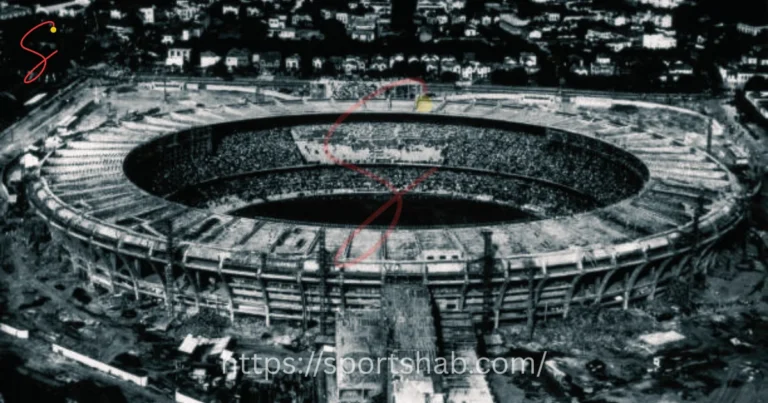
The actual 1950 World Cup eventually used a highly unusual format in which the four group winners advanced to a final round-robin group instead of playing a conventional final. Uruguay ultimately finished top and became champion after defeating Brazil 2-1 in the decisive match at the Maracanã.
Our hypothetical 1946 tournament gives FIFA another possible route: four groups of four followed by a conventional knockout stage.
That would give teams more matches while still preserving the knockout drama football fans love.
FIFA Dream World Cups 1942 & 1946: Four Teams, One Trophy, Endless Determination
The World Cups that never happened but if history had given football a second chance, these four nations could have carried the dreams of an entire generation.
For our FIFA Dream World Cup 1942 & 1946 reconstruction, four teams stand above the rest when we combine their World Cup history, performances around the missing tournaments, attacking quality, squad depth and international form: Argentina, Brazil, Italy and Uruguay.
These are not official 1942 or 1946 participants. Both tournaments were cancelled because of the disruption caused by World War II. What follows is a historical “what if” football analysis, using real performances from the surrounding era to determine which four nations would have had the strongest claim to the trophy.
Argentina The Team That Could Have Ruled the 1940s
Argentina is our strongest candidate for both Dream World Cups.
The foundation was already visible at the inaugural 1930 World Cup, where Argentina reached the final and scored 18 goals in five matches. Guillermo Stábile finished that tournament with eight goals, showing that Argentina had no shortage of attacking firepower.
But the real reason Argentina becomes our Dream World Cup favorite is what happened in the early 1940s.
The emergence of La Máquina at River Plate produced an extraordinary attacking generation. Players such as José Manuel Moreno, Adolfo Pedernera, Juan Carlos Muñoz, Ángel Labruna and Félix Loustau helped create one of the most celebrated attacking units in South American football.
Argentina’s strength was not simply having one superstar.
It was having five players capable of changing a match.
That distinction matters enormously in tournament football.
And by 1945–46, Argentina’s international form made the argument even stronger. Argentina won the 1945 South American Championship, then followed it by winning the 1946 edition, finishing that tournament with five victories from five matches while scoring 17 goals and conceding only three.
That’s the sort of form that makes you sit up and say:
“This team isn’t just good. This team is ready.”
For our Dream World Cup
1942 prediction: Champion Argentina
1946 prediction: Champion Argentina
Italy The Reigning European Giants
Before Argentina can claim the throne, there is one giant standing in the way.
Italy.
The Azzurri were the undisputed World Cup force of the 1930s.
Italy won the 1934 World Cup on home soil and then successfully defended the trophy at the 1938 World Cup in France. They became the first nation to win consecutive World Cups.
That makes Italy the obvious starting point for any 1942 prediction.
The 1938 champions had an impressive combination of experience, tactical discipline and attacking quality. Silvio Piola scored five times during the tournament, while Gino Colaussi also produced a remarkable scoring campaign.
Then there was Vittorio Pozzo, the mastermind behind both championship campaigns.
So why don’t we make Italy our Dream World Cup winner?
Timing.
The war created an enormous interruption in European football. The players who had dominated the 1930s were moving deeper into their careers, while Argentina’s next generation was reaching its prime.
Italy would still be a terrifying opponent in 1942.
But by 1946, the balance would likely have shifted further toward South America.
Dream ranking: Serious title contender.
Uruguay The Original World Champions
Never write Uruguay off. This is the country that started the World Cup story. At the 1930 World Cup, Uruguay won all four of its matches, scored 15 goals and conceded just three. They defeated Argentina 4-2 in the final to become the first world champions.
That pedigree matters. Uruguay also remained highly competitive in South American football during the early 1940s. Their victory at the 1942 South American Championship showed that the country still possessed the mentality and talent required to challenge Argentina.
Players such as Obdulio Varela, Roberto Porta and Severino Varela represented a powerful Uruguayan football tradition built around technical ability, competitiveness and physical strength.
A hypothetical Argentina and Uruguay semi final would be football theatre.
One side has La Máquina.
The other has the spirit of the first World Cup champions.
And you can almost hear the crowd:
“Ninety minutes. No excuses. Winner takes the trophy.”
Dream ranking: Title contender and likely semi finalist.
Brazil The Giant Waiting to Wake Up
Brazil is the most fascinating team on this list because its greatest World Cup success had not arrived yet.
The Seleção had participated in the first three World Cups and was developing rapidly. By the mid-1940s, Brazil had players such as Zizinho, Jair, Chico and Heleno de Freitas, while Ademir de Menezes was emerging as another major attacking threat.
Brazil’s 1946 South American Championship campaign is particularly important for our Dream World Cup analysis.
They finished second behind Argentina and scored 13 goals, while conceding seven. They also defeated Uruguay 4-3 in a thrilling contest.
The signs were there. Brazil had flair, goals,individual brilliance and, most importantly, was getting closer.
By the 1950 World Cup, Brazil would demonstrate just how powerful its attack could be, destroying Sweden 7-1 and Spain 6-1 before suffering the famous defeat to Uruguay in the decisive Maracanã match.
So Brazil may not be our 1942 or 1946 favorite, but they would be the team nobody wanted to meet in the knockout rounds.
Dream ranking: Dark horse with genuine championship potential.
The Dream Final Four
If we reduce the historical evidence to four heavyweight contenders, the picture becomes clear:
Argentina
Strength: Attacking depth and exceptional early-1940s form
Dream status: Favorite
Italy
Strength: World Cup pedigree, tactical organization and experience
Dream status: Defending powerhouse
Uruguay
Strength: Tournament mentality and South American experience
Dream status: Proven champion
Brazil
Strength: Explosive attacking talent and rapidly improving football
Dream status: Dangerous outsider
1942 Dream Semi Final Picture
If we build a hypothetical 1942 knockout tournament around these four giants, the most logical semi-final battles would be:
Argentina vs Brazil
A South American classic before either country had lifted the World Cup in the modern era.
Argentina’s La Máquina would face Brazil’s emerging attacking talent. Argentina’s superior early-1940s form gives them the advantage.
Predicted winner: Argentina
Italy vs Uruguay
The European champions against the original World Cup kings.
Italy’s tactical organization would make this a brutally close contest, but Uruguay’s South American form and competitive mentality could push them through.
Predicted winner: Uruguay
Dream 1942 Final
Argentina vs Uruguay
And our prediction remains
Argentina wins the 1942 Dream World Cup.
1946 Dream Semi Final Picture
By 1946, the balance changes.
Argentina’s case becomes much stronger because we can point to actual mid-1940s results.
Argentina vs Uruguay
Argentina’s attacking generation has matured, while Uruguay’s performances have become less consistent.
Predicted winner: Argentina
Brazil vs Italy
This would be a fascinating meeting of two different football cultures.
Italy’s experience versus Brazil’s emerging attacking revolution.
The longer the match goes, the more Brazil’s younger attacking talent could cause problems.
Predicted winner: Brazil
Dream 1946 Final
Argentina vs Brazil
This is the final football historians would dream about. Argentina arrive with the stronger mid-1940s statistical record. Brazil arrive with attacking brilliance and growing confidence.
prediction
Argentina 3-2 Brazil
A fictional score, of course not a historical result. But as an alternate-history scenario, it is difficult to resist.
Four Teams One Trophy and Endless Determination:
These four nations represent four different chapters of football history.
Uruguay represents the birth of the World Cup.
Italy represents the tactical dominance of the 1930s.
Argentina represents the attacking revolution emerging in South America.
Brazil represents the giant that was preparing to dominate the next generation.
And that’s what makes the missing 1942 and 1946 World Cups so fascinating.
We will never know who would actually have won.
We can only look at the numbers, the players, the form and the footballing trends—and then ask the question every fan loves:
What if the referee had actually blown the whistle?
Based on the evidence, our Dream World Cup verdict is:
1942 Argentina
1946 Argentina
Two tournaments that never happened. One champion that history never got the chance to crown.
FIFA Dream World Cups 1942 & 1946 Finals
Two imaginary finals. Two South American classics. One question: what if football had been allowed to finish the story?
The 1942 and 1946 FIFA World Cups never took place, so there are no official finalists, final scores or champions for either edition. The following finals are therefore hypothetical Dream World Cup outcomes, built from the real performances, player quality and international form surrounding the missing tournaments.
Our earlier analysis puts Argentina at the top of both reconstructed tournaments, but the opponents are very different: Uruguay in 1942 and Brazil in 1946.
FIFA Dream World Cups 1942 Final
Argentina vs Uruguay
Predicted Result: Argentina 3–2 Uruguay
If there was one final that could have captured the imagination of South American football, this would be it.
Argentina and Uruguay already had World Cup history. They met in the 1930 World Cup final, when Uruguay defeated Argentina 4-2 to become the inaugural world champions. FIFA records that Argentina led 2-1 at half-time before Uruguay produced a three-goal second half to claim the trophy.
Twelve years later, our Dream World Cup gives Argentina the chance to rewrite that story.
Argentina’s Advantage
Argentina would enter the hypothetical final with an extraordinary attacking unit developing around La Máquina. José Manuel Moreno, Adolfo Pedernera, Juan Carlos Muñoz and their attacking partners represented the kind of fluid, technically gifted football that could stretch even an experienced Uruguay defence.
The key would be movement.
Argentina would not simply throw crosses into the box and hope for the best. Their attack would look to pull Uruguay’s defensive structure apart, with Pedernera dropping deeper while Moreno and the wide attackers exploited the spaces.
Uruguay, meanwhile, would rely on the qualities that had made them champions in 1930: resilience, technical ability and an almost stubborn refusal to surrender.
And that’s why this would not be a walkover.
How the Dream Final Could Unfold
First half: Argentina would likely try to establish control through possession and quick combinations. Uruguay would answer with aggressive challenges and rapid counter-attacks.
Second half: The match would open up.
Argentina’s greater attacking depth would eventually become decisive, but Uruguay would keep coming. A late Uruguayan goal would make the closing minutes frantic.
The final whistle would arrive with Argentina ahead:
Argentina 3–2 Uruguay
Dream Champion: Argentina
Dream Runner up: Uruguay
This is a fictional scoreline, not a historical result.
But from a performance-based perspective, Argentina has the stronger claim because the country’s early-1940s generation was reaching an exceptional level.
FIFA Dream World Cup 1946 Final
Argentina vs Brazil
Predicted Result: Argentina 3–2 Brazil
If the 1942 final is a rematch of an old rivalry, the 1946 Dream World Cup final would be a glimpse of the South American rivalry that would dominate football for generations.
Argentina against Brazil, Skill against skill, Flair against flair and plenty of attacking firepower.
Argentina: The Favorite
By 1946, Argentina’s case became even stronger.
This isn’t simply a prediction based on famous names. Argentina’s performances in South American football provide substantial evidence.
Argentina won the 1945 South American Championship, then won the 1946 edition, finishing the latter competition unbeaten with five victories and scoring 17 goals while conceding only three. That kind of record makes Argentina the logical favorite for our hypothetical World Cup.
The attack would again be built around players from Argentina’s extraordinary generation, with Norberto Méndez, José Manuel Moreno, Félix Loustau, Mario Boyé, Rinaldo Martino and René Pontoni among the names capable of changing the game.
Brazil: The Challenger Ready to Explode
Brazil would be anything but an easy opponent.
The Seleção was already developing an extraordinary attacking tradition, with players such as Zizinho, Jair, Chico and Heleno de Freitas becoming major figures. Brazil’s performances in the mid-1940s suggested that the country was closing the gap. And there was an important warning for Argentina: Brazil would soon demonstrate just how devastating its attack could become.
At the actual 1950 World Cup, Brazil scored seven against Sweden and six against Spain before Uruguay famously defeated them 2-1 in the decisive match of the final round. FIFA records Brazil’s 1950 campaign as one of the most attacking displays of the tournament.So in our Dream 1946 final, Brazil would have enough attacking quality to make Argentina sweat.
The Dream Final: Argentina vs Brazil
The opening exchanges would likely be frantic.
Argentina would attempt to control the rhythm through combination play, while Brazil would look for quick attacking transitions and individual brilliance.
The match could easily become a classic.
First Half
Argentina take the initiative and create the better chances.Brazil respond with their own attacking bursts. Argentina go into the interval with a narrow advantage.
Second Half
Brazil come out aggressively and find an equalizer. Now the match becomes a street fight with football boots.
Argentina’s midfield begins to dictate possession, while Brazil’s attackers continue threatening on the counter.
Then comes the decisive moment. A flowing Argentine attack creates an opening, and Argentina find the winner. Argentina 3–2 Brazil
The whistle goes.
Argentina are the Dream World Cup 1946 champions.
Again, the 3-2 score is a hypothetical prediction rather than a historical result.
The Two Dream Finals
The alternate history therefore gives us two spectacular championship matches:
1942 Dream Final
Argentina 3–2 Uruguay
Champion: Argentina
1946 Dream Final
Argentina 3–2 Brazil
Champion: Argentina
Why Argentina Wins Both Dream World Cups
There is a strong statistical and footballing argument behind the prediction. Argentina had already demonstrated World Cup quality by reaching the 1930 final. The 1930 team scored heavily, and Argentina’s attacking tradition continued developing afterward.Then came the extraordinary domestic generation of the early 1940s.
By 1945 and 1946, Argentina’s international results strengthened the case even further. Meanwhile, Italy’s historic dominance was becoming increasingly difficult to project across the wartime interruption. Italy had won the 1934 and 1938 World Cups and achieved seven consecutive World Cup victories from their 1934 quarter-final replay through the 1938 final, a record that stood for decades.
Uruguay remained a major threat, but Argentina’s mid-1940s form gives the advantage to the Albiceleste. Brazil, meanwhile, was rapidly approaching its breakthrough but had not yet reached its 1950 attacking peak.
So the hypothetical timeline becomes
1930 Uruguay
1934 Italy
1938 Italy
1942 Argentina Dream Champion
1946 Argentina Dream Champion
1950 Uruguay
The actual World Cup record confirms that Italy won in 1934 and 1938, while Uruguay returned to the summit in 1950 after the 12 year World Cup interruption.
FIFA Dream World Cups 1942 & 1946 Statistics
The tournaments disappeared from the calendar, but the numbers give us enough clues to imagine who might have ruled them.
There are no official FIFA statistics for the 1942 or 1946 World Cups, because neither tournament was played. So the figures below are Dream World Cup projections, not historical World Cup records. To make the predictions credible, I’m basing them on real performances from the surrounding years, particularly the 1945 and 1946 South American Championships. Argentina won the 1946 championship with a perfect five-win record, scoring 17 goals and conceding only three.
One especially useful clue is the 1946 scoring chart: José María Medina scored seven, while Argentina’s Ángel Labruna and Norberto Méndez and Brazil’s Zizinho each scored five.
FIFA Dream World Cup 1942 Statistics
Top Scorer
🇦🇷 José Manuel Moreno 6 Goals. For the 1942 Dream World Cup, José Manuel Moreno gets the nod as our projected top scorer.
Moreno was one of the outstanding figures of Argentina’s legendary attacking generation. Playing around La Máquina, he would have had an extraordinary supply line from players such as Adolfo Pedernera and Juan Carlos Muñoz.His ability to score while also creating chances makes him the ideal attacking centerpiece.
Projected 1942 Golden Boot: Moreno 🇦🇷 6 goals
Other projected contenders
🇮🇹 Silvio Piola 5 goals
🇦🇷 Adolfo Pedernera 5 goals
🇺🇾 Severino Varela 4 goals
🇧🇷 Heleno de Freitas 4 goals
These numbers are hypothetical projections, not recorded World Cup statistics.
1942 Golden Ball
🇦🇷 José Manuel Moren,Player of the Tournament Moreno would be my choice for the 1942 Golden Ball. Why not simply give the award to the top scorer? Because Moreno’s value would go beyond finishing.
He could drop into midfield, carry the ball forward, create openings and combine with Argentina’s other attacking stars. In a tournament featuring La Máquina, he would be one of the players opponents would desperately try to neutralize. And when the opposition spends 90 minutes trying to stop one player, you know you’ve found a difference maker.
Golden Ball 1942:
🇦🇷 José Manuel Moreno
Runner up: 🇮🇹 Giuseppe Meazza
Third: 🇺🇾 Obdulio Varela
1942 Golden Boot
🇦🇷 José Manuel Moreno 6 Goals The Golden Boot follows the same logic as the top scorer award. Moreno’s projected six goals would give him the highest total in our reconstructed tournament.
The important thing is that the projection fits the footballing environment of the period: Argentina had an exceptionally productive attack, while the South American championship results of the early 1940s demonstrate the country’s ability to score heavily.
Golden Boot: José Manuel Moreno 🇦🇷
Projected goals: 6
1942 Golden Glove
The goalkeeper who could frustrate Argentina’s attack. For the 1942 Dream World Cup, I’m giving the Golden Glove to Uruguay’s Aníbal Paz.
Paz was Uruguay’s goalkeeper during the country’s successful 1942 South American Championship campaign. That tournament gives us a genuine historical basis for including him among the strongest goalkeeping candidates of the era.
Uruguay conceded only two goals in six matches during that championship, an impressive defensive record for the period. In our Dream World Cup projection, Paz would therefore be one of the most difficult goalkeepers to beat.
Golden Glove 1942: 🇺🇾 Aníbal Paz
1942 Most Clean Sheets Projection
Uruguay would narrowly take our projected clean-sheet crown. The defensive organization behind Paz, combined with the midfield leadership of Obdulio Varela, gives Uruguay a strong defensive foundation. Italy would be another major contender, particularly because of its tactical organization.
Dream scenario for 1942
Uruguay 2 clean sheets
Italy 2 clean sheets
Argentina 1 clean sheets
Brazil 1 clean sheets
FIFA Dream World Cup 1946 Statistics
By 1946, the picture becomes much easier to predict because we have a particularly valuable real-world benchmark: the 1946 South American Championship. Argentina finished first with 10 points from five matches, scoring 17 and conceding only three. Brazil finished second with 13 goals scored, while Uruguay scored 11.
1946 Top Scorer
🇦🇷 Norberto Méndez 6 Goals, is my projected 1946 World Cup top scorer. There’s a strong statistical argument behind the choice. In the real 1946 South American Championship, Méndez scored five goals, sharing second place on the scoring chart with Argentina teammate Ángel Labruna and Brazil’s Zizinho. Only Uruguay’s José María Medina scored more, with seven.
Méndez also scored twice in Argentina’s 2-0 victory over Brazil in the final match of that championship.So if we’re transferring that form into our hypothetical World Cup, six goals is a reasonable projection.
Projected Top Scorer: 🇦🇷 Norberto Méndez 6 goals
1946 Golden Boot 🇦🇷 Norberto Méndez 6 Goals
Méndez gets the Golden Boot. The choice isn’t based simply on reputation. His real 1946 record gives us something concrete to work with. He already had five goals in five matches during Argentina’s championship-winning campaign.
Give him a longer hypothetical World Cup tournament, with players such as Pedernera, Moreno, Labruna and Loustau around him, and a six-goal projection becomes quite plausible.
Golden Boot: 🇦🇷 Norberto Méndez, Projected goals: 6
1946 Golden Ball 🇦🇷 Adolfo Pedernera
Not necessarily the biggest scorer, just the player who makes everything work. For the 1946 edition, I would switch the Golden Ball from Moreno to Adolfo Pedernera.
Pedernera’s influence was about much more than finishing. He could operate between midfield and attack, create space, combine with teammates and dictate the rhythm of an attacking move. In a Dream World Cup filled with individual stars, Pedernera would be the player connecting the dots. That’s why he gets our Player of the Tournament award.
1946 Golden Ball shortlist
1 Adolfo Pedernera 🇦🇷
2 José Manuel Moreno 🇦🇷
3 Zizinho 🇧🇷
4 Obdulio Varela 🇺🇾
5 Norberto Méndez 🇦🇷
1946 Golden Glove 🇦🇷 Claudio Vacca
Argentina’s Claudio Vacca gets the projected Golden Glove. And again, there is a real statistical foundation behind the selection. Argentina’s actual 1946 South American Championship defense conceded just three goals in five matches, the best defensive record in the competition. Vacca was the goalkeeper in Argentina’s opening match against Paraguay, their 7-1 victory over Bolivia, their 3-1 win over Uruguay and their decisive 2-0 victory against Brazil.T hat makes Vacca the natural goalkeeper for our hypothetical 1946 champion.
Golden Glove: 🇦🇷 Claudio Vacca
1946 Most Clean Sheets Projection
Argentina 2 clean sheets would take the projected defensive award.The real 1946 championship provides the strongest evidence: they conceded just three goals across five matches, while Brazil conceded seven and Uruguay nine.
Dream scenario for 1946
Argentina 2 clean sheets
Uruguay 2 clean sheet
Brazil 1 clean sheet
Italy 1 clean sheet
Argentina therefore combines the tournament’s best attacking record with one of its strongest defenses.That’s exactly why they remain our Dream World Cup 1946 champion.
FIFA Dream World Cups 1942 & 1946 Award Winners
Award Winners 1942
Top Scorer: 🇦🇷 José Manuel Moreno 6 goals
Golden Boot: 🇦🇷 José Manuel Moreno
Golden Ball: 🇦🇷 José Manuel Moreno
Golden Glove: 🇺🇾 Aníbal Paz
Most Clean Sheets: Uruguay 2
Dream Champion: Argentina
Award Winners 1946
Top Scorer: 🇦🇷 Norberto Méndez 6 goals
Golden Boot: 🇦🇷 Norberto Méndez
Golden Ball: 🇦🇷 Adolfo Pedernera
Golden Glove: 🇦🇷 Claudio Vacca
Most Clean Sheets: Argentina 2
Dream Champion: Argentina
The Numbers Tell an Interesting Story
The most fascinating part is that our 1946 predictions aren’t pulled out of thin air.
Argentina’s real 1946 South American Championship campaign produced five wins from five, 17 goals scored and only three conceded. Méndez and Labruna scored five each, while Brazil’s Zizinho also reached five.
Brazil were not far behind: they scored 13 goals and finished second. Their squad included Zizinho, Heleno de Freitas, Jair, Chico, Tesourinha and Ademir, giving them enough attacking firepower to challenge anyone.
So our Dream World Cup doesn’t simply crown Argentina because they are famous.The numbers give them the edge. Argentina had the goals, defense, attacking depth and most importantly, Argentina had the form.
Dream Verdict
If football had given the missing 1942 and 1946 World Cups a stage, our statistical reconstruction produces two Argentine champions with different stars leading the way.
1942 Moreno runs the show.1946 Méndez finishes the job, while Pedernera controls the orchestra.And that is the beauty of a Dream World Cup.The matches never happened but the numbers let us imagine just how spectacular they might have been.
FIFA Dream World Cups 1942 & 1946 Squads
The teams that history never allowed to assemble and the stars who could have turned a lost World Cup into football folklore.
A crucial point before we build these squads: there were no official FIFA squads for either 1942 or 1946, because neither World Cup was played. The squads below are therefore Dream World Cup selections, reconstructed from real players who were active and internationally relevant around the respective periods.
I would also avoid pretending that every player listed was guaranteed to participate. Wartime service, injuries, club commitments and international selection policies make certainty impossible. The goal here is to create the strongest historically plausible squads, not fictionalize them as official FIFA records.
Argentina Dream World Cup 1942 Squad
Argentina would be my No. 1 squad for 1942, largely because the country’s attacking generation was reaching an extraordinary level.
The heart of the team would come from River Plate’s legendary La Máquina, with José Manuel Moreno, Adolfo Pedernera, Juan Carlos Muñoz and Ángel Labruna providing a devastating attacking core. Argentina’s actual 1942 South American Championship squad also gives us useful evidence of the national-team pool, including Moreno and Pedernera.
Goalkeepers: Sebastián Gualco, Juan Estrada
Defenders: José Salomón, Víctor Valussi, José María Minella, Carlos Sosa
Midfielders: Ángel Perucca, Raúl Muñoz, Norberto Yácono, José Ramos
Attackers: José Manuel Moreno, Adolfo Pedernera, Juan Carlos Muñoz, Ángel Labruna, Félix Loustau, Herminio Masantonio, Enrique García
Key Player: José Manuel Moreno
Moreno would be the heartbeat of the attack. His technical ability, movement and creativity make him one of the most important selections in this hypothetical Argentine side. And with Pedernera, Muñoz, Labruna and Loustau around him? Defenders would have a nightmare on their hands.
Dream 1942 XI
Gualco; Salomón, Valussi; Minella, Perucca, Yácono; Muñoz, Pedernera, Masantonio, Moreno, Loustau.
Coach: Guillermo Stábile
Squad strength: ⭐⭐⭐⭐⭐
Dream status: Tournament favorite
Italy Dream World Cup 1942 Squad
Italy enters our hypothetical 1942 tournament as the two-time defending world champion.
The Azzurri had won the 1934 and 1938 World Cups, and FIFA notes that only four players appeared in both championship squads: Giovanni Ferrari, Guido Masetti, Giuseppe Meazza and Eraldo Monzeglio. For 1942, we would retain the core of that championship generation while introducing players who were emerging as the older stars moved toward the end of their international careers.
Goalkeepers: Aldo Olivieri, Guido Masetti
Defenders: Eraldo Monzeglio, Alfredo Foni, Pietro Rava, Mario Genta
Midfielders: Ugo Locatelli, Giovanni Ferrari, Michele Andreolo, Pietro Serantoni
Attackers: Giuseppe Meazza, Silvio Piola, Gino Colaussi, Amedeo Biavati, Sergio Bertoni and Piola is particularly difficult to leave out. At the 1938 World Cup, he scored five goals as Italy successfully defended its title. FIFA describes him as one of the key figures behind that second consecutive championship.
Key Player: Silvio Piola
Piola gives this hypothetical Italy side a ruthless finishing option. If Argentina brings artistry, Italy brings efficiency. One chance. One finish. Game over.
Dream 1942 XI
Olivieri; Foni, Rava, Monzeglio; Locatelli, Andreolo, Ferrari; Biavati, Meazza, Piola, Colaussi.
Coach: Vittorio Pozzo
Squad strength: ⭐⭐⭐⭐⭐
Dream status: Defending champion and major favorite
Uruguay Dream World Cup 1942 Squad
Uruguay’s 1942 case is particularly strong because we can draw directly from the squad that won the 1942 South American Championship.
The Uruguayan Football Association lists players including Aníbal Paz, Schubert Gambetta, Obdulio Varela, Roberto Porta, Severino Varela, Aníbal Ciocca and Bibiano Zapirain in that championship winning squad.
Goalkeepers: Aníbal Paz, Flavio Pereyra
Defenders: Schubert Gambetta, Héctor Romero, Joaquín Bermúdez, Raúl Rodríguez
Midfielders: Obdulio Varela, Eugenio Galvalisi, Blas Bas, Secundino Arrascaeta
Attackers: Roberto Porta, Severino Varela, Aníbal Ciocca, Bibiano Zapirain, Luis Ernesto Castro, Enrique Castro
Key Player: Obdulio Varela
Varela would be the midfield commander. His leadership and personality make him exactly the kind of player you want when the match turns ugly. And let’s be honest World Cup knockout football rarely stays pretty.
Dream 1942 XI
Paz; Gambetta, Romero; Galvalisi, Varela, Bas; Zapirain, Porta, Ciocca, Severino Varela, Luis Ernesto Castro.
Coach: José Pedro Cea
Squad strength: ⭐⭐⭐⭐½
Dream status: Serious title contender
Brazil Dream World Cup 1942 Squad
Brazil would be the wild card.The country had not yet won the World Cup, but its attacking football was developing rapidly. The 1940s generation included outstanding talents such as Zizinho, Heleno de Freitas, Chico, Ademir and Tesourinha.
For our 1942 reconstruction, the squad would be built around the younger versions of those players who were already making their mark.
Goalkeepers: Ary, Oberdan
Defenders: Domingos da Guia, Norival, Juvenal, Biguá
Midfielders: Zizinho, Jaime de Almeida, Jayme, Aleixo
Attackers: Heleno de Freitas, Chico, Tesourinha, Jair, Tim
Key Player: Zizinho
Zizinho is the player I’d build the midfield around. He possessed the technical quality to connect midfield and attack and would give Brazil the creative spark required against Europe’s organized defensive sides.
Dream 1942 XI
Ary; Domingos da Guia, Juvenal; Biguá, Jaime de Almeida, Zizinho; Tesourinha, Jair, Heleno de Freitas, Chico, Tim.
Coach: Flávio Costa
Squad strength: ⭐⭐⭐⭐½
Dream status: Dangerous outsider
Argentina Dream World Cup 1946 Squad
By 1946, Argentina’s hypothetical squad became even more frightening.The team’s case is strengthened by its real performances in South American football. Argentina won the 1945 and 1946 South American Championships, making the Albiceleste the logical favorite in our alternate tournament.
The squad would feature several members of the extraordinary attacking generation that made River Plate’s La Máquina famous.
Goalkeepers: Claudio Vacca, Sebastián Gualco
Defenders: José Salomón, Juan Carlos Fonda, José María Minella, Carlos Sosa
Midfielders: Norberto Yácono, Ángel Perucca, Néstor Rossi, José Ramos
Attackers: José Manuel Moreno, Adolfo Pedernera, Juan Carlos Muñoz, Ángel Labruna, Félix Loustau, Norberto Méndez, Mario Boyé, Rinaldo Martino, René Pontoni
Key Player: Norberto Méndez
For 1946, Méndez becomes a fascinating addition.Argentina would have Moreno’s creativity, Pedernera’s intelligence and Méndez’s finishing ability. That is an attacking combination capable of breaking almost any defense.
Dream 1946 XI
Vacca; Salomón, Minella; Yácono, Rossi, Perucca; Muñoz, Pedernera, Méndez, Moreno, Loustau.
Coach: Guillermo Stábile
Squad strength: ⭐⭐⭐⭐⭐
Dream status: Favorite
Brazil Dream World Cup 1946 Squad
This is where Brazil starts looking seriously dangerous. Historical squad records for Brazil in 1946 include Zizinho, Chico, Ademir, Tesourinha, Heleno de Freitas, Lelé and Eduardo Lima, among others.
Goalkeepers: Moacir Barbosa, Oberdan
Defenders: Domingos da Guia, Juvenal, Norival, Augusto
Midfielders: Zizinho, Jaime de Almeida, Aleixo, Danilo
Attackers: Chico, Ademir, Tesourinha, Heleno de Freitas, Jair, Lelé, Eduardo Lima
Key Player: Ademir
Ademir’s pace and finishing would make him one of the most dangerous attackers in the tournament. Brazil’s attack would have enough individual quality to make Argentina work for every minute of a hypothetical final.
Dream 1946 XI
Barbosa; Augusto, Domingos da Guia; Jaime de Almeida, Zizinho, Danilo; Tesourinha, Jair, Ademir, Heleno, Chico.
Coach: Flávio Costa
Squad strength: ⭐⭐⭐⭐⭐
Dream status: Argentina’s biggest challenger
Italy Dream World Cup 1946 Squad
Italy’s 1946 squad is much harder to construct. The problem isn’t a lack of talent. It’s the 12 years interruption between the 1938 and 1950 World Cups.
The generation that won the 1934 and 1938 titles had aged, while the devastating effects of the war made it impossible to assume that Italy would simply return with the same championship machine. Still, the Azzurri would possess enormous experience.
Goalkeepers: Aldo Olivieri, Giuseppe Moro
Defenders: Alfredo Foni, Pietro Rava, Mario Rigamonti, Carlo Parola
Midfielders: Ugo Locatelli, Carlo Parola, Amedeo Biavati, Bruno Arcari
Attackers: Silvio Piola, Gino Colaussi, Riccardo Carapellese, Amedeo Amadei
Key Player: Silvio Piola
If Italy were going to challenge Argentina and Brazil in 1946, Piola’s finishing would be crucial. But unlike the 1938 side, this version would be relying more heavily on a mixture of established stars and emerging talent.
Dream status: Quarter final, Semi final contender
Uruguay Dream World Cup 1946 Squad
Uruguay would still have the mentality of a champion.The country’s 1942 championship-winning group provides an excellent foundation, with Obdulio Varela, Roberto Porta, Severino Varela, Schubert Gambetta and Aníbal Paz among the standout names.
Goalkeepers: Aníbal Paz, Flavio Pereyra
Defenders: Schubert Gambetta, Héctor Romero, Raúl Rodríguez, Joaquín Bermúdez
Midfielders: Obdulio Varela, Eugenio Galvalisi, Secundino Arrascaeta, Blas Bas
Attackers: Roberto Porta, Severino Varela, Aníbal Ciocca, Bibiano Zapirain, Luis Ernesto Castro
Key Player: Obdulio Varela
Varela’s leadership would again make Uruguay extremely difficult to eliminate. This is the kind of squad that might not dominate possession, but you would never want to face them with your tournament life on the line.
Dream status: Semi final contender
The Four Dream Squads That Matter Most
If we strip away the names and look at the overall balance, our reconstructed tournaments produce a fascinating hierarchy.
1942
Argentina attacking brilliance and La Máquina
Italy defending champions
Uruguay proven South American power
Brazil emerging giant
1946
Argentina strongest overall generation
Brazil explosive attack
Uruguay experienced contender
Italy historic champion rebuilding
The Dream XI of FIFA Dream World Cup 1942
If I had to select one combined XI from our four strongest 1942 squads, it would look something like this:
GK: Aníbal Paz 🇺🇾
DEF: Domingos da Guia 🇧🇷, José Salomón 🇦🇷, Schubert Gambetta 🇺🇾
MID: Obdulio Varela 🇺🇾, Giuseppe Meazza 🇮🇹, Zizinho 🇧🇷
ATT: Juan Carlos Muñoz 🇦🇷, Adolfo Pedernera 🇦🇷, José Manuel Moreno 🇦🇷, Félix Loustau 🇦🇷
That’s a ridiculous attack.
No wonder Argentina is our Dream 1942 champion.
The Dream XI of FIFA Dream World Cup 1946
The 1946 combined XI becomes even more attacking:
GK: Moacir Barbosa 🇧🇷
DEF: Domingos da Guia 🇧🇷, José Salomón 🇦🇷, Schubert Gambetta 🇺🇾
MID: Obdulio Varela 🇺🇾, Zizinho 🇧🇷, Norberto Yácono 🇦🇷
ATT: Juan Carlos Muñoz 🇦🇷, José Manuel Moreno 🇦🇷, Norberto Méndez 🇦🇷, Félix Loustau 🇦🇷
Again, the Argentine influence is enormous.
The Verdict
These squads should never be presented as official 1942 or 1946 FIFA squads. They are carefully reconstructed Dream World Cup selections based on real players, actual international performances and the strongest footballing generations surrounding those lost tournaments. And that distinction actually makes the story better. Because now we can ask the question that football history can never answer. What would La Máquina have done on the biggest stage? Could Italy have defended its crown? Would Uruguay’s old championship mentality have survived? Could Brazil’s attacking revolution have arrived four years earlier? We’ll never know. But if we let the numbers, the players and the era do the talking, Argentina’s 1942 and 1946 Dream World Cup squads have the strongest case for turning the missing years into back-to-back championships.