FIFA: The Untold Story of Football’s Global Empire From 7 Nations in a Paris Room to a $13 Billion Powerhouse
The Day Seven Men Changed the World
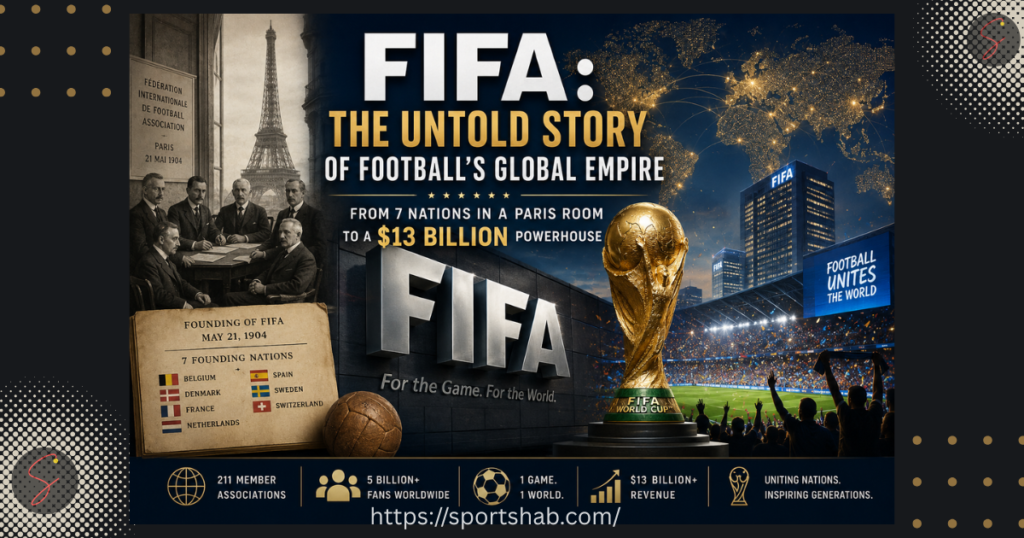
On a quiet spring afternoon in Paris, inside a modest room at rue Saint-Honoré, seven men gathered with a dream so audacious that even they could not have imagined where it would lead. It was May 21, 1904. The nations represented were Belgium, Denmark, France, the Netherlands, Spain, Sweden, and Switzerland. Their mission sounded almost quaint in its simplicity: to unite the world under one game, to make association football a universal language.
Robert Guérin, a French journalist with fire in his eyes, was elected the first president of what they called the Fédération Internationale de Football Association FIFA. They were seven associations in a continent that considered itself the center of the universe. Today, FIFA stands as a colossus with 211 member associations — more than the United Nations itself. From a backroom in Paris to a glass tower in Zurich, from 13 teams at the first World Cup to 48 nations preparing for 2026, FIFA’s journey is not merely the history of a sports organization. It is the history of globalization itself.
This is the story of that empire — the triumphs, the scandals, the billions, the revolutions, and the unanswered questions that will define football’s future.
The Birth of a Giant (1904–1974)
In its earliest years, FIFA was not the global force we know today. It was a European club with modest ambitions. Robert Guérin served only two years before Daniel Burley Woolfall, a British administrator, took the reins and expanded FIFA’s reach, though World War I would soon halt that progress. The interwar years were fragile, but they planted seeds.
The true architect of FIFA’s modern identity arrived in 1921. Jules Rimet, a French lawyer with an almost religious belief in football’s unifying power, would serve as president for 33 years — the longest reign in the organization’s history. Under Rimet, FIFA conceived its greatest invention: the World Cup. In 1930, Uruguay hosted the inaugural tournament with just 13 teams. Many European nations refused to make the transatlantic journey. The final itself was a curious affair — Argentina and Uruguay could not even agree on which ball to use, so they played the first half with an Argentine ball and the second with a Uruguayan one. Uruguay won 4-2, and a tradition was born.
Rimet’s successors — Rodolphe Seeldrayers, Arthur Drewry, and Stanley Rous — stabilized the organization through the post-war era, but FIFA remained largely Eurocentric. It took a Brazilian to change that.
The Havelange Revolution and the Blatter Era (1974 – 2015)
In 1974, João Havelange of Brazil seized the presidency, and FIFA’s trajectory shifted forever. Havelange understood something his predecessors had missed: football’s future lay not in Europe’s old stadiums, but in Africa’s dusty pitches, Asia’s crowded cities, and South America’s passionate barrios. He expanded FIFA’s commercial operations, brokered television deals, and transformed the World Cup into a truly global spectacle. But his legacy would later be tainted by corruption allegations that suggested the money flowed in more directions than just football development.
Sepp Blatter, a Swiss administrator who had served as Havelange’s technical director, succeeded him in 1998. Blatter’s 17-year presidency was the most consequential — and controversial — in FIFA history. Revenues exploded. The World Cup expanded to 32 teams. New markets were conquered. But beneath the glitter, rot was setting in. The ISL marketing scandal of 2011 exposed over $100 million in secret bribes from the 1990s and 2000s. Blatter knew, but stayed silent. The house of cards was wobbling.
Then came the morning of May 27, 2015. Swiss police, acting on a multi-year FBI investigation, stormed the luxury Baur au Lac hotel in Zurich at dawn. Seven high-ranking FIFA officials were arrested. The charges were staggering: racketeering, bribery exceeding $150 million, money laundering, wire fraud, and the selling of World Cup hosting votes. Jeffrey Webb, Eduardo Li, Julio Rocha, and dozens more were indicted. By the time the dust settled, 47 individuals and 2 corporations faced charges across multiple jurisdictions. Blatter resigned in disgrace. The empire had survived, but its soul was in question.
The Infantino Era — Reform, Expansion, and New Controversies (2016–Present)
Enter Gianni Infantino, a Swiss-Italian lawyer who promised to scrub FIFA clean. Elected in February 2016, he inherited an organization whose reputation lay in ruins. His reform agenda was ambitious: an independent Ethics Committee with genuine prosecutorial power, presidential term limits capped at three four-year terms, mandatory financial disclosures, diversity targets for leadership positions, and expanded World Cup formats to promote inclusivity.
The reforms were real, but so were the new controversies. The 2022 World Cup in Qatar brought horrific revelations about migrant worker deaths — estimates suggested over 6,500 laborers perished during stadium construction. The OneLove armband ban, which threatened European captains with yellow cards for supporting LGBTQ+ rights, triggered a diplomatic firestorm. And in 2026, an incident involving former U.S. President Donald Trump pressuring FIFA to overturn a player suspension raised fresh concerns about political interference.
Infantino’s supporters point to record revenues and unprecedented investment in global development. His critics argue that power has simply become more concentrated around one man. The truth, as always, lies somewhere in the messy middle.
The Organizational Empire — How FIFA Actually Works
To understand FIFA’s power, one must understand its architecture. At the apex sits the FIFA Congress — the supreme legislative body where all 211 member associations wield votes. Below it, the FIFA Council acts as the strategic decision-making body, setting the direction for world football.
Six continental confederations serve as FIFA’s operational arms:
- AFC (Asia, including Australia)
- CAF (Africa)
- CONCACAF (North, Central America & Caribbean)
- CONMEBOL (South America)
- OFC (Oceania)
- UEFA (Europe)
Beneath this structure, FIFA operates from its Zurich headquarters with over 700 employees and regional offices in Rabat, Paris, Jakarta, and Miami. The current president, Gianni Infantino, has held office since 2016, navigating the organization through its most lucrative — and scrutinized — period.
The leadership timeline tells its own story: from Guérin’s two-year founding stewardship, to Rimet’s 33-year visionary reign, to Havelange’s 24-year commercial expansion, to Blatter’s 17-year boom-and-bust cycle, and now Infantino’s reform-and-controversy era. Each president left an indelible mark. Each also left questions that the next had to answer.
The World Cup — Football’s Greatest Spectacle
If FIFA is the empire, the World Cup is its cathedral. The tournament has evolved through distinct eras, each reflecting the changing world around it.
The Foundation Era (1930–1978): Beginning with 13 teams in Uruguay, the World Cup grew to 16 participants. The 1950 tournament in Brazil produced the legendary Maracanazo — Uruguay’s shock defeat of the host nation before an estimated 200,000 fans, the highest attendance in football history. In 1958, a 17-year-old Pelé announced himself to the world with two goals in the final against Sweden. In 1966, the Jules Rimet Trophy was stolen before the tournament and famously recovered by a dog named Pickles under a London hedge.
The Growth Era (1982–2002): Expansion to 24 teams in 1982, then 32 in 1998. Dual-hosting arrived with Japan and South Korea in 2002. The 1986 tournament in Mexico gave us Diego Maradona’s dual legacy against England — the “Hand of God” followed by the “Goal of the Century,” a 60-meter dribble past five defenders that remains arguably the greatest individual goal ever scored.
The Modern Era (2006–2022): Technology entered the fray. Goal-line technology debuted in 2014, VAR in 2018, and semi-automated offside technology in 2022. The 2022 tournament in Qatar saw Lionel Messi finally fulfill his destiny, winning the World Cup in one of the most emotionally charged finals ever played.
The 2026 Revolution: The upcoming tournament in the United States, Canada, and Mexico will be the biggest ever — 48 teams, 104 matches, 16 host cities, 1,248 players, and a projected 39-day festival. FIFA expects $15 billion in revenue, a 36% surplus over initial projections.
Only eight nations have ever won the trophy: Brazil leads with five titles (and the unique distinction of playing in all 23 tournaments), followed by Germany and Italy with four each, Argentina with three, France and Uruguay with two, and England and Spain with one.
The Money Game — FIFA’s Financial Powerhouse
FIFA is not merely a sports governing body; it is an economic leviathan. The 2023-2026 four-year cycle targets $13 billion in total revenue — a figure that would make many Fortune 500 companies envious.
The revenue breakdown reveals where the money flows:
- Television & Broadcasting Rights: $5.2 billion (40%)
- Marketing & Sponsorships: $3.5 billion (27%)
- Ticket Sales: $2.2 billion (17%)
- Hospitality & Licensing: $2.1 billion (16%)
The 2026 World Cup alone is projected to generate $15 billion — nearly double the $7.57 billion from Qatar 2022 and triple the $4.8 billion from Brazil 2014. Secondary market ticket sales add another lucrative layer, with FIFA collecting a 30% commission (15% from buyers, 15% from sellers).
Where does this fortune go? FIFA reinvests heavily: record distributions to all 211 member associations, massive development programs, club solidarity payments for releasing players, and operational costs. But critics note that wealth inequality between European giants and developing nations persists despite increased distributions.
The Women’s Football Revolution
Perhaps no area better illustrates FIFA’s potential for positive transformation than women’s football. The investment surge has been staggering: $155 million for the 2019 World Cup in France, $499 million for the 2023 tournament in Australia and New Zealand (a 222% increase), and a targeted $1 billion by 2027.
The 2023 Women’s World Cup was a watershed moment. Over 978,000 fans attended matches. Social media impressions reached billions. In host nations, registered female players skyrocketed. Infrastructure upgrades to 10 stadiums benefited multiple sports, not just football.
FIFA’s strategic goal is audacious: 60 million registered female players globally by 2027. To achieve this, they have launched 13 development programs spanning all 211 member associations, including coach education scholarships, elite mentorship for female coaches, league professionalization support, club licensing standards mandating gender-equal facilities, grassroots initiatives for girls aged 6-14, and administrator capacity building.
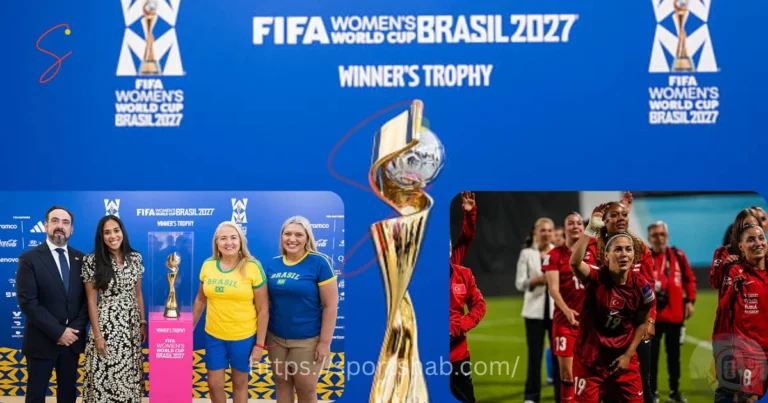
The 2027 Women’s World Cup in Brazil promises to build on this momentum, with South America’s football passion providing a fertile stage for the women’s game’s continued explosion.
Technology & Innovation — The Future of Fair Play
FIFA has embraced technology with a zeal that would have been unthinkable two decades ago.
Goal-Line Technology (GLT) debuted at the 2014 World Cup in Brazil. Using 14 high-speed cameras tracking the ball 500 times per second, it delivers 99.9% accuracy within 1 millimeter and under 1 second. The era of “ghost goals” — like Frank Lampard’s disallowed strike against Germany in 2010 — was effectively ended.
Video Assistant Referee (VAR) arrived in 2018, increasing decision accuracy to 98.9%. Reviewable incidents include goals, penalty decisions, red card offenses, and mistaken identity. While fans debate the impact on game flow, the data is undeniable: fewer catastrophic errors.
Semi-Automated Offside Technology (SAOT) revolutionized the 2022 World Cup in Qatar. Twelve dedicated cameras track 29 anatomical points on each player at 50 times per second, generating 3D animations for broadcast. Decisions that once took 2-4 minutes now take 25-60 seconds.
Connected Ball Technology embedded 500 sensors inside the 2022 match ball, detecting the precise moment of kick for enhanced offside calibration.
The pipeline for future innovations is equally ambitious: AI-powered tactical analysis, smart fabrics monitoring player biometrics, augmented reality fan experiences, blockchain ticketing to eliminate scalping, and 5G-enabled stadium platforms.
Football for Good — The Social Impact Empire
Beyond the pitch and the boardroom, FIFA has built a significant social impact infrastructure through the FIFA Foundation. Its mission is elegantly simple: “Using football’s incredible popularity as a force for good in the world.”
The Community Programme, launched in 2019, reached 154,924 direct beneficiaries in 2024 alone across 54 countries and 130 NGOs, with 48% being women and girls. Since inception, it has touched nearly one million people. Grants of up to $30,000 per organization fund programs focused on underprivileged children, gender equality, health education, peace and reconciliation, and environmental awareness.
The Refugee Programme partners with UNHCR to provide safe football access for forcibly displaced people, with a special focus on young adults, women, and girls. The Humanitarian Fund deploys rapid emergency response, including a recent $1 million commitment for Venezuela relief.
For the 2026 World Cup, FIFA is activating its “Football Unites the World” campaign across all 16 venues, promoting themes of peace, education, anti-racism, and physical activity. Stadium screens, digital toolkits, and player ambassadors will amplify messages to billions.
Mind-Blowing Facts & Records
FIFA’s scale defies comprehension:
- 211 member associations — exceeding the United Nations’ 193 members
- 150+ million registered players globally, including 10+ million women
- 5+ billion cumulative viewers for the 2022 World Cup
- 700+ employees worldwide
Individual records read like mythology:
- Most World Cup titles: Brazil (5)
- Most tournament appearances by a team: Brazil (23/23 — every single World Cup)
- All-time leading goalscorer: Lionel Messi (18 goals, as of June 2026)
- Most matches played: Lionel Messi (26 games across 5 tournaments)
- Youngest goalscorer: Pelé (17 years, 249 days in 1958)
- Oldest goalscorer: Roger Milla (42 years, 39 days in 1994)
- Fastest goal: Hakan Şükür (11 seconds for Turkey in 2002)
- Most winner’s medals: Pelé (3 championships)
Trivia collectors cherish gems like India’s 1950 withdrawal (popular myth blames barefoot play; reality involved travel costs and Olympic priorities), and the fact that only 8 countries have ever won the trophy despite 84+ nations participating.
The Future — 2026, 2030, 2034, and Beyond
The immediate horizon is dominated by the 2026 World Cup — the first 48-team tournament, the first tri-national host, and the first North American World Cup since 1994. From June 11 to July 19, 2026, 16 cities across the USA (11), Canada (2), and Mexico (3) will showcase next-generation technology and unprecedented commercial scale.
The 2027 Women’s World Cup in Brazil targets $1 billion+ investment and aims to solidify the 60 million female player base. The 2025 Club World Cup introduces a new 32-team expanded format.
Looking further, the 2030 World Cup will be a centenary celebration — 100 years since Uruguay 1930. The unique tri-continental format honors football’s origins: Spain, Portugal, and Morocco as primary hosts, with commemorative matches in Argentina, Paraguay, and Uruguay. The 2034 World Cup has been awarded to Saudi Arabia, though the bidding process drew criticism.
Infantino’s vision, “Making Football Truly Global,” rests on 11 strategic pillars: democratizing access, financial redistribution, women’s game transformation, social responsibility, technological leadership, integrity protection, youth development, professionalization, refereeing excellence, sustainable infrastructure, and unity.
But challenges loom: governance transparency, commercialization versus sporting purity, human rights in host selection, wealth inequality between federations, fan accessibility, and political independence. The 2026 Trump incident — where political pressure reversed a player suspension within days — served as a stark reminder that FIFA’s vulnerability to external influence persists.
The Beautiful Game’s Imperfect Guardian
FIFA stands at a crossroads that would have been unimaginable to those seven men in Paris in 1904. It is simultaneously football’s greatest enabler and its most complicated custodian. It has generated unprecedented wealth that funds development in forgotten corners of the world. It has expanded the World Cup to include nations that once could only dream of participation. It has invested billions in women’s football, embraced technological revolution, and reached nearly a million vulnerable people through social programs.
Yet it also carries the scars of corruption that destroyed careers and shattered trust. It has awarded tournaments to nations with troubling human rights records. It has allowed commercial imperatives to sometimes overshadow sporting integrity. It remains an organization where the noble and the questionable coexist in uneasy balance.
Whether one views FIFA as a force for global unity, a profit-maximizing machine with ethical blind spots, or simply the necessary backbone of humanity’s favorite sport, one truth is undeniable: its influence on global culture, economics, and society transcends sport itself.
As the biggest World Cup in history prepares to kick off across North America in 2026, the fundamental question remains urgent: Will FIFA harness its unprecedented power to genuinely elevate football for everyone, everywhere? Or will the old ghosts of greed and compromise continue to haunt the beautiful game?
The answer will not be written in Zurich boardrooms alone. It will be written in the dusty fields of Africa, the crowded streets of Asia, the passionate stadiums of South America, and the living rooms of billions who believe — despite everything — that football belongs to them.
The stakes have never been higher. The game has never been bigger. And FIFA, for all its flaws and triumphs, remains the imperfect guardian of the world’s most perfect obsession.
Frequently Asked Questions (FAQ)
When was FIFA founded and which countries were the original members?
FIFA (Fédération Internationale de Football Association) was founded on May 21, 1904, in Paris, France. The seven founding member associations were Belgium, Denmark, France, the Netherlands, Spain, Sweden, and Switzerland. Robert Guérin, a French journalist, served as the first president. Today, FIFA has grown to 211 member associations — more than the United Nations’ 193 member states.
How much money does FIFA make and what are its main revenue sources?
FIFA targets $13 billion in total revenue for the 2023-2026 four-year cycle. The 2026 World Cup alone is projected to generate $15 billion. Primary revenue streams include television and broadcasting rights ($5.2B / 40%), marketing and sponsorships ($3.5B / 27%), ticket sales ($2.2B / 17%), and hospitality and licensing ($2.1B / 16%). This represents a 300% revenue increase from 2014 levels.
Which country has won the most FIFA World Cup titles?
Brazil holds the record with five FIFA World Cup titles (1958, 1962, 1970, 1994, 2002) and is the only nation to have participated in every single tournament. The eight World Cup-winning nations are: Brazil (5), Germany (4), Italy (4), Argentina (3), France (2), Uruguay (2), England (1), and Spain (1).
What was the 2015 FIFA corruption scandal?
On May 27, 2015, Swiss authorities arrested seven high-ranking FIFA officials in Zurich following a U.S. Department of Justice investigation. Charges included racketeering, bribery exceeding $150 million, money laundering, wire fraud, and selling World Cup hosting votes. Ultimately, 47 individuals and 2 corporations were indicted. Sepp Blatter resigned as president, leading to Gianni Infantino’s election in 2016.
How is FIFA investing in women’s football?
FIFA has dramatically increased women’s football investment from $155 million (2019) to $499 million (2023) — a 222% surge — with a $1 billion target by 2027. The organization aims for 60 million registered female players globally by 2027 through 13 development programs including coach education, league professionalization, infrastructure grants, and grassroots initiatives across all 211 member associations.
What technology does FIFA use in matches?
FIFA employs Goal-Line Technology (GLT, 99.9% accuracy since 2014), Video Assistant Referee (VAR, since 2018), Semi-Automated Offside Technology (SAOT, tracking 29 body points per player at 50x/second since 2022), and Connected Ball Technology (500 sensors inside the ball). Future innovations include AI tactical analysis, smart fabrics, and blockchain ticketing.
How many member associations does FIFA have?
FIFA has 211 member associations across six continental confederations: AFC (Asia), CAF (Africa), CONCACAF (North/Central America & Caribbean), CONMEBOL (South America), OFC (Oceania), and UEFA (Europe). This exceeds the United Nations’ 193 member states, making FIFA the world’s largest sports governing body by membership.
What is the 2026 FIFA World Cup format?
The 2026 World Cup will be the biggest ever, featuring 48 teams (up from 32), 104 matches (up from 64), and 1,248 players. It will be co-hosted by the United States (11 cities), Canada (2 cities), and Mexico (3 cities) from June 11 to July 19, 2026. It is the first tri-national World Cup and the first in North America since 1994.
What reforms has FIFA implemented since the 2015 scandal?
Under President Gianni Infantino, FIFA introduced an independent Ethics Committee, presidential term limits (maximum 12 years), mandatory financial disclosures, diversity requirements for governing bodies, and expanded World Cup formats. However, critics argue that power remains concentrated and new controversies — such as political interference and human rights concerns in host selections — continue to emerge.
What is FIFA’s social impact and community work?
Through the FIFA Foundation, FIFA runs the Community Programme (benefiting nearly 1 million people since 2019), the Refugee Programme with UNHCR, and the Humanitarian Fund for emergency relief. The 2026 “Football Unites the World” campaign promotes peace, education, anti-racism, and youth activity across all 16 host venues, reaching billions through stadium screens and digital platforms.
Related Posts
No Posts Found