FIFA World Cup 1934: Italy’s Triumph That Turned Football Into a Global Spectacle
The inaugural World Cup ignited the dream, but four years later Italy transformed it into a fierce battle for football supremacy. Packed with drama, tactical brilliance, and unforgettable moments, the FIFA World Cup 1934 proved that the world’s biggest sporting prize had truly arrived.
FIFA World Cup 1934
When the final whistle echoed through Rome in June 1934, football had entered a new era. The FIFA World Cup was no longer an experiment—it had become the sport’s grandest competition. After Uruguay’s successful hosting of the inaugural tournament in 1930, the second FIFA World Cup moved to Europe, bringing together the strongest footballing nations in a high-stakes knockout competition.
Unlike the first World Cup, where several European teams declined to travel, the 1934 edition witnessed fierce competition from across Europe and South America. Every match became a battle for survival because there was no room for mistakes. Lose once, and your World Cup journey ended immediately.
Italy embraced the opportunity with confidence, determination, and passionate home support. Their disciplined style, tactical intelligence, and resilient performances carried them all the way to the trophy, making them the second nation—and the first European country—to win the FIFA World Cup.
More importantly, the tournament demonstrated that international football could capture the imagination of millions, setting the stage for generations of unforgettable World Cups.
FIFA World Cup 1934 Winner
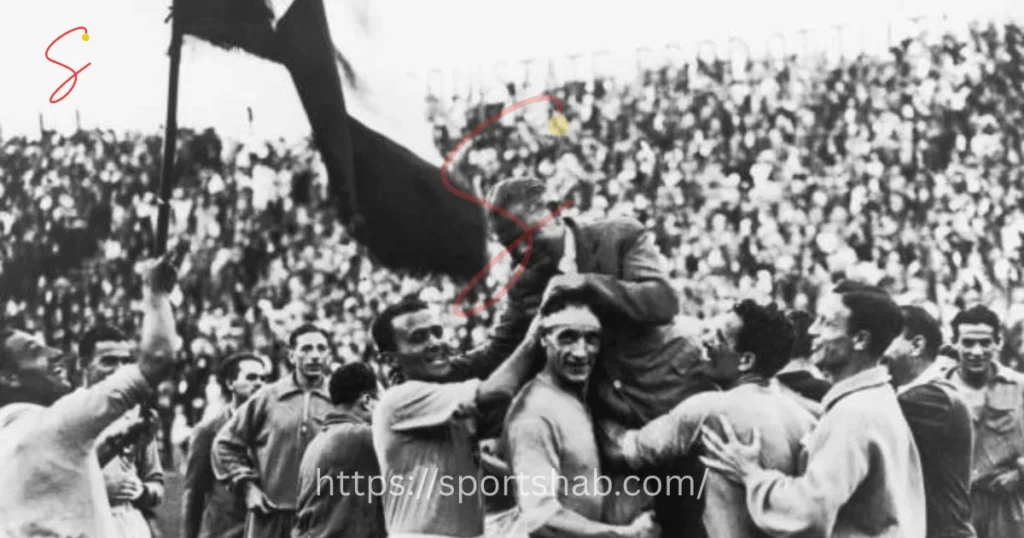
Italy lifted the FIFA World Cup trophy after defeating Czechoslovakia 2-1 after extra time in the final at Rome’s National Fascist Party Stadium on 10 June 1934.
The victory was far from straightforward. Czechoslovakia stunned the home crowd by scoring first during the second half, leaving Italy staring at defeat. Instead of surrendering, the hosts responded like true champions. Raimundo Orsi curled in a magnificent equalizer before Angelo Schiavio found the winning goal during extra time, sending thousands of Italian supporters into celebration.
That comeback crowned Italy as world champions for the very first time and established the nation among football’s elite.
FIFA World Cup 1934 Organized By
The FIFA World Cup 1934 was organized by the Fédération Internationale de Football Association (FIFA), football’s international governing body.
Following the encouraging success of the inaugural tournament in Uruguay, FIFA expanded the competition by introducing a qualification process. The governing body wanted the World Cup to become a truly global championship where teams earned their place instead of receiving automatic invitations.
This decision changed football history forever because every future World Cup would rely on qualifying competitions to determine the finalists.
Host Nation
Italy became the first European country to host the FIFA World Cup after FIFA awarded the tournament to the Italian Football Federation.
Matches were played in eight different cities:
- Rome
- Milan
- Turin
- Florence
- Naples
- Genoa
- Bologna
- Trieste
Hosting the tournament across multiple venues created a festival atmosphere unlike anything football had experienced before. Packed stadiums, passionate supporters, and nationwide excitement transformed the World Cup into a true international spectacle.
FIFA World Cup 1934 Participants
The 1934 FIFA World Cup featured 16 qualified teams, making it larger than the inaugural tournament.
Participating nations included:
Italy, Argentina, Austria, Belgium, Brazil, Czechoslovakia, Egypt, France, Germany, Hungary, Netherlands, Romania, Spain, Sweden, Switzerland, and the United States.
One of the biggest talking points was Egypt’s qualification. The Pharaohs became the first African nation ever to participate in a FIFA World Cup, opening the door for future generations of African football.
Several European powerhouses also arrived with enormous expectations. Austria entered with its legendary “Wunderteam,” Czechoslovakia possessed one of Europe’s strongest defensive units, while Hungary, Germany, and Spain all looked capable of lifting the trophy.
Meanwhile, South American representation was limited. Uruguay, the defending champions, chose not to participate after many European nations had skipped the 1930 tournament in Montevideo.
FIFA World Cup 1934 Tournament Format
The FIFA World Cup 1934 introduced a completely different format from the inaugural competition.
Instead of beginning with group stages, every team entered a straight knockout tournament. There were no second chances. Every match was effectively a final because defeat meant immediate elimination.
The competition consisted of:
- Round of 16
- Quarter-finals
- Semi-finals
- Third-place play-off
- Final
If a match remained level after extra time, a replay was scheduled under the rules in place during that era.
This ruthless structure dramatically increased the excitement. Every tackle mattered. Every goal changed history. Every mistake could end a nation’s dream.
FIFA World Cup 1934 Group Stage Overview
Unlike many modern FIFA World Cups, there was no group stage in the 1934 tournament.
The competition started directly with the Round of 16, making it the only FIFA World Cup ever to begin immediately as a full knockout tournament.
This format created relentless drama from the opening whistle.
Italy announced themselves by defeating the United States 7-1 in a commanding display of attacking football.
Austria survived a fiercely contested encounter against France, winning 3-2 after extra time.
Spain comfortably defeated Brazil 3-1, demonstrating why they were considered genuine title contenders.
Germany edged Belgium 5-2 in a lively contest, while Czechoslovakia eliminated Romania 2-1 through disciplined defending and clinical finishing.
Hungary overcame Egypt despite a spirited performance from the African debutants, while Switzerland shocked many observers by eliminating the Netherlands.
Every opening-round match reinforced one message to the football world:
There would be no easy victories.
The quarter-finals proved even more dramatic.
Italy and Spain produced one of the tournament’s most controversial matches. Their first meeting ended in a bruising 1-1 draw after extra time, forcing a replay the following day. With several Spanish players injured and unavailable, Italy secured a narrow 1-0 victory to reach the semi-finals.
Austria defeated Hungary in another tightly contested battle, while Germany overcame Sweden to continue their impressive run.
Czechoslovakia held off Switzerland to complete the semi-final lineup.
By the end of the quarter-finals, only four nations remained standing—Italy, Austria, Germany, and Czechoslovakia. Each had survived football’s toughest examination, knowing they were now just two victories away from immortality.
The knockout format had transformed every fixture into a high-pressure spectacle. Fans across Europe watched with growing excitement as the world’s finest footballers fought for every inch of the pitch. Unlike today’s tournaments, there were no opportunities to recover from an early setback. One lapse in concentration could send even the strongest team home.
As the semi-finals approached, anticipation reached fever pitch. Italy carried the hopes of an entire nation, Austria’s celebrated “Wunderteam” looked ready to fulfill its promise, Germany had emerged as a dangerous challenger, and Czechoslovakia quietly built momentum with disciplined, organized football. The biggest matches of the tournament were still to come.
FIFA World Cup 1934 Semi-Finals: Four Giants, Two Tickets to Glory
The road to the championship had narrowed to four of Europe’s strongest footballing nations. Italy, Austria, Germany, and Czechoslovakia had survived the brutal knockout rounds and now stood just one victory away from the World Cup final. Every pass carried pressure, every tackle had purpose, and every goal could change football history.
Unlike today’s month-long tournaments filled with second chances, the 1934 FIFA World Cup demanded perfection. The semi-finals were played before passionate crowds who understood they were witnessing history in the making.
Italy vs Austria – The Hosts Edge Past the Wunderteam
Italy entered the semi-final carrying the expectations of an entire nation, while Austria arrived with the reputation of being Europe’s most entertaining side. Nicknamed the “Wunderteam,” Austria had dazzled football fans with technical brilliance and quick passing throughout the early 1930s.
Heavy rain turned the pitch into a muddy battlefield, making attractive football almost impossible. The difficult conditions suited Italy’s disciplined approach. The hosts stayed organized, defended with determination, and capitalized on their opportunity when Enrique Guaita scored the only goal of the match.
Austria pushed relentlessly for an equalizer, but Italy’s defense stood firm. After ninety exhausting minutes, the hosts celebrated a hard-fought 1-0 victory and booked their place in the World Cup final.
It wasn’t the prettiest performance, but championship-winning teams often find ways to win when conditions are against them. Italy had done exactly that.
Czechoslovakia vs Germany – Calm Under Pressure
The second semi-final featured two teams built on tactical discipline rather than flashy football.
Germany had impressed throughout the tournament with energetic attacking play, while Czechoslovakia relied on defensive organization and clinical finishing.
The match remained closely contested for long periods before Czechoslovakia gradually took control. Strong teamwork and intelligent positioning frustrated Germany’s forwards, while precise attacks created scoring opportunities at the other end.
Czechoslovakia secured a deserved 3-1 victory to reach the first World Cup final in their history.
Germany’s campaign ended in disappointment, but they still had one more opportunity to leave Italy with a medal.
Third-Place Play-Off
Germany refused to leave empty-handed.
Facing Austria in the third-place match, the Germans produced one of their finest performances of the tournament, defeating their neighbors 3-2 in an entertaining encounter filled with attacking football.
The victory earned Germany the bronze medal and demonstrated the country’s growing strength on the international stage.
FIFA World Cup 1934 Final
Italy vs Czechoslovakia
On 10 June 1934, football’s attention shifted to Rome, where Italy and Czechoslovakia met to decide the world champions.
The stadium buzzed with anticipation as thousands of supporters filled the stands. Italy had home advantage, but Czechoslovakia had shown throughout the tournament that they possessed the quality to upset any opponent.
The opening stages were tense, with both teams defending carefully and refusing to give away easy opportunities.
Then came the breakthrough.
During the second half, Antonín Puč silenced the Italian crowd by giving Czechoslovakia a 1-0 lead. Suddenly, the hosts faced the possibility of seeing the trophy slip away on home soil.
Champions, however, are defined by their response to adversity.
Italy answered with determination. Raimundo Orsi produced one of the most memorable goals of the tournament, curling a spectacular shot beyond the goalkeeper to level the score.
With the match tied after ninety minutes, extra time was required.
As fatigue began to affect both sides, Angelo Schiavio seized the decisive moment. His winning goal sparked wild celebrations throughout the stadium and secured a dramatic 2-1 victory for Italy.
The comeback remains one of the iconic moments in early World Cup history.
Italy had become the first European nation to win football’s greatest prize.
FIFA World Cup 1934 Interesting Facts
The 1934 World Cup introduced several milestones that permanently changed international football.
It was the first World Cup played in Europe, expanding FIFA’s flagship competition beyond South America and helping football become a truly global event.
The tournament was also the first to require qualification. More than thirty nations entered the qualifying competition, proving how rapidly interest in the World Cup had grown within just four years.
Egypt made history by becoming the first African nation ever to appear at a FIFA World Cup. Although their journey ended in the opening round, their participation opened an important chapter in football history.
For the first and only time in World Cup history, the tournament started immediately with a Round of 16 knockout format. Every team faced elimination from its very first match.
Another memorable feature was the replay between Italy and Spain in the quarter-finals. Their first encounter ended in a physical draw after extra time, forcing a second match the following day because penalty shootouts had not yet been introduced.
Tournament Innovations and Firsts
The FIFA World Cup 1934 wasn’t simply another football tournament—it introduced several innovations that shaped future editions.
The biggest change was the introduction of official qualification rounds. Unlike the inaugural tournament, teams now had to earn their place through competitive qualifying matches.
The event also became the first World Cup hosted in Europe, proving the competition could succeed outside South America.
Another significant development was the widespread use of multiple host cities. Instead of concentrating matches in one location, games were played across Italy, allowing millions of supporters to experience the tournament.
The 1934 edition also highlighted tactical evolution. Defensive organization, structured formations, and disciplined teamwork became just as important as attacking brilliance.
Football was growing up.
FIFA World Cup 1934 Statistics
Goals flowed freely throughout the competition.
The tournament produced 70 goals in 17 matches, averaging more than four goals per game—a remarkable figure that reflected football’s attacking philosophy during the era.
Oldřich Nejedlý of Czechoslovakia finished as the tournament’s leading scorer with five goals. His intelligent movement and clinical finishing played a huge role in his country’s impressive run to the final.
Italy’s Angelo Schiavio, Raimundo Orsi, and Enrique Guaita also delivered crucial goals at important moments, while Edmund Conen and Edmund Hofmann helped Germany secure third place with outstanding attacking performances.
Goalkeeping standards improved significantly compared with the inaugural World Cup. Italian goalkeeper Gianpiero Combi produced several outstanding displays, particularly during the knockout rounds, while František Plánička of Czechoslovakia established himself as one of Europe’s finest goalkeepers through a series of remarkable saves.
Several goalkeepers finished the tournament with multiple clean sheets, reflecting the increasing tactical discipline of international football.
It is important to note that the Golden Ball, Golden Boot, and Golden Glove awards did not exist in 1934.
Modern FIFA awards were introduced decades later:
- Golden Ball (Best Player): introduced in 1982 (official FIFA award lineage recognizes later editions)
- Golden Boot (Top Scorer): officially introduced in 1982
- Golden Glove (Best Goalkeeper): introduced in 1994
Therefore:
- Top Scorer: Oldřich Nejedlý (5 goals)
- Golden Ball: Not awarded
- Golden Boot: Not awarded
- Golden Glove: Not awarded
FIFA World Cup 1934 Squads
Italy’s championship-winning squad featured legendary names such as Gianpiero Combi, Virginio Rosetta, Eraldo Monzeglio, Luis Monti, Giuseppe Meazza, Angelo Schiavio, Raimundo Orsi, Enrique Guaita, Giovanni Ferrari, Attilio Ferraris, and Luigi Allemandi. Their blend of experience, technical ability, and tactical intelligence formed the backbone of the champions.
Runner-up Czechoslovakia relied on stars including František Plánička, Antonín Puč, Oldřich Nejedlý, Josef Košťálek, František Svoboda, and Jaroslav Bouček. Their disciplined performances carried them all the way to the final.
Germany’s bronze-medal squad featured outstanding players such as Edmund Conen, Ernst Lehner, Fritz Szepan, Jakob Bender, and goalkeeper Willibald Kress, while Austria’s famous Wunderteam included Matthias Sindelar, Walter Nausch, Josef Smistik, Karl Sesta, and Josef Bican, whose influence on European football extended well beyond the tournament.
These squads represented the tactical evolution of football during the 1930s. Many of their players became icons whose influence shaped generations of footballers that followed.
The FIFA World Cup 1934 proved that success required more than individual brilliance. Team chemistry, disciplined defending, and intelligent tactics had become the defining ingredients of championship football. Italy mastered each of those qualities, earning a place in football history with a title that transformed the World Cup into the world’s premier sporting competition.
Conclusion
The FIFA World Cup 1934 was far more than the second edition of an international football tournament—it was the competition that convinced the world the World Cup was here to stay. Four years after Uruguay lifted the inaugural trophy, Italy showcased how football could unite a nation, captivate millions of fans, and create moments that would echo through sporting history.
From the introduction of a qualification system to the first European-hosted World Cup, the tournament marked a significant step forward in FIFA’s vision of building a truly global championship. Every knockout match demanded courage, tactical discipline, and nerves of steel. There were no easy routes, no second chances, and no room for error. The pressure produced unforgettable football.
Italy’s dramatic comeback against Czechoslovakia in the final perfectly captured the spirit of the tournament. The hosts refused to surrender when they fell behind, responding with determination and composure to secure a historic 2-1 victory after extra time. That triumph crowned Italy as world champions for the first time and established European football as a dominant force on the international stage.
The 1934 FIFA World Cup also introduced football fans to legendary names such as Giuseppe Meazza, Angelo Schiavio, Gianpiero Combi, František Plánička, Oldřich Nejedlý, and Matthias Sindelar. Their performances inspired future generations and helped shape the tactical evolution of the modern game.
Even after nine decades, football supporters continue to revisit the FIFA World Cup 1934 because it represents a defining chapter in the sport’s history. It was the tournament where the World Cup evolved from an exciting experiment into the most prestigious prize in international football. Every edition played today—from packed stadiums to billions of television viewers—owes part of its legacy to those unforgettable weeks in Italy.
When football history is discussed, the 1934 World Cup deserves its place among the game’s greatest milestones. It wasn’t just about lifting a trophy; it was about proving that the world’s biggest football tournament had found its permanent home.