FIFA World Cup 1986: Maradona’s Mexico Masterclass and Argentina’s Road to World Cup Glory
One man, one No. 10 shirt, and a tournament that turned Diego Maradona into a football immortal.
The FIFA World Cup 1986 was not just another chapter in football history. It was the tournament where Diego Maradona grabbed the game by the collar and made it his own.
Mexico hosted the 13th FIFA World Cup, where 24 nations delivered a month of screamers, controversial calls, penalty shootouts, and individual brilliance that still gives you goosebumps. On 29 June 1986, at the iconic Azteca, Argentina held their nerve to edge past West Germany 3-2 and lift their second world title.
But if Argentina’s triumph had a heartbeat, it was Maradona.
He scored the infamous “Hand of God” goal against England, followed it minutes later with a breathtaking solo run that left defenders chasing shadows, and then produced two more goals against Belgium in the semi-final. In the final, when Germany fought back from 2-0 down to make it 2-2, Maradona delivered one final piece of magic—an inch-perfect pass for Jorge Burruchaga to score the winner.
That was Mexico 1986.
A World Cup where football became theatre, controversy became folklore, and the No. 10 became king.
FIFA World Cup 1986 Winner
Argentina Champions of the World
Argentina won the 1986 FIFA World Cup, defeating West Germany 3-2 in a thrilling final at Mexico City’s Estadio Azteca. Argentina won their second World Cup title after1978.
Argentina’s campaign was built around Maradona, but it was not a one-man show.
Goalkeeper Nery Pumpido provided security behind a defence led by José Luis Brown and Oscar Ruggeri. Jorge Valdano supplied goals in the knockout rounds, while Jorge Burruchaga became the man who finished the final.
Yet Maradona was the difference-maker.
He scored five goals and supplied five assists during the tournament, directly influencing Argentina’s attacking output throughout their run.
When Argentina needed inspiration, their captain stepped forward.
When the game became tense, he wanted the ball.
And when the final needed one decisive moment, Maradona created it.
FIFA World Cup 1986 Organized By
FIFA
The 1986 FIFA World Cup was organized by FIFA, the international governing body of football.
Mexico first hosted the World Cup back in 1970, so 1986 made history as the first time any nation staged the tournament twice. Colombia had actually been picked to host 1986, but pulled out when it couldn’t meet FIFA’s requirements. Mexico then stepped in.
The tournament was originally scheduled for Colombia, but Mexico stepped in and successfully delivered the competition.
And despite concerns following the devastating 1985 Mexico City earthquake, the country hosted a memorable World Cup.
FIFA World Cup 1986 Host
Mexico
Mexico hosted the 1986 FIFA World Cup from 31 May to 29 June 1986.
Matches were played in venues across the country, including the iconic Estadio Azteca in Mexico City, Guadalajara’s Estadio Jalisco, Puebla’s Estadio Cuauhtémoc and other major stadiums.
The Estadio Azteca eventually became the stage for the tournament’s grand finale.
Argentina lifted the trophy there after defeating West Germany 3-2 before a huge crowd.
Mexico therefore became the first nation to host the FIFA World Cup twice.
And what a way to make history.
FIFA World Cup 1986 Participants
24 Nations Arrived in Mexico
The 1986 World Cup retained the 24-team format introduced at Spain 1982.
The participating nations were:
Argentina, Belgium, Brazil, Bulgaria, Canada, Denmark, England, France, Hungary, Iraq, Italy, Mexico, Morocco, Northern Ireland, Paraguay, Poland, Portugal, Scotland, South Korea, Spain, the Soviet Union, Uruguay, West Germany and Algeria.
For Canada and Iraq, this was their first appearance at a FIFA World Cup finals. Morocco also made history by becoming the first African nation to reach the World Cup quarter-finals.
The tournament also produced several memorable underdog performances.
Morocco topped a group containing England, Poland and Portugal.
Belgium reached the semi-finals.
Denmark dazzled during the group stage before collapsing against Spain.
And Canada competed at the finals for the first time.
The World Cup was becoming increasingly global.
FIFA World Cup 1986 Format
A 24-Team Tournament With a Knockout Twist
The 24 teams were divided into six groups of four.
Each nation played three group matches.
The top two teams from each group advanced automatically to the knockout stage.
But there was an important addition: the four best third-place teams also qualified.
That created a Round of 16 featuring 16 nations.
From that point onward, the competition became straight knockout football:
Round of 16, Quarter finals, Semi finals, Third place play off and Final.
This format was much easier for fans to follow than the second group stage used at the 1982 World Cup.
And it produced plenty of knockout drama.
Eight teams were eliminated in the first knockout round, leaving eight quarter-finalists.
Then four.
Then two.
Then one champion.
Simple.
Brutal.
Football.
FIFA World Cup 1986 Group Stage Overview
Group A Argentina, Italy, Bulgaria and South Korea
Argentina began their campaign with a 3-1 victory over South Korea.
Maradona did not need to score to influence the match; his presence shaped Argentina’s attacking play.
Argentina then drew 1-1 with Italy before defeating Bulgaria 2-0.
They finished top of the group with five points and moved into the knockout stage alongside Italy.
Group B Mexico, Paraguay, Belgium and Iraq
The hosts Mexico finished top of Group B after defeating Belgium and Iraq and drawing with Paraguay.
Paraguay also advanced.
Belgium squeezed through as one of the best third-place teams.
Iraq, appearing at their first World Cup, exited after three defeats.
Group C Soviet Union, France, Hungary and Canada
The Soviet Union made an explosive start by crushing Hungary 6-0.
France also impressed, defeating Hungary 3-0 and Canada 1-0.
The Soviet Union and France both finished unbeaten and advanced.
Canada, despite fighting hard, failed to score a goal and were eliminated.
Group D Brazil, Spain, Northern Ireland and Algeria
Brazil were perfect in the group stage.
Three matches.
Three wins.
No goals conceded.
They defeated Spain 1-0, Algeria 1-0 and Northern Ireland 3-0.
Spain finished second.
Northern Ireland and Algeria were eliminated.
Brazil already looked like serious contenders.
Group E Denmark, West Germany, Uruguay and Scotland
Denmark produced one of the tournament’s biggest group-stage statements.
They won all three matches and scored nine goals.
Their 6-1 demolition of Uruguay was especially impressive.
West Germany finished second, while Uruguay progressed as a third place qualifier.
Scotland were eliminated.
Group F Morocco, England, Poland and Portugal
Morocco shocked everyone by topping the group.
They defeated Portugal 3-1, drew 0-0 with Poland and held England to another goalless draw.
England finished second.
Poland also advanced as one of the best third-place teams.
Portugal, despite winning their opening match against England, crashed out after losing their next two games.
Morocco were no longer simply participating.
They were making history.
FIFA World Cup 1986 Final Pool
Round of 16: The Tournament Gets Serious
The group stage had separated the contenders from the pretenders.
Now there was nowhere to hide.
Argentina defeated Uruguay 1-0.
Brazil brushed aside Poland 4-0.
Mexico beat Bulgaria 2-0.
West Germany defeated Morocco 1-0.
France overcame Italy 2-0.
England eliminated Paraguay 3-0, with Gary Lineker scoring twice.
Belgium needed extra time to defeat the Soviet Union 4-3.
Spain crushed Denmark 5-1, with Emilio Butragueño scoring four goals.
The quarter-finals were now set.
And the temperature was rising.
FIFA World Cup 1986 Quarter Finals
Argentina 2-1 England
This was the match that gave football two of its most famous goals.
Argentina faced England in Mexico City.
The first goal came in the 51st minute.
Maradona challenged for a high ball and punched it into the net.
The referee awarded the goal.
England protested.
Maradona later described it as being scored with the “Hand of God.”
Four minutes later, the same man produced something completely different.
Maradona collected the ball inside his own half and began his run.
One defender beaten.
Another.
Then another.
He danced through the England defence before rounding goalkeeper Peter Shilton and rolling the ball into the net.
No controversy.
No argument.
Just genius.
The goal was later voted the FIFA World Cup Goal of the Century.
England pulled one back through Gary Lineker, but Argentina held on.
Argentina 2-1 England.
Maradona had just written himself into football folklore.
Brazil 1-1 France, France Win on Penalties
Brazil and France played a classic.
Careca gave Brazil the lead.
Michel Platini equalised.
Neither side could find a winner during normal time or extra time.
The match went to penalties.
France won the shootout 4-3.
Brazil were eliminated despite producing one of the tournament’s strongest teams.
West Germany 0-0 Mexico, West Germany Win on Penalties
The hosts Mexico fought hard against West Germany.
After 120 goalless minutes, penalties were required.
West Germany won 4-1 on penalties.
Mexico’s dream of reaching the semi-finals had ended.
But their tournament had already become a success.
Belgium 1-1 Spain, Belgium Win on Penalties
Belgium and Spain also needed penalties after a 1-1 draw.
Belgium eventually won the shootout 5-4.
The result sent Belgium into their first-ever World Cup semi-final.
The Red Devils had arrived.
FIFA World Cup 1986 Semi Finals
Argentina 2-0 Belgium
Argentina met Belgium in Mexico City.
Maradona again took centre stage.
He scored Argentina’s first goal in the 51st minute.
Then he struck again in the 63rd.
Argentina 2-0 Belgium.
Two goals.
Another dominant individual display.
Argentina were heading to the final.
Their captain was now only one match away from immortality.
West Germany 2-0 France
France had eliminated Brazil.
West Germany had survived Mexico.
Now they met in the semi-final.
And Germany were ruthless.
Andreas Brehme scored after just nine minutes.
France searched for an equaliser but struggled to break through the German defence.
Then, deep into stoppage time, Rudi Völler scored the second.
West Germany 2-0 France.
Germany were back in the World Cup final.
And waiting for them was Maradona’s Argentina.
FIFA World Cup 1986 Final
Argentina 3-2 West Germany
29 June 1986. Estadio Azteca, Mexico City.
The final looked like it was going Argentina’s way.
José Luis Brown opened the scoring in the 23rd minute.
Argentina led 1-0.
Then Jorge Valdano doubled the advantage in the 56th minute.
Argentina 2-0 West Germany.
The trophy appeared to be slipping away from Germany.
But never count out the Germans.
Karl-Heinz Rummenigge scored in the 74th minute.
Suddenly it was 2-1.
Eight minutes later, Rudi Völler equalised.
2-2.
Argentina’s two-goal advantage had disappeared.
The game was alive again.
Then Maradona produced the moment that mattered.
In the 85th minute, he played a brilliant through ball into the path of Jorge Burruchaga.
Burruchaga raced forward.
One-on-one.
He kept his composure.
And finished.
Argentina 3-2 West Germany.
The final whistle soon followed.
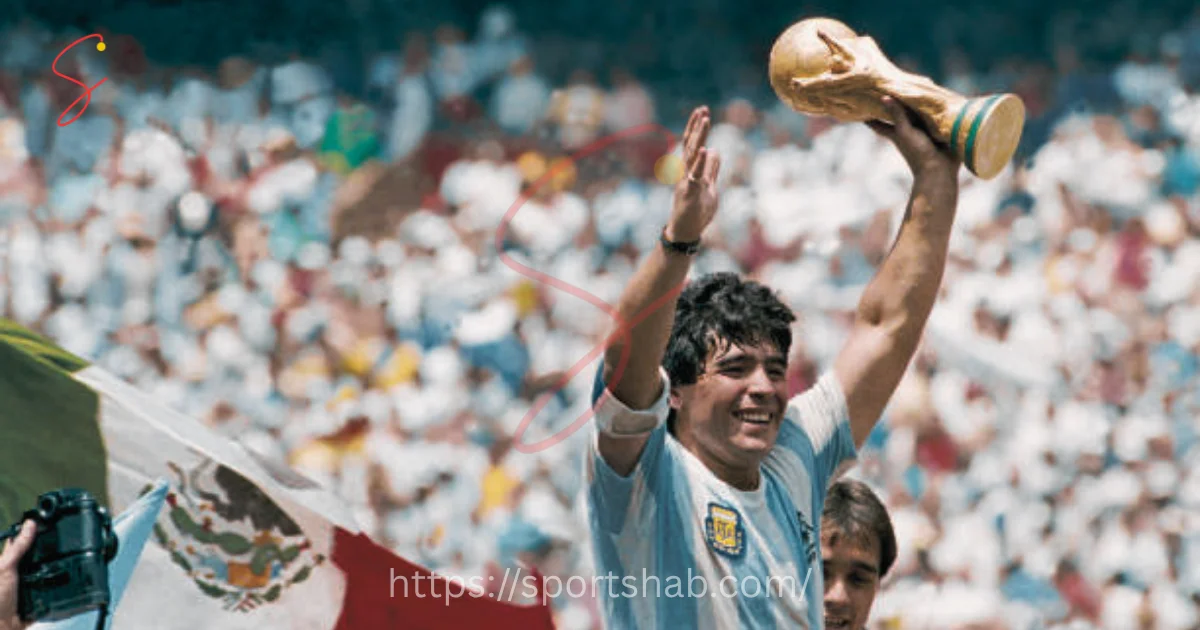
Argentina were champions.
Maradona had done it.
The No. 10 lifted the World Cup and became the defining player of Mexico 1986.
FIFA World Cup 1986 Interesting Facts
Maradona’s “Hand of God”
The first goal against England remains one of the most controversial goals ever scored at a World Cup.
Maradona used his hand to direct the ball into the net.
The goal stood.
Football history gained a phrase that would last forever.
The Goal of the Century
Only minutes after the controversy, Maradona scored one of the greatest goals ever seen.
He carried the ball through the England defence before beating Shilton.
It was the perfect answer to the controversy.
One goal was debated.
The other was admired.
Morocco made African history
Morocco became the first African team to reach the World Cup quarter-finals.
They topped a group containing England, Poland and Portugal before defeating West Germany 1-0 in the Round of 16.
Their run changed perceptions of African football on the world stage.
Denmark’s attacking explosion
Denmark entered the knockout stage after winning all three group matches.
They scored nine goals in the group phase.
But then Spain destroyed them 5-1.
Football giveth.
Football taketh away.
Gary Lineker’s Golden Boot
England striker Gary Lineker scored six goals, making him the tournament’s top scorer.
He scored a hat trick against Poland, two against Paraguay and another against Argentina.
Argentina’s defence mattered too
Maradona understandably received most of the attention, but Argentina conceded only five goals throughout the tournament.
They were not simply entertainers.
They knew how to defend when the game demanded it.
Tournament Innovations and Firsts
Mexico became the first two time host
Mexico had already hosted the 1970 World Cup.
When it staged the 1986 edition, it became the first country to host the tournament twice.
The 24 team format continued
The 24-team format introduced in 1982 was retained.
The major difference was the knockout structure, with the tournament moving into a Round of 16 after the group stage.
Morocco broke a continental barrier
Morocco’s quarter-final appearance was the first time an African nation had gone that far at a World Cup.
Penalty shootouts became a major part of the knockout drama
Four knockout matches at Mexico 1986 were decided by penalty shootouts, including Brazil-France, West Germany-Mexico and Belgium-Spain.
The tournament showed just how much pressure could be packed into those 12-yard battles.
FIFA World Cup 1986 Statistics
Most Goals
Gary Lineker, England, 6 goals
Lineker won the Golden Boot after scoring six times.
His goals came against Poland, Paraguay and Argentina.
Golden Ball
Diego Maradona Argentina
Maradona won the adidas Golden Ball as the best player of the 1986 World Cup.
FIFA’s historical list confirms Maradona as the Golden Ball winner, with West Germany’s Harald “Toni” Schumacher receiving the Silver Ball and Denmark’s Preben Elkjær the Bronze Ball.
Golden Boot
Gary Lineker, England , 6 goals
Lineker’s six goals made him the leading scorer of Mexico 1986.
Golden Glove
The official FIFA Golden Glove award did not yet exist in 1986.
That is an important historical distinction.
The modern goalkeeper award was introduced later, so it would be inaccurate to claim that a particular goalkeeper officially won the 1986 Golden Glove.
However, Jean Marie Pfaff of Belgium and Harald Schumacher of West Germany were among the tournament’s standout goalkeepers.
Schumacher was particularly important during West Germany’s penalty-shootout victory over Mexico.
Tournament Goals
The 1986 World Cup produced 146 goals across 52 matches, averaging approximately 2.81 goals per game.
The tournament’s highest-scoring match was the Soviet Union’s 6-0 victory over Hungary in the group stage, while Spain’s 5-1 win over Denmark was another attacking spectacle.
FIFA World Cup 1986 Squads
Argentina
Argentina’s champion squad included Nery Pumpido, José Luis Brown, Oscar Ruggeri, Julio Olarticoechea, José Cuciuffo, Sergio Batista, Jorge Burruchaga, Héctor Enrique, Jorge Valdano and Diego Maradona.
Maradona wore the captain’s armband and became the central figure of the tournament.
West Germany
West Germany featured Harald Schumacher, Andreas Brehme, Hans-Peter Briegel, Karl-Heinz Förster, Lothar Matthäus, Felix Magath, Karl-Heinz Rummenigge, Klaus Allofs and Rudi Völler.
They reached their second consecutive World Cup final but once again finished runners-up.
France
France’s squad included Joël Bats, Manuel Amoros, Patrick Battiston, Maxime Bossis, Jean Tigana, Alain Giresse, Michel Platini, Dominique Rocheteau and Jean-Pierre Papin.
Their quarter-final victory over Brazil was one of the tournament’s defining matches.
Brazil
Brazil featured Carlos, Júlio César, Edinho, Júnior, Sócrates, Alemão, Careca and Falcão.
They went through the group stage without conceding a goal but were eliminated by France on penalties.
England
England had Peter Shilton, Terry Butcher, Gary Stevens, Kenny Sansom, Bryan Robson, Glenn Hoddle, Peter Beardsley, Gary Lineker and John Barnes.
Lineker’s six goals made him the tournament’s leading scorer.
Belgium
Belgium relied on players such as Jean-Marie Pfaff, Eric Gerets, Jan Ceulemans, Enzo Scifo, Franky Vercauteren and Georges Grün.
Their run to the semi-finals was the best performance in Belgian World Cup history at that point.
Mexico
The hosts featured Pablo Larios, Hugo Sánchez, Manuel Negrete, Tomás Boy, Fernando Quirarte and Miguel España.
Mexico reached the quarter-finals before West Germany eliminated them on penalties.
Morocco
Morocco’s historic team included Badou Zaki, Abdelmajid Dolmy, Aziz Bouderbala, Noureddine Naybet, Mustapha El Haddaoui and Abdelkrim Merry.
Their disciplined performances made them one of the tournament’s biggest surprises.
Denmark
Denmark featured Preben Elkjær, Michael Laudrup, Morten Olsen, Søren Lerby and Jesper Olsen.
They were one of the most entertaining teams in the group stage but suffered a dramatic 5-1 defeat to Spain.
Other Squads
The remaining participants Algeria, Bulgaria, Canada, Hungary, Iraq, Northern Ireland, Paraguay, Poland, Portugal, Scotland, South Korea, Spain, the Soviet Union and Uruguay added different styles and footballing traditions to the tournament.
Mexico 1986 was global football movement.