FIFA World Cup 1930: Where the Beautiful Game Found Its Greatest Stage
No billion-dollar broadcasts. No glittering opening ceremonies. Just fearless footballers, roaring crowds, and one unforgettable dream that gave birth to the world’s biggest sporting spectacle.
FIFA World Cup 1930
Every legendary story has a beginning, and for international football, that story began in Uruguay during the summer of 1930. Before packed stadiums became the norm and billions of viewers tuned in from around the globe, thirteen ambitious nations gathered with one shared goal—to become the first FIFA World Cup champions.
The FIFA World Cup 1930 was much more than a football tournament. It was a bold experiment that transformed into one of the greatest sporting traditions in history. Organized by FIFA and hosted by Uruguay, the competition introduced the world to a championship where national pride mattered just as much as tactical brilliance.
Traveling to Uruguay was no easy task. Most European teams spent weeks crossing the Atlantic Ocean by ship before stepping onto the football pitch. Yet despite the long journeys and financial challenges, the tournament delivered unforgettable matches, spectacular goals, and moments that still inspire football fans nearly a century later.
Uruguay, fresh from winning consecutive Olympic football gold medals, embraced the responsibility of hosting the inaugural competition. The passionate home supporters filled the stadiums with energy, creating an atmosphere unlike anything international football had witnessed before.
When the tournament ended, football had discovered something extraordinary. The FIFA World Cup was no longer just an idea—it had become the sport’s greatest prize.
FIFA World Cup 1930 Winner
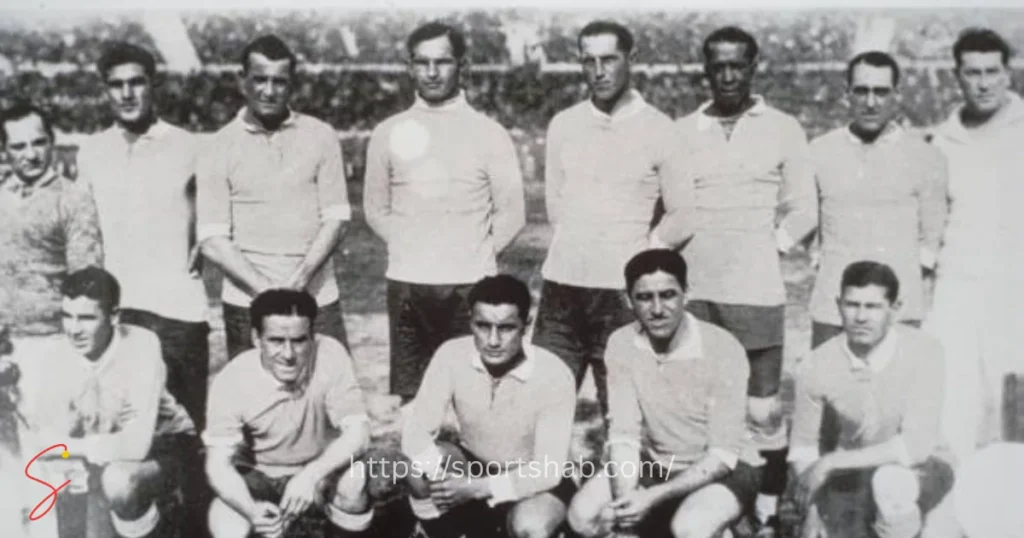
Uruguay became the first nation in history to win the FIFA World Cup after defeating neighboring Argentina 4–2 in the final on 30 July 1930.
The championship match perfectly captured everything football represents—passion, determination, rivalry, and resilience.
Argentina entered halftime leading 2–1 after responding strongly to Uruguay’s early opener. However, the hosts refused to surrender in front of their passionate supporters. Uruguay dominated the second half, scoring three unanswered goals to complete a dramatic comeback and lift the Jules Rimet Trophy for the very first time.
Captain José Nasazzi proudly became football’s first World Cup-winning captain, while Uruguay secured a place in sporting history that can never be erased.
FIFA World Cup 1930 Organized By
The FIFA World Cup 1930 was organized by the Fédération Internationale de Football Association (FIFA) under the leadership of FIFA President Jules Rimet.
Rimet dreamed of creating a global championship that would bring together the strongest football nations outside the Olympic Games. Many doubted whether such a tournament could succeed, especially during the worldwide economic depression.
Football, however, had other plans.
Despite logistical challenges and limited international travel, FIFA successfully launched what would become the world’s largest sporting event.
Today, every FIFA World Cup owes its existence to Jules Rimet’s vision and determination.
Host Nation
Uruguay earned the right to host the first FIFA World Cup after impressing FIFA with its football achievements and commitment to building world-class facilities.
The tournament took place entirely in Montevideo, with matches played at three stadiums:
- Estadio Centenario
- Estadio Pocitos
- Parque Central
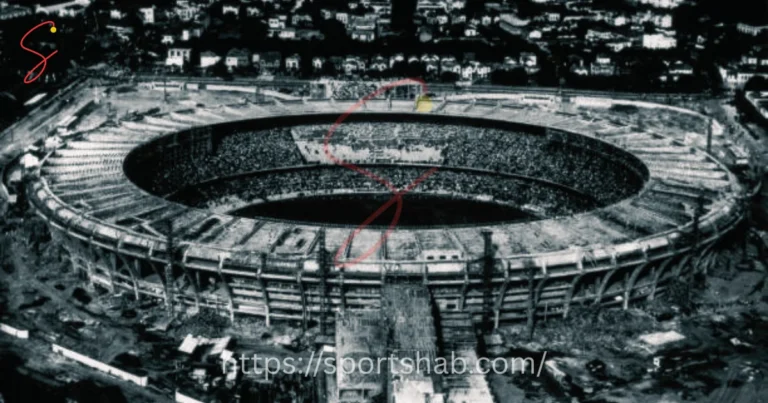
The magnificent Estadio Centenario was specially constructed to celebrate Uruguay’s centenary of independence and quickly became one of football’s most iconic venues.
Thousands of supporters packed the stadium despite difficult weather during the opening days of the tournament, proving that football already possessed an incredible ability to unite people.
FIFA World Cup 1930 Participants
The inaugural FIFA World Cup featured 13 national teams from three continents.
South America
Uruguay, Argentina, Brazil, Chile, Bolivia, Paraguay, and Peru.
Europe
France, Belgium, Romania, and Yugoslavia.
North America
United States and Mexico.
Several leading European nations chose not to participate because the long sea journey to South America required significant time and expense.
Even so, the teams that accepted the challenge helped create football history.
France earned another special place in history by playing the opening match of the tournament against Mexico.
Tournament Format
Unlike the knockout competition introduced four years later, the FIFA World Cup 1930 began with a group stage.
The thirteen teams were divided into four groups.
Three groups contained three teams, while one group included four teams.
Only the winner of each group advanced to the semi-finals.
There were:
- Group Stage
- Semi-finals
- Final
There was no Round of 16, no quarter-finals, and no third-place playoff.
The format rewarded consistency because a single disappointing performance could prevent a team from reaching the knockout stage.
Group Stage Overview
The opening stage immediately delivered excitement.
Group One
Argentina, Chile, France, and Mexico competed in the tournament’s largest group.
Argentina opened with a narrow victory over France before producing a thrilling 6–3 win against Mexico. Their final match against Chile effectively decided the group, and Argentina emerged victorious to book a place in the semi-finals.
Although France failed to qualify, the nation celebrated an everlasting achievement when Lucien Laurent scored the first goal in FIFA World Cup history during the opening match against Mexico.
Group Two
Brazil entered the competition among the favorites but suffered a surprising defeat against Yugoslavia in their opening fixture.
Yugoslavia followed that victory by comfortably defeating Bolivia to finish top of the group.
Brazil recovered by beating Bolivia, but their opening loss proved too costly.
The group reminded football fans that reputation alone never wins World Cups.
Group Three
Host nation Uruguay found themselves alongside Romania and Peru.
The opening match against Peru proved difficult, but Uruguay secured a hard-fought 1–0 victory.
Confidence grew rapidly during the second match as the hosts defeated Romania 4–0, sealing qualification for the semi-finals.
Supported by passionate crowds inside the Estadio Centenario, Uruguay looked increasingly capable of winning the inaugural championship.
Group Four
The United States became one of the biggest surprises of the tournament.
They defeated Belgium 3–0 before repeating the same scoreline against Paraguay.
Strong defending and clinical finishing carried the Americans into the semi-finals, making them one of the competition’s most unexpected success stories.
By the end of the group stage, only four nations remained:
Argentina, Uruguay, Yugoslavia, and the United States.
The inaugural FIFA World Cup had already produced stunning goals, memorable upsets, and football heroes.
Yet the biggest matches were still waiting.
The semi-finals promised fierce rivalries, enormous pressure, and the opportunity to compete for football’s greatest prize.
The world’s first World Cup champion would soon be crowned, but only one team would write its name into history forever.
FIFA World Cup 1930 Semi-Finals: Four Nations Chasing Football Immortality
The group stage had separated the contenders from the dreamers. Only four teams remained standing—Uruguay, Argentina, the United States, and Yugoslavia. Each nation had earned the right to compete for the biggest prize football had ever offered.
The atmosphere in Montevideo was electric. Thousands of supporters packed the stadiums, waving flags, singing anthems, and believing history was about to be written. Every player understood that one outstanding performance could secure a place in the first-ever FIFA World Cup Final.
The semi-finals delivered exactly what football fans hoped for—high-scoring action, dramatic moments, and commanding displays from the tournament’s two strongest teams.
Uruguay vs Yugoslavia – A Champion’s Comeback
Uruguay entered the semi-final carrying the hopes of the host nation, but the match began with an unexpected twist.
Yugoslavia stunned the home crowd by taking an early lead, briefly silencing the thousands inside the Estadio Centenario. For a moment, it looked as though one of the tournament’s biggest upsets was about to unfold.
Then the hosts responded like champions.
Uruguay increased the tempo, dominated possession, and attacked relentlessly. Pedro Cea equalized before the home side completely took control of the match.Uruguay’s attack was equally devastating when it found its rhythm.
By the final whistle, Uruguay had stormed to a remarkable 6–1 victory.
The comeback wasn’t just impressive—it sent a clear warning to Argentina that the hosts were ready for the biggest match in football history.
The crowd celebrated long after the match ended, knowing their team stood just one victory away from lifting the inaugural FIFA World Cup.
Argentina vs United States – Ruthless From Start to Finish
The second semi-final featured South American flair against North American determination.
The United States had surprised everyone by winning Group Four without conceding a goal. Their disciplined defending and quick counterattacks had earned widespread admiration.
Argentina, however, arrived with one of the tournament’s most dangerous attacking lineups.
From the opening whistle, Argentina controlled possession and dictated the pace. Their forwards created chance after chance, overwhelming the American defense with clever movement and accurate finishing.
Guillermo Stábile once again demonstrated why he was becoming the tournament’s biggest attacking star. His sharp positioning and clinical finishing helped Argentina build an unstoppable advantage.
Despite the United States fighting bravely, Argentina secured an emphatic 6–1 victory, comfortably reaching the World Cup Final.
The result confirmed what many football experts already believed.
The inaugural championship would be decided by South America’s two greatest footballing rivals.
Final Pool
Many football fans search for information about the “FIFA World Cup 1930 Final Pool.”
Historically, there was no final pool in the 1930 FIFA World Cup.
The tournament followed a straightforward structure:
The four group winners advanced directly to the semi-finals, and the two winners then met in the final.
Unlike several Olympic football competitions of that era, FIFA never used a final league or championship pool during the inaugural World Cup.
FIFA World Cup 1930 Final
Uruguay vs Argentina
On 30 July 1930, football witnessed its first World Cup Final.
The match featured two neighboring rivals whose footballing history already stretched beyond international tournaments.
An estimated crowd of nearly 70,000 supporters created one of the loudest sporting atmospheres ever experienced at the time. The rivalry between Uruguay and Argentina extended far beyond football—it was a battle for continental supremacy.
Uruguay struck first through Pablo Dorado, sending the home supporters into celebration.
Argentina refused to panic.
Carlos Peucelle equalized before Guillermo Stábile scored again to give Argentina a 2–1 halftime lead.
At halftime, the pressure rested entirely on the hosts.
Great teams, however, thrive under pressure.
Uruguay emerged after the break with renewed determination.
Pedro Cea equalized before Santos Iriarte unleashed a powerful strike that gave Uruguay the lead once again.
As Argentina pushed desperately for another equalizer, Héctor Castro delivered the decisive blow, scoring Uruguay’s fourth goal to secure a famous 4–2 victory.
The final whistle sparked unforgettable celebrations throughout Montevideo.
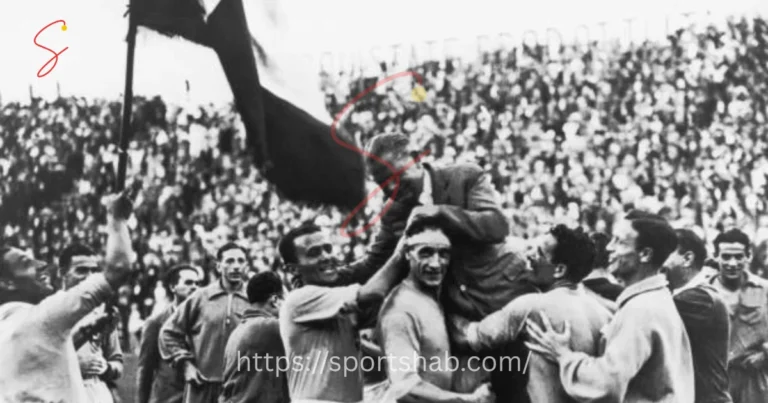
Players embraced one another, supporters flooded the streets, and Uruguay became the first FIFA World Cup champions in history.
The victory represented more than lifting a trophy.
It marked the birth of football’s greatest tradition.
FIFA World Cup 1930 Interesting Facts
The inaugural FIFA World Cup produced countless stories that continue to fascinate football supporters almost a century later.
French forward Lucien Laurent scored the very first goal in FIFA World Cup history during France’s opening match against Mexico.
The tournament featured only 13 teams, making it the smallest FIFA World Cup in history.
Uruguay built the magnificent Estadio Centenario specifically for the tournament and the country’s centenary celebrations. Today, it remains one of football’s most iconic stadiums.
European teams traveled to South America by passenger ship, spending weeks crossing the Atlantic before the tournament even began.
Another famous story surrounded the World Cup Final itself.
Both Uruguay and Argentina wanted to use their own preferred football for the championship match. As a compromise, the referee used Argentina’s ball during the first half and Uruguay’s ball during the second half.
It remains one of the most unusual moments in World Cup history.
Tournament Innovations and Firsts
The FIFA World Cup 1930 introduced countless milestones that forever changed international football.
It was the first FIFA World Cup ever organized, creating a brand-new global competition outside the Olympic Games.
It became the first major international football tournament hosted entirely by one nation under FIFA’s control.
Lucien Laurent scored the tournament’s first-ever World Cup goal.
Uruguay became the first World Cup champions.
José Nasazzi lifted the first Jules Rimet Trophy as captain.
The tournament also demonstrated that international football could attract huge crowds, worldwide media attention, and fierce national pride.
Everything football fans enjoy today began in Montevideo.
FIFA World Cup 1930 Statistics
The tournament featured 18 matches and produced 70 goals, averaging almost 3.9 goals per match.
Argentina’s Guillermo Stábile finished as the tournament’s leading scorer with eight goals, despite missing Argentina’s opening match.
His remarkable finishing ability remains one of the greatest debut performances in FIFA World Cup history.
Argentina scored the most goals during the tournament with 18, while champions Uruguay finished with 15.
Defensively, Uruguay conceded only three goals, showcasing excellent organization throughout the competition.
Goalkeepers also played an important role.
Uruguay’s Enrique Ballestrero and the United States’ Jimmy Douglas each recorded two clean sheets, the highest total during the tournament.
Many readers search for the Golden Ball, Golden Boot, and Golden Glove winners for the 1930 FIFA World Cup.
Historically, these awards did not exist.
The official record is:
- Top Scorer: Guillermo Stábile (Argentina) – 8 goals.
- Golden Ball: Not officially awarded.
- Golden Boot: Not officially awarded.
- Golden Glove: Not officially awarded.
Those individual FIFA awards were introduced decades later, so assigning them to the 1930 tournament would be historically inaccurate.
FIFA World Cup 1930 Team Squads
The inaugural World Cup brought together footballers who would become pioneers of the international game.
Uruguay’s championship-winning squad included iconic names such as José Nasazzi, Enrique Ballestrero, José Andrade, Pedro Cea, Héctor Scarone, Héctor Castro, Pablo Dorado, Santos Iriarte, and Lorenzo Fernández. Their teamwork, leadership, and determination carried the hosts to football’s first world title.
Argentina’s outstanding squad featured Guillermo Stábile, Luis Monti, Francisco Varallo, Carlos Peucelle, Juan Evaristo, Manuel Ferreira, Fernando Paternoster, and goalkeeper Juan Botasso. Their attacking football made Argentina the tournament’s highest-scoring team.
The United States impressed with players such as Jimmy Douglas, Bert Patenaude, Bart McGhee, Jimmy Gallagher, and Alexander Wood, while Yugoslavia relied on stars including Aleksandar Tirnanić, Blagoje Marjanović, and Đorđe Vujadinović during their memorable run to the semi-finals.
Brazil’s squad featured Preguinho, who scored the nation’s first-ever World Cup goal, alongside Fausto, Carvalho Leite, and Joel. France was led by Lucien Laurent, forever remembered as the scorer of the first goal in FIFA World Cup history.
Belgium, Bolivia, Chile, Mexico, Paraguay, Peru, and Romania also contributed talented squads that helped establish the World Cup as a truly international competition. Although many of those nations exited early, every player became part of football history simply by participating in the inaugural tournament.
The FIFA World Cup 1930 proved that greatness isn’t measured only by trophies. Sometimes, simply being there when history begins is an achievement that lasts forever.
Conclusion
The FIFA World Cup 1930 was more than the birth of an international football tournament—it marked the beginning of a global tradition that continues to unite billions of fans. What started in Montevideo with just 13 teams and three stadiums has grown into the world’s most celebrated sporting event, but the spirit of that first competition remains unmatched.
Uruguay’s triumph was built on courage, teamwork, and unwavering belief. From overcoming a halftime deficit against Argentina in the final to lifting the first Jules Rimet Trophy, the hosts showed the qualities that every future world champion would strive to emulate. Their victory wasn’t simply a national achievement; it became a landmark moment in football history.
The tournament also introduced legendary names that still resonate with football supporters today. José Nasazzi’s leadership, Guillermo Stábile’s incredible goalscoring run, José Andrade’s elegant midfield play, Héctor Scarone’s creativity, and Lucien Laurent’s historic first World Cup goal all became part of football folklore.
Beyond the action on the pitch, the FIFA World Cup 1930 proved that football could connect cultures, inspire nations, and create unforgettable memories. Teams crossed oceans by ship, supporters filled Montevideo’s stadiums with passion, and FIFA’s ambitious vision finally became reality.
Nearly a century later, every FIFA World Cup still carries the legacy of those remarkable weeks in Uruguay. Every opening ceremony, every dramatic final, every record-breaking performance, and every new champion traces its roots back to the inaugural tournament of 1930. It was the competition that gave football its greatest stage and gifted the sporting world a tradition that continues to grow with every generation.