FIFA World Cup 1954: Bern’s Miracle and the Day Football Defied the Script
Hungary had the goals, the unbeaten streak and a two-goal lead. West Germany had something even more dangerous belief.
1954 FIFA World Cup in Switzerland was football turned up to maximum volume. Goals flew in, underdogs punched above their weight, records tumbled, and the tournament produced one of the most astonishing finals in football history.
At the center of it all stood Hungary’s Golden Team, a side that arrived in Switzerland looking almost unbeatable. Ferenc Puskás, Sándor Kocsis, Nándor Hidegkuti and Zoltán Czibor had already established themselves as some of the most exciting players on the planet.
Hungary had gone more than four years without defeat and had demolished England 6-3 at Wembley before following it with a 7-1 victory in Budapest. FIFA describes Hungary as one of the most overwhelming pre-tournament favourites in World Cup history.
4 July 1954, Hungary raced into a 2-0 lead against West Germany in the final. Surely the trophy was already heading to Budapest?
West Germany fought back, levelled the match and scored the winner six minutes from time. Helmut Rahns 84th minute strike completed a 3-2 comeback and created what became known as the Miracle of Bern.
For Hungary, it was heartbreak. For West Germany, it was the beginning of a new footballing era. And for the World Cup, it was pure gold.
FIFA World Cup 1954 Winner
West Germany
West Germany won the 1954 FIFA World Cup, defeating Hungary 3-2 in the final at the Wankdorf Stadium in Bern.
The result was extraordinary because Hungary had already destroyed West Germany 8-3 in the group stage. The Germans were not simply facing the tournament favourites they were facing a team that had beaten them by five goals only two weeks earlier.
Yet the second meeting was a completely different story. Hungary scored twice inside the opening nine minutes through Puskás and Czibor. West Germany responded through Max Morlock and Helmut Rahn before Rahn struck again in the 84th minute.
Final score: West Germany 3-2 Hungary.
The comeback ended Hungary’s incredible 30-match unbeaten run, which FIFA notes remained an international record until Argentina surpassed it decades later. The Germans had not just won a trophy, they pulled off one of football’s greatest escapes.
FIFA World Cup 1954 Organized By
FIFA World Cup 1954 was organized by FIFA, the Fédération Internationale de Football Association.
The tournament was awarded to Switzerland at the FIFA Congress in Rio de Janeiro on 22 July 1950. The finals were eventually staged from 16 June to 4 July 1954 across six Swiss cities.The competition came only four years after the dramatic 1950 tournament in Brazil, but football had changed considerably.
The post war generation was emerging, tactical ideas were developing and several nations were beginning to build highly sophisticated attacking systems. Hungary was the greatest example.Their passing, movement and positional interchange were years ahead of what many opponents were accustomed to facing.
Host Nation: Switzerland
Switzerland hosted the 1954 FIFA World Cup, bringing the world’s best football nations together in a country that offered a compact and picturesque setting for the tournament.
Matches were played in Basel, Bern, Geneva, Lausanne, Lugano and Zürich. The opening match took place at Lausanne’s La Pontaise Stadium, while the final was played at Bern’s Wankdorf Stadium.
Switzerland also had a respectable tournament of its own. The hosts reached the quarter finals after finishing second in their group. And then they became part of one of the wildest matches in World Cup history.
Austria 7-5 Switzerland
One match,Twelve goals and Absolute chaos. FIFA currently lists Austria 7-5 Switzerland as the highest-scoring match in World Cup history. you blinked in that game, you probably missed a goal.
FIFA World Cup 1954 Participants
The 1954 World Cup featured 16 teams:
Austria, Belgium, Brazil, Czechoslovakia, England, France, Hungary, Italy, Mexico, South Korea, Scotland, Switzerland, Turkey, Uruguay, Yugoslavia and West Germany.
The tournament was therefore considerably more compact than today’s World Cup, but it featured an extraordinary concentration of talent.
Hungary brought Puskás and Kocsis.
Brazil had Didi and Nilton Santos.
Uruguay had Obdulio Varela and Juan Alberto Schiaffino.
England had Stanley Matthews and Tom Finney.
France had a young Raymond Kopa beginning to make his mark.
West Germany arrived with Fritz Walter, Max Morlock and Helmut Rahn.
The stage was loaded.
FIFA World Cup 1954 Format
The 1954 World Cup format was unusual by modern standards.
16 teams were divided into four groups of four. However, each team played only two matches in the group stage, rather than playing every opponent once.
Each group contained two seeded and two unseeded teams. Points determined who advanced, while goal difference was not used to break ties. If teams were level, a playoff was required. That rule created two additional playoff matches.
In Group B, West Germany and Turkey finished level on points, so they played again. West Germany won the playoff 7-2.
In Group D, Switzerland and Italy were also tied on points. Switzerland won their playoff 4-1.
The top two teams from each group then advanced to the quarter finals.From there, the tournament switched to traditional knockout football:
Quarter finals, Semi-finals, Third place match, and Final, It was a strange format, but it produced an unforgettable tournament.
FIFA World Cup 1954 Group Stage Overview
Group A Brazil, Yugoslavia, France and Mexico
Brazil opened their campaign with a bang, defeating Mexico 5-0.
Yugoslavia defeated France 1-0, while France later beat Mexico 3-2.
Brazil and Yugoslavia then played a 1-1 draw after extra time, leaving both sides on three points. They advanced to the quarter-finals.
Brazil had scored six goals and conceded just one.
Yugoslavia had scored twice and conceded once.
The two South American and European powers moved on, while France and Mexico were eliminated.
Group B Hungary, West Germany, Turkey and South Korea
This group was where the tournament’s fireworks really began.
Hungary demolished South Korea 9-0.
Sándor Kocsis scored three times, while Puskás added two. Hungary looked terrifying.
Then came the first meeting between Hungary and West Germany.
Hungary 8 – 3 West Germany
Eight goals, Germans scored three and Hungary looked unstoppable. West Germany recovered by beating Turkey 4 -1, but because Turkey also defeated South Korea 7-0, the two sides finished level on points. FIFA’s unusual format demanded a playoff.
West Germany 7-2 Turkey
West Germany won comfortably and advanced alongside Hungary. Few people could have imagined that these two teams would meet again in the final, and even fewer would have predicted what happened next.
Group C Uruguay, Austria, Czechoslovakia and Scotland
Defending champions Uruguay began strongly, defeating Czechoslovakia 2-0.
Austria beat Scotland 1-0.
Uruguay then destroyed Scotland 7-0, while Austria defeated Czechoslovakia 5-0.
Both Uruguay and Austria finished with maximum points and advanced.
Uruguay had not conceded a single goal in the group stage.
Austria had also kept two clean sheets. The quarter final promised fireworks.It delivered them.
Group D England, Switzerland, Italy and Belgium
England opened with a dramatic 4-4 draw against Belgium after extra time.
Switzerland defeated defending champions Italy 2-1.
England then beat Switzerland 2-0, while Italy defeated Belgium 4-1.
England finished first.
Switzerland and Italy were level on points, forcing another playoff.
Switzerland won 4-1 and knocked the defending champions out of the tournament.
Italy’s reign was over.The World Cup had a new generation of contenders.
Quarter Finals: Eight Teams
Four Tickets to the Last Four, The quarter finals produced some of the most entertaining football of the tournament.
Austria 7-5 Switzerland
This was not a football match, It was a goal avalanche.
Switzerland raced into a 3-0 lead, but Austria responded with five goals before half-time. Switzerland kept fighting, but Austria eventually prevailed 7-5.
The 12-goal thriller remains the highest-scoring match in World Cup history. Austria were through,Switzerland were out.
Uruguay 4-2 England
Uruguay’s champions continued their march.
Carlos Borges opened the scoring before England’s Nat Lofthouse equalised.
Obdulio Varela restored Uruguay’s lead just before half time.
Juan Alberto Schiaffino then made it 3-1 early in the second half.
England pulled one back through Tom Finney, but Uruguay scored again to secure a 4-2 victory.The defending champions were into the semi finals.
Hungary 4-2 Brazil
This was one of the tournament’s most physical and controversial matches.Hungary took control early and eventually defeated Brazil 4-2.
The match became known as the Battle of Bern, with both sides reduced to ten men after three players were sent off.
Hungary advanced, but the game left bruises far beyond the scoreboard.
West Germany 2-0 Yugoslavia
West Germany produced a controlled performance against Yugoslavia. An own goal gave Germany the lead before Helmut Rahn added a second late in the match.
The Germans were through to the semi finals.
And suddenly, the team that had been beaten 8-3 by Hungary was only two wins away from becoming world champion.
FIFA World Cup 1954 Semi Finals
West Germany 6-1 Austria
West Germany entered the semi final with growing confidence. Austria had scored 17 goals in its previous four matches, but Germany had an answer for everything. The Germans destroyed Austria 6-1.
Max Morlock, Ottmar Walter, Fritz Walter and Hans Schäfer were among the attacking figures driving the German machine forward.
The result sent West Germany into its first World Cup final. And waiting for them? The most feared team in the tournament.
Hungary 4-2 Uruguay After Extra Time
This was arguably the greatest match of the tournament before the final.Hungary led 2-0, but Uruguay refused to surrender.The defending champions fought back to make it 2-2 and force extra time.
Then Hungary found another gear.The Magical Magyars scored twice in extra time to win 4-2 and reach the final.Hungary were now unbeaten in 30 matches.
Hungary had scored goals for fun, defeated West Germany 8-3, beaten Brazil,eliminated the defending champions.Everything pointed toward one conclusion:Hungary would win the World Cup, Football had other plans.
FIFA World Cup 1954 Final
West Germany 3-2 Hungary
Date: 4 July 1954
Venue: Wankdorf Stadium, Bern
Attendance: approximately 62,500–65,000
Result: West Germany 3-2 Hungary
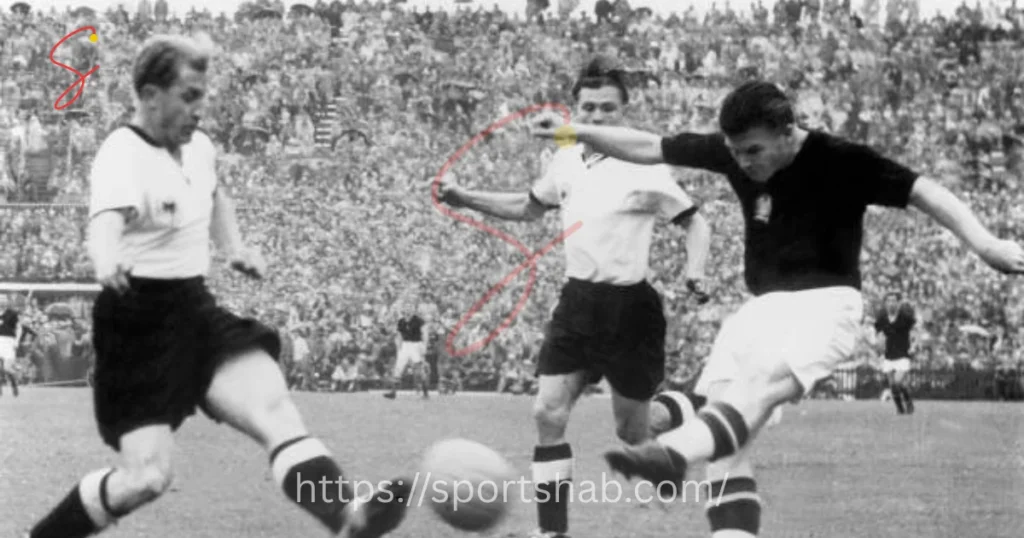
The final began like a coronation.Hungary scored twice inside the first nine minutes.Ferenc Puskás struck in the sixth minute.Zoltán Czibor made it 2-0 three minutes later.Hungary were flying.
But West Germany refused to panic.Max Morlock pulled one back in the 11th minute.Then Helmut Rahn equalised in the 18th.From 2-0 down, Germany had levelled the match in just 12 minutes.The second half became a Hungarian siege.
Puskás and Nándor Hidegkuti tested the German defence. Hungary hit the woodwork, while Toni Turek made crucial saves. FIFA records several desperate defensive interventions from West Germany as Hungary pushed for the winner.
Then, six minutes from time, Germany broke forward.
Rahn received the ball.
He shot.
Goal.
Hungary had one final chance when Puskás appeared to equalise, but the goal was ruled out for offside.The final whistle arrived, West Germany was world champion.The Miracle of Bern had done.
FIFA World Cup 1954 Interesting Facts
The 1954 tournament was stuffed with extraordinary numbers and stories.
Hungary scored a World Cup record 27 goals.
That record still stands. Hungary scored 27 goals in five matches, averaging an astonishing 5.4 goals per game.
West Germany scored 25 goals.
The champions were the second-highest-scoring team of the tournament, despite conceding 14 goals. FIFA records Hungary and West Germany as the two highest-scoring teams in a single World Cup edition.
Hungary scored nine against South Korea.
The 9-0 victory remains one of the biggest wins in World Cup history.
Hungary scored eight against West Germany.
And then lost to them in the final. That single fact tells you almost everything about the madness of 1954.
Austria 7-5 Switzerland produced 12 goals.
It remains the highest-scoring match in World Cup history.
Hungary’s unbeaten streak ended at 30 matches.
The final defeat to West Germany snapped one of football’s most remarkable unbeaten runs.
39 of the 45 teams that entered qualification actually played.
The qualifying campaign attracted 45 entries, with 36 teams ultimately participating in qualifying matches.
FIFA World Cup 1954 Tournament Innovations and Firsts
The 1954 World Cup was unusual in several ways.
The tournament used a seeded group system, meaning teams did not play every opponent in their group. That structure produced the need for playoff matches when teams finished level on points.
It also continued the use of extra time when knockout matches were level after 90 minutes.
The tournament was also the first World Cup in which the champions came from West Germany, a landmark moment for German football.
Perhaps the most important innovation, however, was not a rule change. It was tactical.Hungary’s 4-2-4 style attacking structure, fluid movement and deep-lying forward play represented a major step forward in international football.
Hidegkuti frequently dropped into deeper areas, confusing defenders who were accustomed to marking forwards more rigidly.The Germans, meanwhile, used preparation, physical conditioning and tactical adaptability to overcome Hungary.
The rain in Bern also became part of the story. West Germany’s screw in studs helped them handle the wet conditions, while the weather was famously associated with the expression “Fritz Walter weather.”
FIFA World Cup 1954 Statistics
The 1954 World Cup was arguably the most spectacularly productive tournament of its time.
There were 140 goals in 26 matches, an astonishing average of more than five goals per game.But the individual statistics were even more impressive.
Most Goals Sándor Kocsis 11 Goals
Hungary’s Sándor Kocsis finished as the tournament’s leading scorer with 11 goals.
His scoring record remains one of the most remarkable individual performances in World Cup history. FIFA lists Kocsis among the tournament’s legendary scoring leaders and notes that Hungary’s 27 goal haul remains the single edition record.
Kocsis scored:
3 against South Korea
4 against West Germany
2 against Brazil
2 against Uruguay
That’s 11 goals in four matches, and here’s the cruel twist,He scored none in the final. Hungary still scored twice, but West Germany found three.
FIFA World Cup 1954 Golden Boot
Sándor Kocsis 11 Goals
Golden Boot was not yet an official FIFA World Cup award in 1954, but if the modern award is applied retrospectively, there is absolutely no debate about the winner.
Sándor Kocsis.
Eleven goals.He outscored every other player in Switzerland.His four-goal performance against West Germany in the group stage remains particularly memorable because the same German defence eventually held Hungary to only two goals in the final.Sándor Kocsis is retrospective 1954 Golden Boot Winner.
GFIFA World Cup 1954 olden Ball
Fritz Walter retrospective Winner
The Golden Ball was not officially awarded in 1954; FIFA’s modern Player of the Tournament award came later.
For a retrospective award, however, Fritz Walter deserves serious consideration, he was the creative and emotional heartbeat of West Germany. He captained the side, orchestrated attacks and played a crucial role in the team’s tactical response to Hungary.
Fritz Walter influence was particularly obvious in the final.When Germany fell 2-0 behind, Walter helped keep the team composed rather than allowing the match to disappear.That leadership became vital as West Germany recovered.
Retrospective Golden Ball: 🇩🇪 Fritz Walter
Other legitimate contenders would include:
Sándor Kocsis 🇭🇺
Ferenc Puskás 🇭🇺
Helmut Rahn 🇩🇪
Juan Alberto Schiaffino 🇺🇾
But if the award is tied to the player who combined leadership, creativity and championship impact, Fritz Walter gets the nod.
FIFA World Cup 1954 Golden Glove
Roque Máspoli retrospective Winner
Like the Golden Ball and Golden Boot, the Golden Glove did not exist as an official World Cup award in 1954.For our retrospective award, Uruguay goalkeeper Roque Máspoli is a strong choice.
Uruguay reached the semi-finals and conceded only four goals in the group stage before losing 4-2 to Hungary after extra time. More importantly, Máspoli helped Uruguay keep two clean sheets in the tournament.That puts him among the strongest goalkeeping performers of the competition.
Retrospective Golden Glove consideration
Austria’s Walter Zeman and West Germany’s Toni Turek would also deserve consideration.Turek, in particular, produced several important saves in the final when Hungary were hammering the German goal. FIFA’s account of the match specifically highlights his crucial interventions.
Most Clean Sheets
The clean sheet race was surprisingly tight.
Austria 2 clean sheets
Uruguay 2 clean sheets
Both teams kept two clean sheets during the tournament. Austria defeated Scotland 1-0 and Czechoslovakia 5-0 without conceding. Uruguay defeated Czechoslovakia 2-0 and Scotland 7-0. Their defensive records show that this World Cup was not only about attacking madness.There were also teams capable of shutting the door completely.
FIFA World Cup 1954 Squads
The tournament allowed each nation a squad of 22 players, the same permitted squad size used at the preceding World Cups.
Rather than drowning in 352 names, we can understand the squads hrough their major players and tactical leaders.
West Germany
The champions were built around Fritz Walter, Ottmar Walter, Helmut Rahn, Max Morlock, Hans Schäfer, Werner Liebrich, Horst Eckel, Karl Mai, Jupp Posipal, Werner Kohlmeyer and goalkeeper Toni Turek.
Coach Sepp Herberger was the mastermind.
This wasn’t simply a collection of talented players. Herberger built a team capable of adapting to the opponent.
Hungary
The Magical Magyars featured perhaps the most famous attacking group of the tournament:
Ferenc Puskás, Sándor Kocsis, Nándor Hidegkuti, Zoltán Czibor, József Bozsik and Mihály Lantos, with Gyula Grosics in goal.
The squad also included József Tóth, Mihály Tóth, József Zakariás, Jenő Buzánszky and Gyula Lóránt.
Coach Gusztáv Sebes created one of the most revolutionary international teams of the twentieth century.
Austria
Austria possessed an outstanding attacking unit featuring Ernst Ocwirk, Ernst Happel, Theodor Wagner, Alfred Körner, Robert Körner, Erich Probst, Gerhard Hanappi and Walter Zeman.
They finished third after beating Uruguay 3-1.
Uruguay
The defending champions were led by captain Obdulio Varela, with Juan Alberto Schiaffino, José Míguez, Carlos Borges, Alcides Abbadie, Víctor Andrade, Matías González and goalkeeper Roque Máspoli among the major names.
Uruguay reached the semi-finals before losing 4-2 to Hungary after extra time.
Brazil
Brazil’s squad included Didi, Nilton Santos, Djalma Santos, Julinho, Pinga, Baltazar, Bauer and goalkeeper Castilho.
This was not yet the Brazil that would dominate the world in 1958, but the foundations were already visible.
England
England had stars such as Stanley Matthews, Tom Finney, Billy Wright, Stan Mortensen, Nat Lofthouse, Tom Taylor and Ronnie Clayton.
They reached the quarter-finals but were beaten 4-2 by Uruguay.
France
France’s most exciting attacking player was a young Raymond Kopa, who would later become one of European football’s biggest stars.
France also had players including Robert Jonquet, Jean Vincent and Jean-Jacques Marcel.
Italy
Italy arrived as former champions but failed to escape the group stage.
Their squad included Giampiero Boniperti, Amleto Frignani, Carlo Galli, Egisto Pandolfini, Benito Lorenzi and goalkeeper Giovanni Viola.
Czechoslovakia
Czechoslovakia featured Ladislav Novák, Jiří Trnka, Jiří Hledík and other experienced international players, but they lost both group matches and failed to score.
Turkey
Turkey produced an entertaining campaign, defeating South Korea 7-0 but losing twice to West Germany.
Lefter Küçükandonyadis was among their best known attacking players.
Mexico
Mexico included goalkeeper Antonio Carbajal, who would go on to become one of the most famous goalkeepers in World Cup history.
Belgium
Belgium’s squad included Jef Mermans, Rik Coppens and Henri Anoul.Their 4-4 draw against England was one of the tournament’s early thrillers.
Switzerland
The hosts had Robert Ballaman, Josef Hügi, Jacques Fatton and goalkeeper Georges Parlier.Their 5-7 defeat to Austria remains one of the most entertaining matches ever played at a World Cup.
Yugoslavia
Yugoslavia had an excellent technical side featuring Rajko Mitić, Stjepan Bobek, Miloš Milutinović, Zlatko Čajkovski and Vladimir Beara. They reached the quarter-finals before losing 2-0 to West Germany.
Scotland
Scotland brought players including Andy Aird, Willie Cunningham, Bobby Brown, Tommy Docherty, Eric Brown and Willie Ormond. They were eliminated after two group defeats.
South Korea
South Korea made its World Cup debut but faced one of the toughest possible assignments. Hungary defeated them 9-0, followed by Turkey’s 7-0 victory. Despite the results, simply reaching the World Cup stage represented an important moment for Korean football.
FIFA World Cup 1954: Tournament That Changed Football’s Story
1954 FIFA World Cup was supposed, belong to Hungary.
The numbers practically screamed it.
31 matches unbeaten.
27 World Cup goals.
Sándor Kocsis with 11 goals.
A 9-0 opening victory.
An 8-3 demolition of West Germany.
A 4-2 victory over Brazil.
A 4-2 extra-time victory over defending champions Uruguay.
Then Hungary reached the final, they scored twice in nine minutes, and still lost. That’s what makes the 1954 World Cup so unforgettable.West Germany did not have the most spectacular attack, nor did they have the tournament’s top scorer and the longest unbeaten streak but Hungary.
But when the rain came down in Bern and the pressure reached boiling point, Fritz Walter, Helmut Rahn, Max Morlock and their teammates refused to surrender.Rahn’s 84th-minute goal turned sporting expectation upside down. The final whistle confirmed the impossible. West Germany 3-2 Hungary.
The Miracle of Bern wasn’t simply an upset. It was a reminder that football doesn’t award trophies for reputation, statistics or predictions. Hungary had the magic, West Germany had the moment and on 4 July 1954, the World Cup belonged to West Germany.