
FIFA World Cup 1982: Italy’s Great Impossible Comeback, Paolo Rossi’s Golden Redemption.
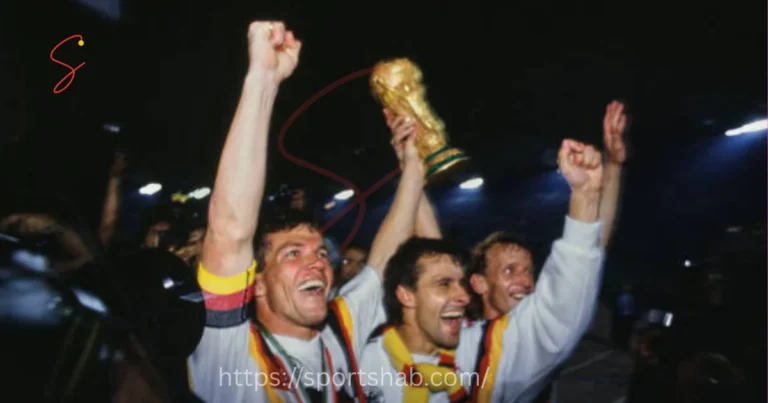
Caption: When Brazil dazzled, France battled and Italy stumbled, nobody expected the Azzurri to rule Madrid but football had one more twist in store.
The FIFA World Cup 1982 was a tournament that refused to follow the script.
Italy arrived in Spain with enormous expectations but almost no momentum. Brazil played some of the most attractive football of the tournament. France produced a thrilling attacking side. Algeria stunned one of Europe’s giants. Cameroon left the competition unbeaten. And West Germany survived one of the wildest semi-finals ever witnessed at a World Cup.
But when the dust finally settled in Madrid, Italy were champions.
Their hero was a striker who had spent the opening phase of the tournament without scoring a single goal.
His name was Paolo Rossi.
Paolo Rossi found his magic at exactly the right moment. After a quiet start to the tournament, the Italian striker came alive when the pressure was at its highest. He fired a stunning hat-trick against Brazil, added two more goals in the semi-final against Poland, and then opened the scoring against West Germany in the final. Six goals across three crucial matches turned Rossi from a player under scrutiny into Italy’s undisputed hero. His remarkable run earned him both the 1982 Golden Ball and Golden Boot.
That is the beauty of football.
Sometimes the player everyone is questioning becomes the player everyone remembers.
1982 World Cup was also historic because it expanded from 16 to 24 teams for the first time. 52 matches, 146 goals and teams from five continents in the world cup.
So buckle up.
This is the story of the 1982 FIFA World Cup a tournament of shocks, controversy, beautiful football, unforgettable goals and one spectacular Italian comeback.
FIFA World Cup 1982 Winner
Italy World Champions for the Third Time
defeating West Germany 3-1 in the final at Madrid’s Santiago Bernabéu Stadium on 11 July 1982 Italy won the 1982 FIFA World Cup, It was Italy’s third World Cup triumph.
The road to the trophy was anything but comfortable.
Italy opened the tournament with three straight draws. They drew 0-0 with Poland, 1-1 with Peru and 1-1 with Cameroon. Yet they squeezed through to the next phase because they had scored more goals than Cameroon after the teams finished level on points and goal difference.
It was hardly the beginning of a championship campaign.
Then came the second round.
Italy defeated Argentina 2-1 before meeting Brazil in what became one of the greatest World Cup matches ever played.
Brazil had the stars.
Italy had Rossi.
Italians won 3-2 with Rossi scoring all three goals.
After beating Poland 2-0 in the semi-final, Italy reached the final against West Germany.
Rossi scored again.
Marco Tardelli followed.
Alessandro Altobelli added another.
West Germany pulled one back through Paul Breitner, but Italy held firm.
Italy 3-1 West Germany.
The Azzurri had gone from struggling outsiders to world champions.
FIFA World Cup 1982 Organized By
FIFA
The 1982 FIFA World Cup was organized by FIFA, the international governing body of association football.
It was the 12th edition of the FIFA World Cup, staged in Spain from June to July 1982.
FIFA’s decision reflected the growth of football around the world and allowed more nations from Africa, Asia, Central America and Oceania to compete at the highest level. The expansion to 24 teams represented a major moment in the history of the competition.
And the new arrivals weren’t there simply to make up the numbers.
Algeria defeated West Germany.
Cameroon went unbeaten.
Honduras held Spain to a draw.
New Zealand made its World Cup debut.
Kuwait produced one of the tournament’s strangest moments.
The football map was getting bigger.
FIFA World Cup 1982 Host
Spain
Spain hosted the 1982 FIFA World Cup.
Matches were played across the country, with major venues in cities such as Madrid, Barcelona, Seville, Bilbao and Valencia.
final took place at Santiago Bernabéu Stadium in Madrid, Italy 3-1 West Germany.
Spain entered the competition hoping home advantage could inspire a deep run.
It didn’t quite happen.
The hosts survived the first group stage but were eliminated during the second phase.
Instead, Spain watched Italy, Brazil, France, Poland and West Germany battle for the trophy.
And what a battle it became.
FIFA World Cup 1982 Participants
The 24 Nations That Reached Spain
The 1982 World Cup was the first edition to feature 24 teams.
The participants were Algeria, Argentina, Austria, Belgium, Brazil, Cameroon, Chile, Czechoslovakia, El Salvador, England, France, Honduras, Hungary, Italy, Kuwait, New Zealand, Northern Ireland, Peru, Poland, Scotland, Spain, the Soviet Union, Yugoslavia and West Germany.
World Cup finals debut: Algeria, Cameroon, Honduras, Kuwait and New Zealand.
The expanded field was more than a numbers game.
It gave emerging football nations an opportunity to test themselves against the traditional giants.
And some of them made sure the giants remembered their names.
FIFA World Cup 1982 Format
The 24 Team Experiment
The tournament format was unlike anything that had come before.
The 24 teams were divided into six groups of four. Each team played the other three teams in its group, with the top two advancing.
That produced 12 second-round qualifiers.
Those 12 teams were then divided into four groups of three.
winner of each second round group reached the semi finals.
From there, the tournament followed a more familiar knockout route:
Semi finals, third place match, final.
It was an unusual structure and was used only once.
FIFA abandoned the second group stage From 1986 onward, and introduced a Round of 16.
So if you’re studying the evolution of the World Cup, Spain 1982 is a fascinating turning point.
FIFA World Cup 1982 Group Stage Overview
Group 1 Poland, Italy, Cameroon and Peru
Italy’s opening campaign was anything but convincing.
They drew 0-0 with Poland, 1-1 with Peru and 1-1 with Cameroon.
Three matches.
Three draws.
Three goals scored.
Three goals conceded.
Paolo Rossi failed to score.
Italy eventually advanced alongside Poland because their goals scored were enough to separate them from Cameroon.
Nobody looking at that group would have confidently predicted Italy would lift the trophy.
But World Cups aren’t won by predictions.
They’re won on the pitch.
Group 2 West Germany, Austria, Algeria and Chile
This group delivered one of the tournament’s biggest shocks.
Algeria defeated West Germany 2-1.
The debutants showed absolutely no fear against one of Europe’s established powers.
Algeria also defeated Chile, giving themselves a genuine chance of progressing.
But controversy followed.
West Germany defeated Austria 1-0 in their final group match, a result that sent both European teams through while eliminating Algeria.
Because the result suited both sides, the game became infamous as the “Disgrace of Gijón.”
The controversy eventually influenced FIFA’s tournament planning. From later World Cups, decisive final group matches were scheduled simultaneously to reduce the possibility of teams manipulating results according to their qualification interests.
Group 3 Argentina, Belgium, Hungary and El Salvador
Defending champions Argentina suffered an early setback, losing 1-0 to Belgium.
Diego Maradona then announced himself with two goals against Hungary as Argentina won 4-1.
They defeated El Salvador 2-0 but finished behind Belgium.
Their title defence eventually ended during the second round after defeats against Italy and Brazil.
Maradona had shown flashes of brilliance, but Argentina were unable to repeat their 1978 success.
Group 4 England, France, Czechoslovakia and Kuwait
England started strongly.
They defeated France 3-1, with Bryan Robson scoring one of the tournament’s memorable early goals.
England then beat Czechoslovakia 2-0 before drawing 0-0 with Kuwait.
France recovered and advanced with England.
Kuwait, meanwhile, became involved in one of the strangest incidents of the tournament when their players stopped during a match against France after hearing a whistle from the crowd.
The episode remains one of the more bizarre moments in World Cup history.
Group 5 Spain, Northern Ireland, Yugoslavia and Honduras
Spain struggled to turn home advantage into dominance.
The hosts drew 1-1 with Honduras, defeated Yugoslavia 2-1 and drew 0-0 with Northern Ireland.
Northern Ireland topped the group.
Group also etched its name into the history books when Northern Ireland’s Norman Whiteside stepped onto the pitch at just 17 years and 41 days old — making him the youngest player ever to grace a World Cup stage.
Group 6 Brazil, Soviet Union, Scotland and New Zealand
Brazil looked like a machine.
They defeated the Soviet Union 2-1.
Then they dismantled Scotland 4-1.
New Zealand were beaten 4-0.
Brazil 10 goals scored and only two conceded finished top of the group.
Zico was flying.
Sócrates was controlling the midfield.
Falcão was pulling strings.
Éder was producing spectacular attacking moments.
Brazil looked like the team to beat.
Then Italy arrived.
FIFA World Cup 1982 Final Pool
The Second Group Stage
The second phase contained four groups of three.
Only the group winners could reach the semi-finals.
This was where the tournament caught fire.
Group A Poland, Soviet Union and Belgium
Poland defeated Belgium 3-0, with Zbigniew Boniek scoring a hat-trick.
They then drew 0-0 with the Soviet Union.
Poland advanced to the semi-finals.
Boniek was becoming one of the most dangerous attackers in the competition.
Group B West Germany, England and Spain
England and West Germany played out a 0-0 draw.
West Germany then defeated Spain 2-1.
England were eliminated despite remaining unbeaten.
West Germany moved into the semi-finals.
For England, it was a painful tournament.
No defeat.
No semi-final.
That’s football.
Group C Italy, Brazil and Argentina
This was the group that produced the tournament’s defining match.
Italy defeated Argentina 2-1.
Brazil then beat Argentina 3-1.
That meant Brazil only needed a draw against Italy to advance.
Italy had to win.
The stage was set.
Italy 3-2 Brazil The Match That Changed Everything
Brazil were expected to advance.
They had played dazzling football.
Italy had struggled.
But Paolo Rossi had finally found his rhythm.
Rossi opened the scoring.
Brazil equalised through Sócrates.
Rossi struck again.
Falcão equalised.
Then Rossi completed his hat-trick.
Italy 3-2 Brazil.
Brazil attacked desperately for another equaliser.
It never came.
The final whistle sent Italy into the semi-finals and Brazil home.
Rossi’s hat trick describes as one of the defining performances of the tournament.
It was the moment everything changed.
The quiet Italian striker had become the tournament’s biggest story.
Group D France, Austria and Northern Ireland
France won the group after defeating Austria 1-0 and Northern Ireland 4-1.
Michel Platini was at the centre of their attacking play.
France advanced to the semi-finals.
And then came one of the most dramatic nights in World Cup history.
FIFA World Cup 1982 Semi Finals
Italy 2-0 Poland
Italy faced Poland in Barcelona.
By now, Paolo Rossi was on fire.
He scored in the 22nd minute.
Then he struck again in the 73rd.
Italy 2-0 Poland.
Rossi had now scored five goals in his previous two matches.
Italy were heading to the final.
The man who had entered the tournament without a goal was suddenly one of the most feared forwards in Spain.
West Germany 3-3 France, West Germany Win 5-4 on Penalties
The other semi-final was pure football theatre.
West Germany scored first through Pierre Littbarski.
Michel Platini equalised from the penalty spot.
Then extra time produced madness.
France moved 3-1 ahead through Marius Trésor and Alain Giresse.
Surely it was over.
Not quite.
Karl-Heinz Rummenigge pulled one back.
Klaus Fischer equalised.
3-3.
The match went to penalties.
West Germany eventually won the shootout 5-4.
Harald Schumacher made crucial saves.
Germany were in the final.
France were heartbroken.
The match remains in World Cup history one of the most dramatic semi finals.
FIFA World Cup 1982 Final
Italy 3-1 West Germany
11 July 1982. Santiago Bernabéu, Madrid.
Italy and West Germany arrived at the final after completely different journeys.
Italy had struggled early.
West Germany had survived controversy and drama.
Now there was only one prize.
The first half ended goalless.
Then Paolo Rossi changed the game.
Paolo Rossi 57th Minute
Rossi headed Italy into the lead.
1-0 Italy.
His sixth goal of the tournament had arrived at exactly the right moment.
Then came Marco Tardelli.
Marco Tardelli 69th Minute
Tardelli doubled Italy’s advantage.
2-0.
His celebration became one of the most iconic scenes in World Cup history.
Arms pumping.
Face screaming with emotion.
He knew Italy were getting close.
Very close.
Alessandro Altobelli 81st Minute
Altobelli made it 3-0.
West Germany were in serious trouble.
Paul Breitner scored two minutes later, but it was only a consolation.
Italy 3-1 West Germany.
The final whistle, Italy was world champions.
Captain Dino Zoff lifted the trophy at the age of 40.
Italy had won their third World Cup.
And Paolo Rossi had completed perhaps the greatest individual turnaround in World Cup history.
FIFA World Cup 1982 Interesting Facts
Paolo Rossi went from zero goals to Golden Boot
Before Italy’s fifth match, Rossi had scored zero goals.
Zico, Rummenigge and Boniek had already scored four each.
Then Rossi scored three against Brazil, two against Poland and one against West Germany.
Six goals.
Three matches.
Golden Boot.
Golden Ball.
FIFA World Cup 1982 champion.
That is some turnaround.
Brazil scored 15 goals but didn’t reach the semi-finals
Brazil’s attacking football was one of the tournament’s biggest attractions.
They scored 15 goals but were eliminated by Italy in the second round.
It remains one of football’s classic examples of a brilliant team meeting an opponent at exactly the wrong moment.
Cameroon finished unbeaten
Cameroon drew all three of their first-round matches and were eliminated without losing.
They had become one of the tournament’s surprise stories.
Their goalkeeper Thomas N’Kono also emerged as one of the competition’s standout performers.
Algeria shocked West Germany
A World Cup debutant defeating one of the strongest European teams was a huge statement.
Algeria’s victory over West Germany demonstrated that the expanded tournament could produce genuine competitive shocks.
Norman Whiteside made history
At 17 years and 41 days, Whiteside became the youngest player to appear at a World Cup.
That record made the Northern Ireland teenager an instant part of tournament history.
Tournament Innovations and Firsts
The World Cup expanded to 24 teams
Spain 1982 was the first World Cup with 24 participating nations.
The expansion helped football become more representative of the global game.
The second group stage made its debut
Twelve teams advanced from the opening round into four groups of three.
Only the four group winners reached the semi-finals.
FIFA used the system only once, It was a bold experiment.
The 1982 tournament helped reshape group-stage scheduling
The controversial West Germany-Austria match exposed a weakness in the tournament structure.
Later World Cups adopted simultaneous final group matches to reduce the incentive for teams to manipulate qualification scenarios.
The Golden Boot began in 1982
There is another interesting award detail.
The tournament’s top-scorer prize Golden Shoe was first awarded in 1982, later FIFA renamed it the Golden Boot in 2010.
So when modern articles call Rossi the 1982 Golden Boot winner, that is understandable, but historically, the award was called the Golden Shoe at the time.
FIFA World Cup 1982 Statistics
The tournament by the numbers
The 1982 FIFA World Cup featured:
24 teams
52 matches
146 goals
17 venues
2.81 goals per match,The tournament averaged.
France scored the most goals overall with 16, with those goals coming from 10 different players.
Italy scored 12 goals during their title-winning campaign.
Brazil scored 15.
West Germany scored 12.
Poland scored 11.
And Paolo Rossi led all players with six.
Top Scorer
Paolo Rossi, Italy, 6 goals
Rossi scored three against Brazil, two against Poland and one in the final against West Germany.
He didn’t simply score goals.
He scored them when Italy’s World Cup was on the line.
Golden Ball
Paolo Rossi , Italy
Rossi won the adidas Golden Ball as the tournament’s best player.
Falcão of Brazil won the Silver Ball, while Karl-Heinz Rummenigge of West Germany received the Bronze Ball.
Golden Boot
Paolo Rossi, Italy, 6 goals
Golden Shoe in 1982 and was later renamed the Golden Boot. Rossi’s six goals made him the tournament’s leading scorer.
Golden Glove
There was no official FIFA Golden Glove award in 1982.
That distinction matters.
The modern goalkeeper award came later, so it would be historically inaccurate to say that Dino Zoff, Peter Shilton or another goalkeeper officially won the 1982 Golden Glove.
Peter Shilton recorded four clean sheets in five appearances, one of the best goalkeeper records in World Cup.
Most Clean Sheets
Peter Shilton, England, 4
Peter Shilton was an absolute wall between the sticks for England, keeping four clean sheets in five matches, a remarkable feat that FIFA’s own goalkeeper records still recognize from that 1982 campaign.
The achievement is even more impressive because England conceded only once throughout the tournament.
FIFA World Cup 1982 Squads
Italy
Italy’s champion squad was built around experienced leaders and technically gifted attackers.
Key names included Dino Zoff, Claudio Gentile, Gaetano Scirea, Fulvio Collovati, Giuseppe Bergomi, Antonio Cabrini, Marco Tardelli, Gabriele Oriali, Bruno Conti, Francesco Graziani, Alessandro Altobelli and Paolo Rossi.
The manager was Enzo Bearzot, whose decision to continue trusting Rossi became one of the great managerial calls in World Cup history.
West Germany
West Germany relied on players including Harald Schumacher, Hans-Peter Briegel, Paul Breitner, Uli Stielike, Pierre Littbarski, Klaus Fischer, Karl-Heinz Rummenigge and Horst Hrubesch.
Rummenigge finished with five goals, but Germany fell short in Madrid.
Poland
Poland featured Józef Młynarczyk, Władysław Żmuda, Zbigniew Boniek, Grzegorz Lato, Andrzej Szarmach, Stefan Majewski and Andrzej Kupcewicz.
Boniek’s four goals helped Poland reach the semi-finals, where Italy proved too strong.
Brazil
Brazil’s celebrated squad included Waldir Peres, Leandro, Oscar, Luizinho, Júnior, Toninho Cerezo, Sócrates, Falcão, Zico, Serginho and Éder.
They were arguably the tournament’s most entertaining side.
But football does not hand out trophies for style points.
Italy eliminated them.
France
France had a superb generation led by Michel Platini, Alain Giresse, Jean Tigana, Marius Trésor, Maxime Bossis, Dominique Rocheteau and Didier Six.
They reached the semi-finals and pushed West Germany all the way to penalties.
Argentina
The defending champions featured Ubaldo Fillol, Daniel Passarella, Osvaldo Ardiles, Mario Kempes and Diego Maradona.
Maradona scored twice against Hungary, but Argentina’s title defence ended in the second round.
England
England’s squad included Peter Shilton, Terry Butcher, Phil Thompson, Kenny Sansom, Ray Wilkins, Bryan Robson, Glenn Hoddle, Trevor Francis and Paul Mariner.
England finished unbeaten but failed to reach the semi-finals.
Algeria
The debutants were led by players such as Rabah Madjer, Lakhdar Belloumi, Salah Assad and Ali Fergani.
Their victory over West Germany made them one of the tournament’s breakout stories.
Cameroon
Thomas N’Kono was among the stars of a disciplined Cameroon team that remained unbeaten.
Their three draws were enough to create a lasting impression, even though they did not progress.
Spain
The hosts included Luis Arconada, José Camacho, Antonio Maceda, Juanito and Santillana.
Spain reached the second phase but failed to advance further.
Other Participants
The remaining tournament squads represented Austria, Belgium, Chile, Czechoslovakia, El Salvador, Honduras, Hungary, Kuwait, New Zealand, Northern Ireland, Peru, Scotland, the Soviet Union and Yugoslavia.
Together, these 24 teams helped make Spain 1982 one of the most geographically diverse World Cups of its era.