FIFA World Cup 1998: France’s Night of Glory, Zidane’s Double and the Birth of a New World Champion
One nation waited decades for its moment. One midfielder rose on the biggest night. And when the final whistle echoed through Paris, France had finally conquered the world.
The FIFA World Cup 1998 was the tournament when football’s map suddenly became bigger, the pressure became heavier and France finally got its hands on the trophy.
Played in France from 10 June to 12 July 1998, the 16th FIFA World Cup introduced a major change to the competition, for the first time, 32 teams competed in the finals. The expanded field brought more nations, more matches, more stories and a wider global audience.
And what a tournament it was.
One tournament. One trophy. Thirty-two nations. Sixty-four matches. And one unforgettable night when Zidane’s two headers helped France turn home advantage into football immortality
But the road to that night at the Stade de France was anything but simple.
There were golden goals, penalty shootouts, shock eliminations, spectacular individual performances and one of the most surprising semi-finalists football had seen in years.
This is the story of the FIFA World Cup 1998.
FIFA World Cup 1998 Winner
France Lift the Trophy on Home Soil
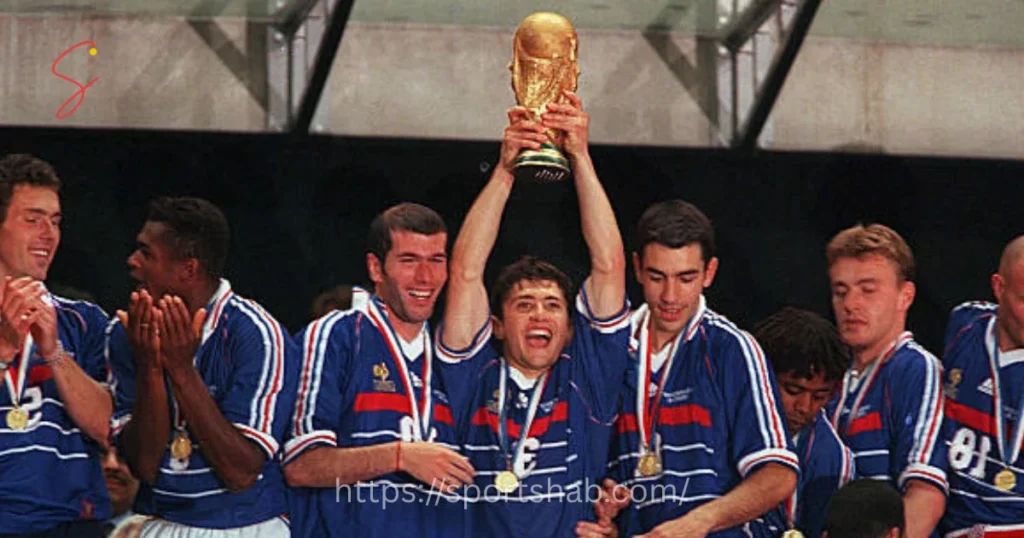
France was the winner of the 1998 FIFA World Cup.
They defeated defending champions Brazil 3-0 in the final at the Stade de France in Saint-Denis on 12 July 1998.
It was France’s first World Cup championship and made them the seventh nation to win the competition. They also became the sixth country to win the World Cup on home soil.
The victory was especially meaningful because France had waited a long time for this moment.
Before 1998, France had reached in three World Cup semi finals, 1958, 1982 and 1986, but had never made the final.
This time, there would be no heartbreak.
No missed opportunity.
No “maybe next time.”
France had arrived.
And when the biggest match came, they delivered.
FIFA World Cup 1998 Organized By
The 1998 FIFA World Cup was organized by FIFA, the international governing body of association football.
France had been selected as host on 2 July 1992, beating Morocco in the bidding process. It was the second time after sixty years France had hosted FIFA World Cup, previously was 1938 tournament.
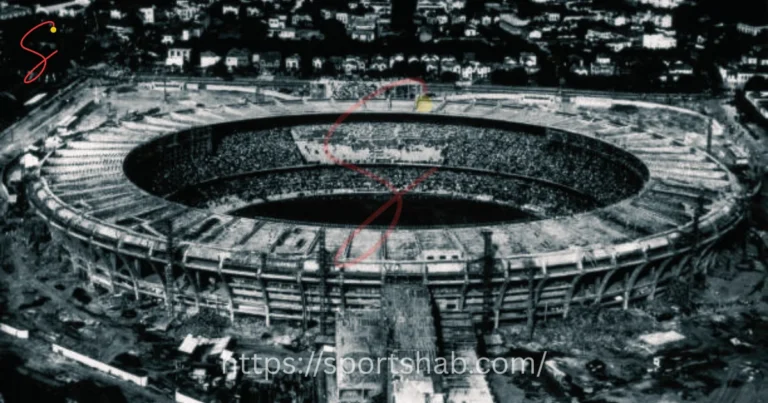
The tournament was played across 10 stadiums in 10 host cities, with the newly constructed Stade de France in Saint-Denis becoming the centerpiece of the competition.
The opening match and final were both staged at the Stade de France.
It was more than a stadium.
It became the stage on which French football history was rewritten.
FIFA World Cup 1998 Host
France
France hosted the 1998 FIFA World Cup from 10 June to 12 July 1998.
Ten cities welcomed the world’s best national teams, while millions of supporters travelled across the country to experience the tournament.
For the host nation, expectations were enormous.
France had talented players, but there was still uncertainty surrounding the team. Brazil were the defending champions and were widely considered the strongest side in the competition.
So the pressure was real.
The French players had to answer one question every time they stepped onto the pitch:
Could they actually win it?
By 12 July, there was no question left.
FIFA World Cup 1998 Participants
The 1998 tournament featured 32 national teams, the first World Cup to expand from 24 teams to 32.
The teams were divided into eight groups of four.
The participants were:
Group A: Brazil, Scotland, Morocco and Norway.
Group B: Italy, Chile, Austria and Cameroon.
Group C: France, Denmark, South Africa and Saudi Arabia.
Group D: Nigeria, Paraguay, Spain and Bulgaria.
Group E: Netherlands, Mexico, Belgium and South Korea.
Group F: Germany, Yugoslavia, Iran and the United States.
Group G: Romania, England, Colombia and Tunisia.
Group H: Argentina, Croatia, Jamaica and Japan.
Croatia, Jamaica, Japan and South Africa Four nations made their World Cup debuts.
Croatia would go much further than anyone could reasonably expect.
The newly independent nation reached the semi-finals and eventually finished third.
Japan, South Africa and Jamaica did not make the knockout stage, but their participation reflected the increasingly global nature of the World Cup.
The tournament was getting bigger.
And the football world was getting harder to predict.
FIFA World Cup 1998 Format
The 32-Team Revolution
The biggest structural change at France 1998 was the expansion from 24 teams to 32.
The format was straightforward.
The 32 teams were divided into eight groups of four. Each team played three group-stage matches.
Three points were awarded for a victory, one for a draw and zero for a defeat.
The top two teams from each group advanced to the Round of 16.
From there, the competition became a straight knockout tournament:
Round of 16 → Quarter-finals → Semi-finals → Third-place match → Final.
The expansion meant that the 1998 World Cup contained 64 matches, compared with 52 in 1994 there was an extra 12 matches.
Another major innovation was the use of the golden goal during extra time in knockout matches.
The first famous example arrived when France faced Paraguay in the Round of 16.
Laurent Blanc scored the decisive golden goal in the 114th minute, sending France into the quarter finals. FIFA describes the goal as the first golden goal at a World Cup.
Suddenly, extra time was no longer simply about surviving until penalties.
One touch could end everything.
One mistake could send you home.
That changed the tension dramatically.
FIFA World Cup 1998 Group Stage Overview
Group A: Brazil Start Strong, Norway Sneak Through
Brazil opened the tournament with a 2–1 victory over Scotland.
They followed it with a comfortable 3–0 win against Morocco.
But then came the surprise.
Norway defeated Brazil 2–1 in their final group match.
Brazil still finished first with six points, while Norway advanced in second with five. Morocco finished third with four points, despite also winning a match. Scotland were eliminated with one point.
Norway’s qualification was a reminder that even the tournament favorite could be pushed around.
Group B: Italy Stay Unbeaten
Italy topped Group B with seven points.
The Azzurri drew 2–2 with Chile before defeating Cameroon 3–0 and Austria 2–1.
Chile finished second despite drawing all three of their matches.
Austria and Cameroon went home.
Italy had not produced breathtaking football, but they had done something very Italian:
They kept finding ways to get results.
Group C: France Cruise Through
The hosts were perfect.
France defeated South Africa 3–0, Saudi Arabia 4–0 and Denmark 2–1.
Three matches.
Three victories.
Nine points.
Nine goals scored.
conceded only one goal.
Thierry Henry began to announce himself on the international stage, while the French midfield and defense demonstrated the balance that would eventually carry them to the trophy.
Denmark finished second and also advanced.
South Africa took third.
Saudi Arabia finished fourth.
Group D: Nigeria Surprise Spain
Group D delivered one of the tournament’s biggest group-stage shocks.
Nigeria defeated Spain 3–2 in their opening match.
That result immediately put the Super Eagles on the football map.
Nigeria eventually won the group with six points, followed by Paraguay with five. Spain finished third despite scoring eight goals, while Bulgaria ended with one point.
Spain’s early exit was one of the tournament’s great disappointments.
Group E: Netherlands and Mexico Refuse to Separate
The Netherlands drew all three group matches.
They drew 0–0 with Belgium, beat South Korea 5–0 and then drew 2–2 with Mexico.
Mexico also finished unbeaten, winning once and drawing twice.
The Netherlands topped the group on goals scored, while Mexico finished second.
It was tight, unpredictable and exactly the kind of group that kept fans doing mental arithmetic.
Group F: Germany and Yugoslavia Advance
Germany finished top with seven points.
They defeated the United States 2–0, drew 2–2 with Yugoslavia and beat Iran 2–0.
Yugoslavia also finished with seven points but took second place.
Iran earned three points.
The United States lost all three games.
The Germans had survived the group stage, but they were already showing signs that this was not the same dominant machine of previous generations.
Group G: Romania Top England
Romania won Group G with seven points.
England finished second with six.
The two sides met in one of the group’s key games, with Romania winning 2–1.
Colombia finished third, while Tunisia ended fourth.
England advanced, but their route ahead would become considerably more dramatic.
Group H: Argentina Perfect, Croatia Impress
Argentina won all three matches and finished with nine points.
They defeated Japan 1–0, Jamaica 5–0 and Croatia 1–0.
Croatia finished second with six points.
Jamaica won one match and finished third,Japan lost all three games.
Croatia’s qualification was only the beginning.
The new nation was about to make history.
FIFA World Cup 1998 Final Pool and Knockout Stage
There was no separate final pool at the 1998 World Cup.
After the group stage, the competition moved directly into the Round of 16.
The knockout stage immediately produced drama.
Italy defeated Norway 1–0.
Brazil beat Chile 4–1.
France needed a golden goal from Laurent Blanc to defeat Paraguay 1–0.
Denmark crushed Nigeria 4–1.
Germany came from behind to beat Mexico 2–1.
The Netherlands defeated Yugoslavia 2–1.
Croatia beat Romania 1–0.
Argentina and England produced one of the tournament’s most entertaining matches, finishing 2–2 before Argentina won 4–3 on penalties.
Then came the quarter finals.
France defeated Italy on penalties after a 0–0 draw.
Brazil beat Denmark 3–2.
The Netherlands defeated Argentina 2–1.
And Croatia shocked Germany 3–0.
That result changed the tournament.
Croatia were no longer a cute underdog story.
They were genuine contenders.
FIFA World Cup 1998 Semi Finals
Brazil 1–1 Netherlands: Brazil Survive the Shootout
Brazil and the Netherlands met in Marseille on 7 July.
Ronaldo opened the scoring for Brazil.
Patrick Kluivert eventually equalized for the Dutch.
Neither side could find another goal during extra time.
So, once again, penalties decided the outcome.
Brazil won on penalties in a shootout 4–2.
The Netherlands had pushed the defending champions all the way.
But Brazil were heading back to the final.
They were one match away from defending their crown.
France 2–1 Croatia: Thuram Becomes the Unexpected Hero
The second semi final produced one of the strangest individual stories of the tournament.
Croatia took the lead through Davor Šuker.
Then France responded.
Not through Zidane.
Not through Henry.
Not through Djorkaeff.
Through Lilian Thuram.
Thuram had scored only once for France before the match.
Then he scored two in the biggest game of his career.
Football had found another hero.
FIFA World Cup 1998 Final: France vs Brazil
Zidane Writes His Name Into Football History at France vs Brazil 1998 World Cup final.
The final took place at the Stade de France on 12 July 1998.
France faced Brazil.
The defending champions had Ronaldo, Rivaldo, Cafu, Roberto Carlos and Dunga.
France had Zidane, Deschamps, Thuram, Marcel Desailly, Emmanuel Petit and Fabien Barthez.
The pre-match focus was heavily influenced by Ronaldo’s condition after an alarming episode before kickoff. He eventually played, but Brazil never looked like the same attacking force that had carried them through the tournament.
France smelled blood.
And they attacked the moment.
In the 27th minute, Zinedine Zidane headed France into the lead.
The crowd erupted.
Brazil looked rattled.
Then, just before halftime, Zidane did it again.
Another header.
Another goal.
France led 2–0.
Two set pieces.
Two headers.
Two punches to Brazil’s championship dream.
The second half became a test of nerve.
Brazil pushed.
France defended.
Marcel Desailly was sent off after receiving a second yellow card, leaving France with ten men.
But the French defense refused to crack.
Then, deep into stoppage time, Emmanuel Petit raced forward and finished the counterattack.
France 3–0 Brazil.
Game over.
World champions.
France had conquered the World Cup, For the first time in history.
And Zidane?
He had just turned a final into a legend.
FIFA World Cup 1998 Interesting Facts
France Conceded Only Two Goals
France were extraordinarily difficult to break down.
The champions conceded only two goals in seven matches. FIFA notes that this was a record low total at the time, later equaled by Italy in 2006 and Spain in 2010.
The French defense was not simply good.
It was suffocating.
France Had Five Clean Sheets
Fabien Barthez recorded five clean sheets during the tournament, he conceded only two goals across seven appearances
France build one of the strongest defensive campaigns in World Cup history.
Croatia Finished Third at Their First World Cup
Croatia’s 1998 campaign was extraordinary.
Playing in their first World Cup, they reached the semi finals.
A debut.
A semi-final.
A bronze medal.
Not bad.
Davor Šuker Won the Golden Boot
Croatia’s star striker scored six goals and finished as the tournament’s leading scorer.
Suker the 1998 adidas Golden Boot winner.
His goals helped Croatia become the tournament’s surprise package.
Ronaldo Won the Golden Ball
Brazil’s Ronaldo was named the tournament’s Golden Ball winner, despite Brazil losing the final.
Davor Suker also received the Silver Ball and Lilian Thuram the Bronze Ball.
That tells you how highly Ronaldo’s tournament was regarded.
Michael Owen Was the Best Young Player
England’s teenage striker Michael Owen won the Best Young Player Award.
His breathtaking goal against Argentina became one of the defining moments of his early career.
At just 18, Owen announced himself to the world.
The Golden Goal Made History
Laurent Blanc scored the first golden goal in World Cup history, in extra time France defeated Paraguay 1–0.
The goal was not just a winner.
It was a new kind of World Cup ending.
France’s World Cup Was Not Perfectly Clean
France had three red-card incidents during the tournament.
Zidane was sent off against Saudi Arabia.
Laurent Blanc was dismissed in the semi-final.
Marcel Desailly was sent off in the final.
France still won the trophy.
That makes their defensive resilience even more impressive.
FIFA World Cup 1998 Tournament Innovations and Firsts
The World Cup Expanded to 32 Teams
This was the defining structural change of France 1998.
The tournament expanded from 24 teams to 32, allowing more nations to compete at the highest level.
It was the beginning of the 32-team World Cup era that continued for decades.
The Golden Goal Arrived
The golden goal rule was introduced for knockout matches going into extra time.
The first World Cup match decided by the rule was France vs Paraguay.
Laurent Blanc scored in the 114th minute, ending the contest instantly.
The Fourth Official Began Showing Stoppage Time
France 1998 also introduced a hand-held electronic display for fourth officials to indicate stoppage time.
It sounds ordinary today.
Back then, it was a new technology entering World Cup environment.
The adidas Tricolore
The official match ball was the adidas Tricolore, a design that became closely associated with France 1998.
The most recognizable World Cup ball design of its era inspired by the French national colors.
FIFA World Cup 1998 Statistics
1998 FIFA World Cup 64 matches featured and produced 171 goals an average of approximately 2.67 goals per match
France scored 15 goals across seven matches.
Brazil scored 14.
Croatia scored 11.
The Netherlands scored 13.
The tournament offered a mixture of high-scoring matches and brutally tight knockout contests.
France’s defensive numbers stand out most.
They conceded just two goals in seven games.
That is remarkable considering they faced teams such as Denmark, Italy, Croatia and Brazil during their journey.
FIFA World Cup 1998 Top Scorer
Davor Šuker finished as the tournament’s leading scorer with six goals.
one of the finest individual scoring campaigns by a player representing a World Cup debutant.
His sixth goal of the tournament came against the Netherlands in the third-place match.
Six goals.
A bronze medal.
A Golden Boot.
A tournament to remember forever.
FIFA World Cup 1998 Golden Ball
Ronaldo 1998 World Cup, won the adidas Golden Ball as the tournament’s best player.
The Brazilian striker was one of the most feared forwards in world football and scored four goals during the tournament.
Although Brazil lost the final, his overall performances were strong enough to earn the individual award.
FIFA World Cup 1998 Golden Glove
The goalkeeper award was officially known at the time as the Lev Yashin Award.
Fabien Barthez of France won it.
The award had been introduced as the Lev Yashin Award in 1994 and was renamed the Golden Glove in 2010.
Barthez played seven matches, recorded five clean sheets and conceded just two goals.
In other words, the award was not difficult to justify.
FIFA World Cup 1998 Best Young Player
Michael Owen won the Best Young Player Award.
He became an instant global star after his spectacular individual goal against Argentina.
FIFA World Cup 1998 Most Clean Sheets
France’s Fabien Barthez recorded five clean sheets.
France’s defensive record was one of the biggest reasons they lifted the trophy.
FIFA World Cup 1998 Squads
Each participating nation selected a 22 player squad, meaning 704 players were registered for the tournament.
France Squad
The France 1998 World Cup squad, champions were led by Didier Deschamps, with stars including Zinedine Zidane, Thierry Henry, Youri Djorkaeff, Emmanuel Petit, Patrick Vieira, Marcel Desailly, Laurent Blanc, Lilian Thuram, Bixente Lizarazu, Christian Karembeu and Fabien Barthez.
The squad was built around balance.
Barthez provided security behind a powerful defense.
Deschamps and Petit controlled the midfield.
Zidane and Djorkaeff supplied creativity.
The forwards provided movement and finishing.
This was not a one-man team.
That was precisely its strength.
Brazil Squad
The defending champions featured Ronaldo, Rivaldo, Bebeto, Romário, Dunga, Cafu, Roberto Carlos, Aldair, Taffarel, Leonardo and César Sampaio among their major names.
Brazil had enough attacking talent to terrify any defense.
But France’s organization eventually proved too strong.
Croatia Squad
Croatia’s historic team featured Davor Šuker, Robert Prosinečki, Zvonimir Boban, Robert Jarni, Alen Bokšić, Slaven Bilić and Dražen Ladić.
Šuker provided the goals.
Boban and Prosinečki supplied creativity.
The result was one of the most entertaining underdog campaigns of the tournament.
Netherlands Squad
The Dutch squad included Dennis Bergkamp, Patrick Kluivert, Edgar Davids, Clarence Seedorf, Frank de Boer, Ronald de Boer, Ronald Koeman, Marc Overmars and Edwin van der Sar.
Their 2–1 victory over Argentina in the quarter-finals was one of their best performances.
They eventually lost to Brazil on penalties in the semi-final.
Argentina Squad
Argentina possessed stars such as Gabriel Batistuta, Javier Zanetti, Gabriel Heinze, Ariel Ortega, Claudio López, Fernando Redondo and Roberto Ayala.
They survived a dramatic penalty shootout against England but were eliminated by the Netherlands in the quarter-finals.
Italy Squad
Italy brought another generation of technically gifted and tactically disciplined players, including Paolo Maldini, Roberto Baggio, Alessandro Del Piero, Christian Vieri, Alessandro Nesta, Fabio Cannavaro and Gianluca Pagliuca.
They pushed France all the way to penalties in the quarter-final before their campaign ended.
Germany Squad
Germany’s experienced squad included Lothar Matthäus, Jürgen Klinsmann, Oliver Bierhoff, Andreas Möller, Thomas Hässler and Jürgen Kohler.
England Squad
England featured Alan Shearer, Michael Owen, David Beckham, Paul Scholes, Paul Ince, Sol Campbell, Tony Adams and David Seaman.
Owen’s goal against Argentina became an instant classic.
But the shootout defeat meant another painful World Cup exit for England.
Nigeria Squad
Nigeria had Jay-Jay Okocha, Sunday Oliseh, Finidi George, Rashidi Yekini, Daniel Amokachi and Celestine Babayaro.
Their group-stage victory over Spain was spectacular.
Unfortunately for the Super Eagles, Denmark ended their tournament with a convincing 4–1 win in the Round of 16.
Romania Squad
Romania’s golden generation included Gheorghe Hagi, Gheorghe Popescu, Dan Petrescu, Ilie Dumitrescu, Adrian Ilie and Viorel Moldovan.
They topped their group but lost 1–0 to Croatia in the Round of 16.
Why the FIFA World Cup 1998 Still Matters
France Changed Its Football Identity
Before 1998, France had talented generations but had repeatedly fallen short when the pressure became unbearable.
The 1998 team changed that.
They were organized.
They were disciplined.
They were physically strong.
And they knew how to win ugly when necessary.
The final against Brazil was the perfect example.
France did not need a masterpiece of flowing football.
They needed three goals and a clean sheet.
Mission accomplished.
Zidane Became a Global Superstar
Zinedine Zidane had already established himself as an elite footballer.
But the 1998 final elevated him into something else.
A global icon.
Two headers in a World Cup final are enough to make a career unforgettable.
Zidane was not awarded Golden Ball in this tournament, Ronaldo won it, but Zidane’s final performance became the defining individual image of France’s triumph.
Croatia Announced a New Football Nation
Croatia’s third place finish was one of the tournament’s great stories.
Their first World Cup appearance ended with a bronze medal and a Golden Boot winner.
That is an introduction to world football that most nations would happily accept.
The 32 Team Era Had Arrived
The expansion to 32 teams changed the World Cup permanently.
More countries could participate.
More regions could dream.
More players could experience the biggest stage.
France 1998 was therefore not only a tournament remembered for Zidane and Šuker.
Beginning of the modern 32 team World Cup era.