FIFA World Cup 1958: Birth of a Football King
Brazil arrived with a 17 years old nobody knew. They left Sweden with a new world champion and a boy called Pelé who would never be forgotten.
1958 FIFA World Cup in Sweden was more than a football tournament. It was the moment the modern game began to take shape.
Brazil finally conquered the world. Sweden reached a home final. France produced one of the greatest individual scoring performances ever seen. The Soviet Union made its World Cup debut. Northern Ireland shocked Europe. And somewhere in the middle of it all, a skinny 17 years old Pelé announced himself to the planet.
This was also the first World Cup staged in Europe since the devastating years of the Second World War. The tournament carried the weight of history, but the football itself felt wonderfully alive.
There were 35 matches and 126 goals, with attacking football taking center stage. France’s Just Fontaine scored an astonishing 13 goals, a record for a single World Cup that still stands. Brazil, meanwhile, discovered the attacking brilliance of Pelé and Garrincha and finally lifted the Jules Rimet Trophy.
And the final?
Brazil defeated host nation Sweden 5-2.
But that scoreline doesn’t tell the whole story.
The real story is about a teenager crying on the pitch, a team playing football years ahead of its time, and a nation finally getting its hands on the trophy it had desperately wanted.
So, football fans, let’s rewind the clock. Sweden, 1958. World was about to meet Brazil.
FIFA World Cup 1958 Winner, Brazil
Brazil
Brazil won the 1958 FIFA World Cup, defeating host nation Sweden 5-2 in the final at the Råsunda Stadium in Solna. This was Brazil’s first World Cup title, ending years of disappointment after their painful defeats in previous tournaments.
The victory was especially significant because Brazil had changed its approach after the psychological scars of the 1950 World Cup. The national team arrived in Sweden with a talented squad, a stronger tactical structure and two extraordinary attacking weapons: Garrincha and Pelé.
Pelé was only 17 years old. He hadn’t even played in the first two group matches.By the end of the tournament, he had scored six goals and become the youngest player ever to score in a World Cup final. Brazil had found its superstar.
The final against Sweden was another demonstration of Brazil’s attacking confidence.
Sweden scored first through Nils Liedholm.
Brazil simply shrugged.
Vavá equalised.
Vavá scored again.
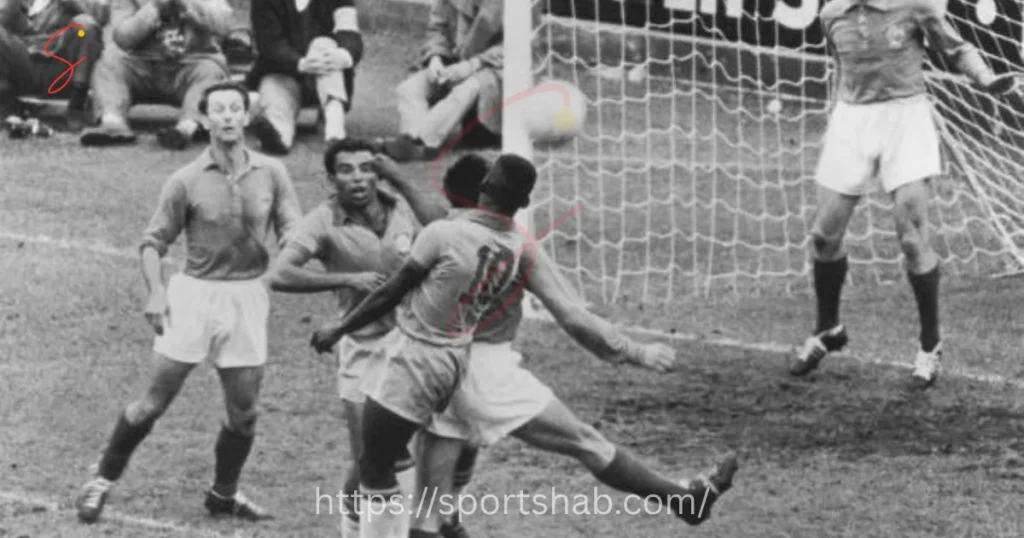
Pelé added another.
Zagallo scored.
Sweden pulled one back.
Then Pelé finished the job.
Brazil 5-2 Sweden. The Jules Rimet Trophy was finally heading to South America.
FIFA World Cup 1958 Organized By
1958 FIFA World Cup was organized by FIFA, the Fédération Internationale de Football Association.
The tournament had been awarded to Sweden at the FIFA Congress in Rio de Janeiro on 22 July 1950. Sweden was selected to host the competition following the World Cup’s return to Europe. The tournament was played from 8 June to 29 June 1958.
Qualification was already becoming more competitive. 55 nations entered the 1958 qualifying competition, with 48 actually playing qualifying matches, while 16 eventually reached the finals. The football world was expanding, and FIFA was beginning to build a World Cup that looked increasingly like the global competition we recognize today.
Host Nation: Sweden
Sweden hosted the 1958 FIFA World Cup, with matches spread across several cities including Stockholm, Gothenburg, Malmö, Norrköping, Halmstad, Helsingborg, Västerås, Sandviken, Örebro, Borås, Uddevalla and Eskilstuna.
The final was staged at the Råsunda Stadium in Solna, near Stockholm.
And Sweden did not merely provide the stadiums.
The host nation went all the way to the final.
That made the tournament even more dramatic.
Imagine the atmosphere, your country reaching the World Cup final on home soil, and standing between you and history is Brazil, a team playing some of the most exciting football the world had ever seen.
Sweden had already defeated Mexico, Hungary and West Germany during the tournament. But Brazil was a different beast.
FIFA World Cup 1958 Participants
The 1958 World Cup featured 16 teams:
Argentina, Austria, Brazil, Czechoslovakia, England, France, Hungary, Northern Ireland, Paraguay, Scotland, Sweden, Soviet Union, West Germany, Wales, Yugoslavia and Mexico.
Several nations made important appearances.
Soviet Union played at its first World Cup.
Northern Ireland reached the quarter-finals after surviving a playoff against Czechoslovakia.
Wales also reached the quarter finals despite entering the tournament as one of the less fancied sides.
Argentina, meanwhile, endured a disastrous campaign and finished bottom of their group.
The tournament was therefore a mixture of established powers, emerging football nations and surprise packages, and one teenager would steal the entire show.
FIFA World Cup 1958 Format
The 1958 tournament used a 16 team format divided into four groups of four.
Each team played the other three teams in its group.Unlike the 1954 tournament, the system did not use seeded pairings that restricted opponents.
Teams received points for results, and when two or more teams finished level, playoff matches were used rather than goal difference to determine who advanced. This produced three group playoffs.
The top two teams from each group advanced to the quarter finals.
From there, the competition became a straight knockout tournament:
Quarter finals → Semi-finals → Third place match → Final.
It was a straightforward structure, but there was one fascinating quirk.
Goal difference was not used to separate teams in the group standings.
That meant a team could score heavily and still be forced into a playoff.
Football loved making things complicated.
FIFA World Cup 1958 Group Stage Overview
Group A
West Germany, Northern Ireland, Czechoslovakia and Argentina
Defending champions West Germany began with a 3-1 victory over Argentina.
Northern Ireland shocked Czechoslovakia with a 1-0 win.
Argentina then defeated Northern Ireland 3-1,
while West Germany drew 2-2 with Czechoslovakia.
The final round produced fireworks.
Czechoslovakia demolished Argentina 6-1,
while West Germany drew 2-2 with Northern Ireland.
West Germany finished first.
Northern Ireland and Czechoslovakia were level on points, forcing a playoff.
Northern Ireland won 2-1 after extra time.
The Irish were heading into the quarter-finals.
Argentina? Bottom of the group. A huge footballing nation had been knocked out in spectacular fashion.
Group B
France, Yugoslavia, Paraguay and Scotland
France announced themselves with an explosive 7-3 victory over Paraguay.
Yugoslavia and Scotland drew 1-1.
The French then lost 3-2 to Yugoslavia, but recovered by beating Scotland 2-1.
Yugoslavia drew 3-3 with Paraguay in their final match.
France finished top with four points, while Yugoslavia also finished on four.
But one Frenchman was already writing his own chapter.Just Fontaine had scored a hat-trick against Paraguay and he was nowhere near finished.
Group C
Sweden, Wales, Hungary and Mexico
Host nation Sweden opened with a comfortable 3-0 victory over Mexico.
Wales drew 1-1 with Hungary.
Sweden defeated Hungary 2-1, while Wales and Mexico played another 1-1 draw.
In the final round, Sweden drew 0-0 with Wales.
Hungary defeated Mexico 4-0.
That left Sweden top and Wales and Hungary level on three points.So, once again, a playoff was required.Wales defeated Hungary 2-1.The result was massive.Hungary, one of Europe’s traditional powers, were eliminated.Wales were through to the quarter finals.
Group D
Brazil, Soviet Union, England and Austria
Brazil started with a confident 3-0 win over Austria.
Soviet Union drew 2-2 with England.
Brazil then played out a goalless draw 0-0 against England.
Soviet Union defeated Austria 2-0.
In the final round, Brazil beat the Soviet Union 2-0. England drew 2-2 with Austria.
England and the Soviet Union level on three points.Another playoff.
Soviet Union won 1-0.England was eliminated.
Brazil topped the group without conceding a goal.
And the world still hadn’t seen Pelé.
Brazil’s Secret Weapon: Pelé Finally Enters
Brazilian coach Vicente Feola made one of the most important decisions in World Cup history. After two group matches.“Veni, vidi, vici” He came, He saw, He conquered, Pelé finally was selected against the Soviet Union.
The teenager had already been generating enormous excitement at home, but international audiences were about to see what the hype was about.He did not score in that match, but his presence changed Brazil’s attacking movement.
Then came Wale,.and suddenly, the teenager was no longer a promising youngster.He was a World Cup star.Pelé scored the only goal of Brazil’s 1-0 quarter final victory over Wales. He was only 17 years old.The tournament had found its youngest superstar.
FIFA World Cup 1958 Quarter Finals
Sweden 2 – 0 Soviet Union
Sweden continued their home adventure by defeating the Soviet Union 2-0.
The hosts were becoming increasingly confident.
They had reached the last four.
One more victory would send them into a World Cup final on home soil.
West Germany 1 – 0 Yugoslavia
The defending champions faced a determined Yugoslavian side.
West Germany eventually won 1-0, securing their place in the semi-finals.
The champions were still alive. But their title defence was about to meet its toughest test.
France 4 – 0 Northern Ireland
France destroyed Northern Ireland 4-0, once again, Fontaine was involved.French attack was becoming one of the tournament’s most dangerous. Fontaine had already scored seven goals in the competition, But his real masterpiece was still to come.
Brazil 1 – 0 Wales
Brazil had the talent.Wales had the defensive discipline.For 66 minutes, the Welsh kept Brazil quiet.Then Pelé found space.The teenager scored the only goal of the game.
Sixteen year olds dream of moments like this.
FIFA World Cup 1958 Semi Finals
Brazil 5 – 2 France
This was not a semi-final.
This was an attacking masterclass.
Brazil and France produced a seven-goal thriller in Stockholm.
Brazil eventually won 5-2.
Pelé scored a hat-trick.
Yes, a 17-year-old Pelé scored three goals in a World Cup semi final.
France’s Just Fontaine continued his own incredible tournament by scoring one goal, but Brazil’s attacking brilliance proved too much.
The Brazilian attack, Garrincha. Didi. Vavá. Zagallo. Pelé. had become almost impossible to contain.Pick your poison.Brazil is in the final.
Sweden 3 – 1 West Germany
The other semi final had a very different mood.Sweden had home support behind them.West Germany had the experience of being defending champions.The Germans even took the lead through Hans Schäfer.
Sweden fought back,eventually won 3-1, with Nils Liedholm, Gunnar Gren and Kurt Hamrin involved in the comeback.
Sweden had reached the World Cup final.
The dream was alive.
One more match.
One trophy.
Brazil stood in the way.
FIFA World Cup 1958 Final, Brazil Winner
Brazil 5 – 2 Sweden
The Day Brazil Became Champions
Date: 29 June 1958
Venue: Råsunda Stadium, Solna, Sweden
Final: Brazil 5-2 Sweden
Attendance: approximately 49,700 to 50,000
Sweden had the home crowd.
Sweden had confidence.
Sweden scored first.
4th minute Nils Liedholm.
The hosts were ahead.
For a few seconds, Brazilian supporters probably thought: Here we go again.
But Brazil’s response was immediate.
9th minute Vavá.
1-1.
Five minutes later, Vavá struck again.
Brazil 2-1 Sweden.
The comeback had become a takeover.
Then came the moment that entered football folklore.
55th minute Pelé.
The teenager controlled the ball, lifted it over a defender and fired home
Brazil led 3-1.
That goal wasn’t simply another goal.
It was a declaration.
Pelé had arrived.
Zagallo added a fourth in the 68th minute.
Sweden pulled one back through Agne Simonsson.
Then, in the final minute, Pelé scored again.
Brazil 5-2 Sweden.
Brazil were world champions.
The South American nation had finally lifted the Jules Rimet Trophy.
And Pelé? He was crying,his teammates lifted him.
The world had just witnessed the beginning of one of football’s greatest careers.
FIFA records the 1958 final as the highest scoring World Cup final in history, a record that still stands.
FIFA World Cup 1958 Interesting Facts
Pelé was only 17
Pelé became the youngest player to score in a World Cup final, scoring twice against Sweden.
He was not merely young.
He was still a teenager.
He finished the tournament with six goals.
Just Fontaine scored 13 goals
France’s Just Fontaine scored 13 goals in six matches, setting the record for most goals by a player in a single World Cup edition.
His record remains untouched.
He scored against Paraguay, Yugoslavia, Scotland, Northern Ireland, Brazil and West Germany.
His final contribution was extraordinary: four goals against West Germany in the third place match, which France won 6-3.
Fontaine did it in borrowed boots
Here’s a story that sounds almost too perfect. Fontaine had only brought one pair of boots to Sweden.One broke, teammate, Stéphane Bruey, had the same shoe size and lent him his boots. He went on to score 13 goals wearing them.Football really does know how to write its own scripts.
Wales reached the quarter finals
Wales entered the tournament without being considered a major favourite.Yet they eliminated Hungary in a playoff and reached the last eight. They eventually lost 1-0 to Brazil, the scorer was Pelé.
The Soviet Union made its World Cup debut
The 1958 tournament marked the Soviet Union’s first appearance at the World Cup. They progressed from their group after defeating England in a playoff but lost 2-0 to Sweden in the quarter finals.
Argentina suffered a nightmare
Argentina finished bottom of Group A after defeats against West Germany and Czechoslovakia.
Their 6-1 defeat to Czechoslovakia was particularly painful.For a football nation with enormous expectations, Sweden 1958 was a tournament to forget.
Tournament Innovations and Firsts
The 1958 World Cup introduced several important developments.
One of the biggest was the return to a more conventional four-team group format, with each team playing three group matches.
The tournament also featured a major development in qualification.
For the first time, teams were seeded according to strength rather than geographical location during the European qualifying process.
The 1958 World Cup was also the first tournament in which the Soviet Union appeared.
Most importantly, however, the tournament represented a tactical turning point.
Brazil’s attacking structure gave Garrincha and Pelé freedom to attack from wide and central positions while Didi controlled the rhythm from midfield.
The result was breathtaking.
Brazil could defend when necessary, but their greatest weapon was imagination.
They didn’t simply attack.
They attacked with flair.
FIFA World Cup 1958 Statistics
The numbers from Sweden 1958 tell a fascinating story.
The tournament produced 126 goals in 35 matches, an average of roughly 3.6 goals per game.
Brazil scored 16 goals during the tournament.
France scored 23, despite finishing third.
Just Fontaine alone scored 13.
And the final produced seven goals.
But the individual statistics make the tournament truly remarkable.
Most Goals: Just Fontaine 🇫🇷
13 Goals
There is no debate here.Just Fontaine was the top scorer of the 1958 FIFA World Cup.
And not by a small margin.
He scored 13 goals in six matches.His record is still the highest number of goals scored by a player in a single World Cup edition.
Fontaine scored a hat trick against Paraguay, two against Yugoslavia, one against Scotland, two against Northern Ireland, one against Brazil and four against West Germany.
That final four goal explosion took him from nine goals to 13.His scoring rate was extraordinary, approximately one goal every 42 minutes.
1958 Top Scorer Just Fontaine 13 goals
Golden Boot: Just Fontaine 🇫🇷
The Golden Boot was not yet an official FIFA award in 1958 in the form used today. But under modern retrospective recognition, the winner is obvious.
Golden Boot: Just Fontaine
His 13 goals remain a World Cup single tournament record. He finished well ahead of Pelé, who scored six.
Fontaine didn’t win the World Cup. But he left Sweden with one of the greatest scoring records football has ever seen.
Golden Ball: Didi 🇧🇷
The Golden Ball for the 1958 World Cup is generally credited to Brazil’s Didi. Didi was the elegant engine of Brazil’s midfield.While Pelé and Garrincha attracted the headlines, Didi controlled the tempo.His passing, composure and ability to dictate the rhythm gave Brazil the platform to attack.
Didi was also named the tournament’s best player in the historical awards record, while Pelé became the face of the tournament, Didi was the conductor behind the orchestra.
Golden Ball: Didi, That distinction matters.Football isn’t always won by the player who scores the most goals. Sometimes the man controlling the game is the one making the magic happen.
Golden Glove: Gilmar 🇧🇷 Retrospective Choice
The Golden Glove was not an official World Cup award in 1958, so any selection should be described as retrospective.
Brazil goalkeeper Gilmar is a strong candidate.
Brazil conceded only four goals in six matches, keeping clean sheets against Austria, England and Wales.
Gilmar’s calm presence behind a defence featuring Djalma Santos, Bellini, Orlando and Nilton Santos was crucial to Brazil’s title-winning campaign.
Sweden’s Kalle Svensson and West Germany’s Fritz Herkenrath were also notable goalkeepers.
But for a retrospective 1958 award, Golden Glove: Gilmar 🇧🇷
Most Clean Sheets
Brazil and Sweden were among the strongest defensive teams during the tournament.
Brazil 3 clean sheets
Austria 3-0
England 0-0
Wales 1-0
Sweden 3 clean sheets
Mexico 3-0
Wales 0-0
Soviet Union 2-0
The shared figure shows that the 1958 World Cup wasn’t simply about attacking brilliance, both finalists could defend.Brazil simply had more firepower when it mattered most.
FIFA World Cup 1958 Squads
The 16 participating nations brought some of the most recognizable names of the era. Rather than turning the article into a giant name dump, here are the principal players who shaped each squad and campaign.
Brazil
Brazil’s legendary squad included Gilmar, Djalma Santos, Nilton Santos, Bellini, Orlando, Zito, Didi, Garrincha, Vavá, Pelé and Zagallo.
Coach Vicente Feola guided the team.
The combination of experience and youthful brilliance was extraordinary.
Pelé was 17.
Garrincha was 24.
Didi was 29.
Brazil had the perfect mixture.
Sweden
The hosts relied on players including Kalle Svensson, Orvar Bergmark, Sven Axbom, Nils Liedholm, Gunnar Gren, Kurt Hamrin, Agne Simonsson, Lennart Skoglund and Gunnar Nordahl.
Sweden’s experienced attacking players helped them reach the final.
Their home support made them one of the tournament’s most dangerous sides.
France
France’s squad was led by Just Fontaine, with Raymond Kopa, Roger Piantoni, Jean Vincent, Robert Jonquet and Dominique Colonna among the major names.
They finished third after defeating West Germany 6-3.
Fontaine scored four goals in that match.
What a way to finish a World Cup.
West Germany
The defending champions had Fritz Walter, Helmut Rahn, Uwe Seeler, Hans Schäfer, Horst Eckel, Karl-Heinz Schnellinger and goalkeeper Fritz Herkenrath.
They reached the semi-finals before losing 3-1 to Sweden.
France then defeated them 6-3 in the third-place match.
Soviet Union
The Soviet team featured goalkeeper Lev Yashin, one of the greatest goalkeepers in football history, although he was not yet at the peak of his legendary reputation.
They also had players such as Igor Netto and Valentin Ivanov.
The Soviet Union reached the quarter-finals.
Wales
Wales’ memorable squad included John Charles, Cliff Jones, Ivor Allchurch, Terry Medwin, Jack Kelsey and Stuart Williams.
They defeated Hungary in the playoff before losing narrowly to Brazil.
Northern Ireland
Northern Ireland had Harry Gregg, Danny Blanchflower, Jimmy McIlroy, Billy Bingham and Peter McParland.
They reached the quarter-finals before France ended their campaign.
Hungary
Hungary were rebuilding after the loss of several stars from the great team of the early 1950s.
Their squad still contained experienced figures such as Nándor Hidegkuti, József Bozsik and Gyula Grosics, but they were eliminated by Wales.
Argentina
Argentina’s squad included stars such as Amadeo Carrizo, Omar Sívori’s contemporaries and José Sanfilippo-era talent, although their campaign was disappointing.
They finished bottom of Group A.
Czechoslovakia
Czechoslovakia featured players including Josef Masopust, Ladislav Novák and Josef Bican-era successors, but their tournament ended after a playoff defeat to Northern Ireland.
Paraguay
Paraguay were involved in one of the tournament’s wildest opening games, losing 7-3 to France.
They also scored nine goals across their group campaign.
Yugoslavia
Yugoslavia featured talented players including Rajko Mitić, Dragoslav Šekularac and Vladimir Beara.
They reached the quarter finals but lost 1-0 to West Germany.
Mexico
Mexico were captained by legendary goalkeeper Antonio Carbajal.
They lost to Sweden and Brazil but secured a point against Wales.
England
England’s squad included Tom Finney, Johnny Haynes, Billy Wright, Bobby Charlton and Duncan Edwards’ generation of players, although the team was still recovering from the Munich air disaster earlier that year.
England were eliminated by the Soviet Union in the group playoff.
Austria
Austria had players including Ernst Happel, Ernst Ocwirk, Gerhard Hanappi and Walter Zeman. They failed to advance from Group D.
Scotland
Scotland’s squad included Dave Mackay, Ian McColl and other leading British players, but they finished bottom of Group B.
FIFA World Cup 1958: Finally Brazil Found Its Footballing Identity
The 1958 World Cup wasn’t simply another tournament added to FIFA’s record books.It was a turning point. Brazil had waited years for this moment.
Sweden, the host nation, reached the final.
France produced Just Fontaine, who scored 13 goals, still the record for one World Cup.
The Soviet Union made its debut.
Wales became giant killers.
Northern Ireland reached the quarter finals.
Brazil discovered a teenager.Pelé, he entered the arena carrying expectations but left carrying the trophy.
He scored six goals, three in the semi final, twice in the final and became the youngest player to score in a World Cup final
Perhaps most importantly, Brazil stopped being remembered only for what it had lost.It became remembered for what it had won.
The final against Sweden was the perfect conclusion. Sweden scored first, but Brazil never panicked. Vavá equalised. Vavá put Brazil ahead. Pelé produced his piece of magic. Zagallo added another. Sweden scored again.Then Pelé struck for the second time.
Game over Brazil 5-2 Sweden,history made.
The photograph of Pelé crying on the shoulders of his teammates became one of football’s defining images.But behind that teenage superstar was a complete team.
Didi controlled the midfield.
Garrincha terrorized defenders.
Vavá finished chances.
Zagallo worked tirelessly.
Gilmar provided security behind them.
Brazil played with an attacking freedom that would eventually become part of the country’s footballing identity.
1958 FIFA World Cup remains so important.
It wasn’t just the tournament where Brazil won its first title.
It was the tournament where the world discovered what Brazilian football could become, because somewhere in Sweden, a 17 years old boy had just taken his first steps toward becoming Pelé the King of Football.