What Is the Ballon d’Or? History, Winners, Rules and Complete Guide
The Ballon d’Or is one of the most prestigious individual awards in football. Every year, it recognises outstanding players whose performances, achievements and influence have made them stand out during the relevant football season. Since its creation in 1956, the award has become closely associated with the greatest names in football history, from Stanley Matthews, Alfredo Di Stéfano and Johan Cruyff to Michel Platini, Marco van Basten, Lionel Messi and Cristiano Ronaldo.
But what exactly is the Ballon d’Or, who created it, how does ballon d or voting work, and why is winning the award considered such a major achievement?
This complete guide explains the Ballon d’Or history meaning, origin, rules, voting system, winners, trophies, categories and evolution from 1956 to the modern era.
What Is the Ballon d’Or?
The Ballon d’Or, French for “Golden Ball,” is an annual football award presented to recognise the outstanding male footballer in the world. The award was created by the French football magazine France Football and was first presented in 1956.
Over the decades, the Ballon d’Or has evolved from a European player award into a global football honour. Its winners include many of the sport’s most influential players, making the award an important part of football history.
The award is not simply based on goals or trophies. The voting criteria also consider a player’s individual performances, impact, team achievements, sporting conduct and overall influence during the relevant period.
What Does Ballon d’Or Mean?
The term Ballon d’Or literally means “Golden Ball” in French.
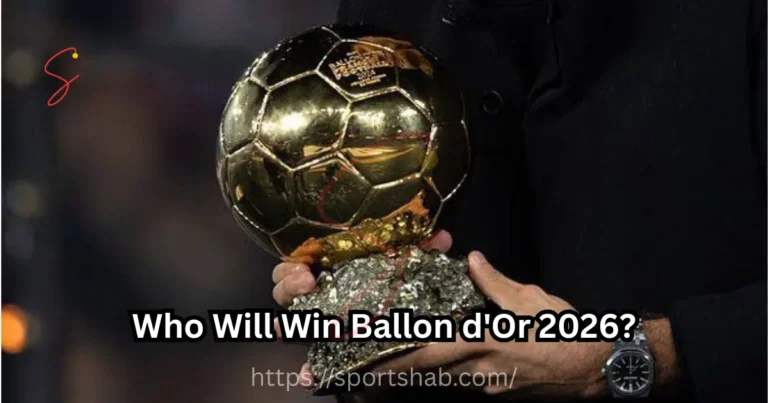
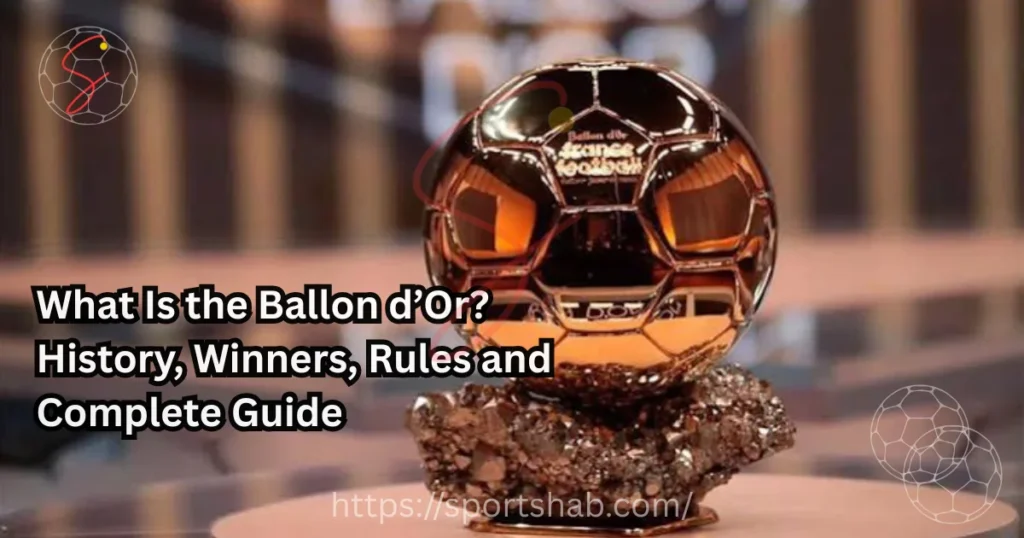
The name reflects the golden football shaped trophy awarded to the winner. Although the award is commonly called the Ballon d’Or around the world, it is also sometimes referred to as the Golden Ball award.
Today, the Ballon d’Or name is strongly connected with individual excellence in football.
Who Created the Ballon d’Or?
The Ballon d’Or was created by France Football in the 1950s. The idea emerged from French football journalism at a time when European football was becoming increasingly interconnected.
The concept is associated with Gabriel Hanot and the France Football editorial team, with journalist Jacques Ferran playing an important role in organising the competition.
The award was designed to recognise the best footballer in Europe and initially had a much narrower eligibility system than it does today.
When Was the First Ballon d’Or Awarded?
The first Ballon d’Or was awarded in 1956.
The inaugural winner was Sir Stanley Matthews, the legendary English winger who played for Blackpool. He became the first name on what would eventually become one of football’s most famous individual honours lists.
Interestingly, the first presentation was far more modest than today’s global allon d or ceremony. Matthews received the trophy on 18 December 1956 at Blackpool Town Hall, rather than at a huge international awards gala.
That first award marked the beginning of a competition that would later include virtually every major footballing nation and many of the game’s greatest legends.
Why Was the Ballon d’Or Created?
The main purpose of the Ballon d’Or was to recognise individual excellence in European football.
During the 1950s, club football in Europe was growing rapidly. The European Champion Clubs’ Cup had also begun in the 1955-56 season, creating greater interest in comparing players from different countries.
France Football’s award provided journalists with a way to identify the player they considered the best in European football.
Its purpose gradually expanded as football itself became more global.
The Ballon d’Or eventually moved beyond its original European focus and became a worldwide individual football award.
How Has the Ballon d’Or Changed Over Time?
The Ballon d’Or has undergone several major changes since 1956.
1956–1994: European Players Only
When the award was introduced, it was essentially a prize for the best European footballer.
Non-European players were not eligible even if they were playing at the highest level in Europe.
This meant some outstanding players from South America, Africa and other parts of the world could not compete for the award.
1995: Major Eligibility Change
In 1995, the rules were expanded.
Players of any nationality became eligible as long as they played for a European club.
This opened the door for legendary non-European players.
One of the most important consequences came that same year when George Weah of Liberia became the first African player to win the Ballon d’Or.
2007: Global Eligibility
Another major change arrived in 2007.
The award became open to players from clubs anywhere in the world, making the Ballon d’Or a genuinely global competition.
2010–2015: FIFA Ballon d’Or Era
Between 2010 and 2015, France Football’s Ballon d’Or was merged with FIFA’s World Player of the Year award.
The combined prize became known as the FIFA Ballon d’Or.
During this period, Lionel Messi won four consecutive awards from 2010 through 2012 and again in 2015, while Cristiano Ronaldo won in 2013 and 2014.
2016: Ballon d’Or Returns
The partnership between FIFA and France Football ended after the 2015 award.
From 2016, the award returned to the Ballon d’Or name under France Football.
FIFA subsequently developed its own separate men’s individual award, now known as The Best FIFA Men’s Player.
2020: No Ballon d’Or
The Ballon d’Or was not awarded in 2020.
The award was cancelled during the COVID-19 pandemic after France Football concluded that the circumstances did not provide sufficiently fair conditions for judging the season. The official historical record therefore lists 2020 as cancelled rather than having a winner.
2022: Season-Based Voting
Another important change came in the voting period.
Previously, the award was primarily judged over a calendar year. The criteria were later changed so that the assessment focused on a full football season, making the award more closely connected to performances from August through the following summer.
How Does Ballon d’Or Voting Work?
The Ballon d’Or winner is selected through a jury of specialist football journalists.
Under the current system described by UEFA, one journalist from each of the top 100 countries in the FIFA men’s world ranking participates in the men’s vote, while the women’s Ballon d’Or uses representatives from the top 50 countries in the FIFA women’s ranking.
For the men’s award, journalists select their top 10 players from a shortlist of 30 ballon d or nominees.
The players receive points according to their position in each journalist’s ranking:
| Position | Points |
|---|---|
| 1st | 15 |
| 2nd | 12 |
| 3rd | 10 |
| 4th | 8 |
| 5th | 7 |
| 6th | 5 |
| 7th | 4 |
| 8th | 3 |
| 9th | 2 |
| 10th | 1 |
The player collecting the most points wins the Ballon d’Or.
If two players finish level on points, the number of first-place votes is used as the first tie breaker, followed by second-place votes and then subsequent rankings if necessary.
What Are the Ballon d’Or Voting Criteria?
Winning major trophies can help a player, but trophies alone do not automatically decide the Ballon d’Or.
The official criteria include three major areas:
1. Individual Performance
The player’s personal level, consistency, decisive moments and overall influence are considered.
Goals, assists, creativity, defensive contributions, goalkeeping performances and other elements can all contribute depending on the player’s position.
2. Team Achievements
A player’s success with their club or national team is also considered.
Winning major competitions such as domestic titles, continental competitions or international tournaments can strengthen a player’s case.
3. Class and Fair Play
Sporting behaviour and fair play are also part of the evaluation.
This means the Ballon d’Or is intended to recognise more than statistics alone.
Who Is Eligible for the Ballon d’Or?
The modern Ballon d’Or is open to footballers regardless of nationality or the league in which they play.
This is very different from the original award, which was restricted to European players.
The evolution of eligibility is one of the most important parts of Ballon d’Or history, because it transformed the prize from a European award into a truly global football honour.
What Awards Are Presented at the Ballon d’Or Ceremony?
The Ballon d’Or ceremony has developed into a broader football awards event rather than simply a single trophy presentation.
The modern programme includes several major honours.
Men’s Ballon d’Or
This is the main men’s individual award and recognises the outstanding male footballer.
Women’s Ballon d’Or
The Ballon d’Or Féminin recognises the outstanding female footballer.
It was introduced in 2018, marking an important milestone in women’s football. The first winner was Ada Hegerberg.
Kopa Trophy
The Kopa Trophy recognises the best young player.
It is named after French football legend Raymond Kopa and is one of the major awards presented during the Ballon d’Or ceremony.
Yashin Trophy
The Yashin Trophy recognises the best goalkeeper.
It is named after Soviet goalkeeping legend Lev Yashin, the only goalkeeper to win the men’s Ballon d’Or, doing so in 1963.
Gerd Müller Trophy
The Gerd Müller Trophy honours the leading scorer in club and international football.
It is named after legendary German striker Gerd Müller.
Johan Cruyff Trophy
The Johan Cruyff Trophy recognises the best coach in men’s and women’s football.
The award considers factors such as team performance, titles, leadership, tactical ability, player development and sporting conduct.
Club of the Year
The Ballon d’Or awards also recognise the best men’s and women’s clubs.
Club performances, trophies, memorable victories, expectations and fair play can all be considered.
Sócrates Award
The Sócrates Award recognises footballers involved in significant solidarity, humanitarian or social initiatives.
It is named after Brazilian football icon Sócrates, who was also known for his social and political engagement.
The award demonstrates that the Ballon d’Or ceremony is not only about goals and trophies but can also celebrate positive contributions away from the pitch.
Ballon d’Or vs FIFA Ballon d’Or: What Is the Difference?
The terms Ballon d’Or and FIFA Ballon d’Or are sometimes used interchangeably, but historically they refer to different periods.
The original Ballon d’Or was created by France Football in 1956.
From 2010 to 2015, France Football and FIFA combined their major men’s individual awards under the FIFA Ballon d’Or name.
After the partnership ended, the traditional Ballon d’Or returned in 2016.
FIFA then continued with its own separate award, eventually known as The Best FIFA Men’s Player.
Who Has Won the Most Ballon d’Or Awards?
Lionel Messi holds the record for the most men’s Ballon d’Or victories, with eight.
His wins came in:
- 2009
- 2010
- 2011
- 2012
- 2015
- 2019
- 2021
- 2023
Cristiano Ronaldo is second with five Ballon d’Or victories.
Other three-time winners include:
- Johan Cruyff
- Michel Platini
- Marco van Basten
The complete historical winners list confirms Messi’s eight victories and Ronaldo’s five.
Complete Ballon d Or Winners List
The Ballon d’Or has produced a remarkable list of winners across seven decades.
| Year | Winner |
|---|---|
| 1956 | Stanley Matthews |
| 1957 | Alfredo Di Stéfano |
| 1958 | Raymond Kopa |
| 1959 | Alfredo Di Stéfano |
| 1960 | Luis Suárez |
| 1961 | Omar Sívori |
| 1962 | Josef Masopust |
| 1963 | Lev Yashin |
| 1964 | Denis Law |
| 1965 | Eusébio |
| 1966 | Bobby Charlton |
| 1967 | Flórián Albert |
| 1968 | George Best |
| 1969 | Gianni Rivera |
| 1970 | Gerd Müller |
| 1971 | Johan Cruyff |
| 1972 | Franz Beckenbauer |
| 1973 | Johan Cruyff |
| 1974 | Johan Cruyff |
| 1975 | Oleh Blokhin |
| 1976 | Franz Beckenbauer |
| 1977 | Allan Simonsen |
| 1978 | Kevin Keegan |
| 1979 | Kevin Keegan |
| 1980 | Karl-Heinz Rummenigge |
| 1981 | Karl-Heinz Rummenigge |
| 1982 | Paolo Rossi |
| 1983 | Michel Platini |
| 1984 | Michel Platini |
| 1985 | Michel Platini |
| 1986 | Ihor Belanov |
| 1987 | Ruud Gullit |
| 1988 | Marco van Basten |
| 1989 | Marco van Basten |
| 1990 | Lothar Matthäus |
| 1991 | Jean-Pierre Papin |
| 1992 | Marco van Basten |
| 1993 | Roberto Baggio |
| 1994 | Hristo Stoichkov |
| 1995 | George Weah |
| 1996 | Matthias Sammer |
| 1997 | Ronaldo |
| 1998 | Zinedine Zidane |
| 1999 | Rivaldo |
| 2000 | Luís Figo |
| 2001 | Michael Owen |
| 2002 | Ronaldo |
| 2003 | Pavel Nedvěd |
| 2004 | Andriy Shevchenko |
| 2005 | Ronaldinho |
| 2006 | Fabio Cannavaro |
| 2007 | Kaká |
| 2008 | Cristiano Ronaldo |
| 2009 | Lionel Messi |
| 2010 | Lionel Messi |
| 2011 | Lionel Messi |
| 2012 | Lionel Messi |
| 2013 | Cristiano Ronaldo |
| 2014 | Cristiano Ronaldo |
| 2015 | Lionel Messi |
| 2016 | Cristiano Ronaldo |
| 2017 | Cristiano Ronaldo |
| 2018 | Luka Modrić |
| 2019 | Lionel Messi |
| 2020 | Not awarded |
| 2021 | Lionel Messi |
| 2022 | Karim Benzema |
| 2023 | Lionel Messi |
| 2024 | Rodri |
| 2025 | Ousmane Dembélé |
The historical record is maintained by UEFA and shows the evolution of the award from Stanley Matthews in 1956 to Ousmane Dembélé in 2025.
Ballon d’Or Winners in the Modern Era
The modern history of the award is dominated by a small group of extraordinary players.
Lionel Messi’s record eight victories place him at the top of the all-time list, while Cristiano Ronaldo’s five wins make him the second-most successful men’s Ballon d’Or winner.
The rivalry between Messi and Ronaldo became one of the defining stories in Ballon d’Or history, particularly during the 2008–2017 period.
However, the award has continued to produce new winners. Luka Modrić ended the Messi-Ronaldo sequence in 2018, while Karim Benzema, Rodri and Ousmane Dembélé have also added their names to the recent winners list.
Ballon d’Or and the Greatest Players in Football History
The Ballon d’Or is often used as one way of measuring a player’s individual legacy, but winning the award is not the only measure of greatness.
Players from different generations competed under different rules, tactical systems and voting structures.
For example, legends such as Pelé and Diego Maradona were not able to win the original Ballon d’Or under its historical eligibility rules.
The award’s eligibility changed significantly over time, meaning modern comparisons between players from different eras should always take the historical context into account.
Why Is the Ballon d’Or So Important?
The Ballon d’Or matters because it combines individual excellence, team success and football legacy.
Winning the award can become a defining moment in a player’s career.
For fans, the Ballon d’Or also provides a historical record of how football’s greatest players were viewed during different generations.
From Stanley Matthews in the 1950s to Messi and Ronaldo in the 21st century, the winners list tells the story of how football has changed.
Ballon d’Or History: From 1956 to Today
The history of the Ballon d’Or is essentially a history of football’s changing global landscape.
The award began as a European honour in 1956. It gradually opened to players of all nationalities, became global in eligibility, entered the FIFA Ballon d’Or era, returmed to its traditional name and eventually expanded into a wider awards programme covering men’s and women’s football, young players, goalkeepers, coaches, clubs, top scorers and social contrnibutions.
That evolution is what makes the Ballon d’Or more than just an annual trophy. It is a record of football’s greatest individual performers across generations.