The ICC: How Three Nations at Lord’s Built an Empire That Rules 2.5 Billion Hearts
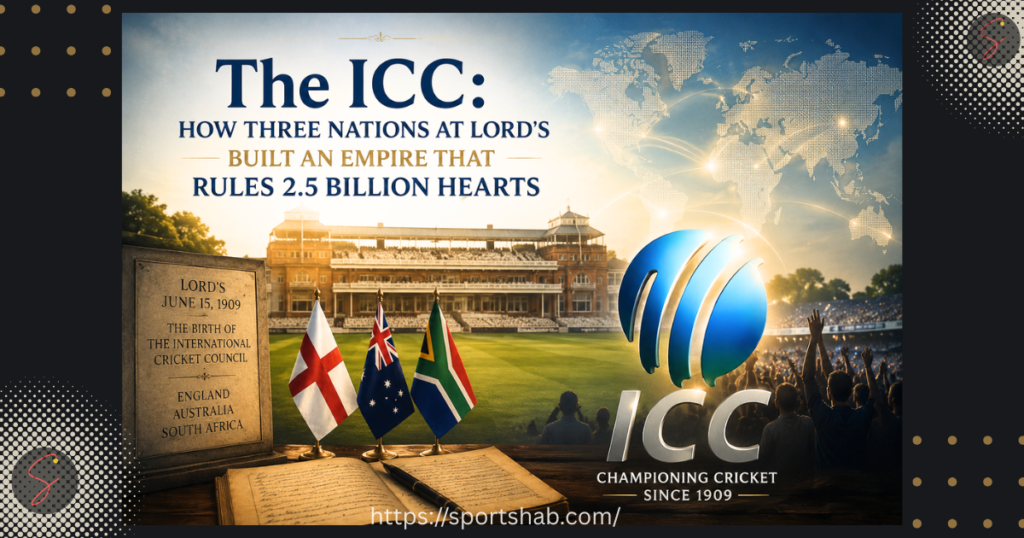
The Long Room, 1909
On a summer afternoon in 1909, inside the hallowed Long Room at Lord’s Cricket Ground in London, three men shook hands and changed the destiny of a sport forever. They represented Australia, England, and South Africa the only nations then deemed worthy of playing Test cricket. The document they signed was modest, almost bureaucratic: the formation of the Imperial Cricket Conference. There were no cameras, no flashing lights, no billion-dollar broadcast deals. Just three colonial powers agreeing that the game they loved deserved a common rulebook.
None of them could have imagined that this small club of empire would one day transform into the International Cricket Council a governing body with 111 member nations, headquarters in the desert metropolis of Dubai, and the power to stop wars, start revolutions, and make grown men weep in stadiums from Mumbai to Melbourne. The ICC is not just the administrator of cricket. It is the keeper of a religion practiced by 2.5 billion people. And like all religions, its history is a tapestry of miracles, betrayals, reforms, and redemption.
This is the untold story of that empire — from the imperial drawing rooms of London to the glass towers of Dubai, from 13 Test-playing nations to a T20 world, and from the gentleman’s code to the billion-dollar thunderdome.
The Imperial Era When Cricket Was a Colonial Handshake (1909 – 1965)
The ICC was born not out of passion, but out of administration. Abe Bailey, the South African cricket magnate, wrote to Francis Lacey of the Marylebone Cricket Club (MCC) in 1907 suggesting a formal body to regulate international cricket between the three Commonwealth dominions. The Australians were initially skeptical. The English were cautiously enthusiastic. The South Africans simply wanted recognition.
On June 15, 1909, the Imperial Cricket Conference was formally constituted at Lord’s. The name itself was a statement of identity — this was not international cricket; it was imperial cricket. Only countries within the British Empire were welcome. The first act of the new body was to organize the 1912 Triangular Tournament in England, featuring the three founding nations. It was a commercial and sporting failure, washed out by rain and apathy, but it established a precedent: the ICC existed to bring order to the chaos of international scheduling.
For decades, the Conference remained a gentleman’s club. India, New Zealand, and the West Indies were admitted as full members in 1926, but they were junior partners in an organization run from London. Pakistan joined in 1952 after Partition, bringing with it a new kind of passion — and tension. In 1961, South Africa’s membership lapsed when it left the Commonwealth, a prelude to the sporting isolation that would follow its apartheid policies.
The ICC in this era was not a global governing body in the modern sense. It was a committee that met occasionally, made recommendations rather than binding decisions, and left the real power with the MCC at Lord’s. Cricket grew, but it grew slowly, wrapped in the comfortable cardigan of tradition.
Breaking the Empire The World Cup is Born (1965–1989)
The year 1965 marked a quiet revolution. The Imperial Cricket Conference was renamed the International Cricket Conference. For the first time, non-Commonwealth countries could join — though only as associate members with diluted voting rights. Fiji and the United States became the first associates, followed by Bermuda, Denmark, and the Netherlands. The empire was opening its doors, if only a crack.
But the true earthquake came in 1973, when the ICC decided to stage a Cricket World Cup. The inaugural tournament in 1975 was a revelation. England hosted eight teams — the six Test nations plus Sri Lanka and East Africa — in a 60-over spectacle that introduced colored clothing, white balls, and floodlit finishes to a generation weaned on whites and five-day draws. Clive Lloyd’s West Indies won the first two editions, and cricket discovered that it could be a television product.
The 1980s brought more change. Sri Lanka, an associate since 1965, was promoted to full membership in 1981 and played its first Test in 1982. The third umpire — equipped with video replay — was introduced in 1992, a technological leap that seems quaint now but was revolutionary then. In 1989, the body changed its name one final time: the International Cricket Council. The initials stayed the same, but the philosophy shifted. The MCC president would no longer automatically serve as ICC president. Colin Cowdrey became the first independent president. The council was finally growing up.
The Modern Council From Lord’s to the Desert (1989–2014)
The 1990s were a decade of expansion and upheaval. South Africa returned to the fold in 1991, its apartheid era ending with a triumphant tour and a new place at the table. Zimbabwe joined as a full member in 1992. In 1993, the ICC created the position of chief executive, appointing David Richards of Australia. For the first time, the organization had a professional administrator rather than a part-time committee man.
In 1997, the ICC became an incorporated body with an executive board. Clyde Walcott, the legendary West Indian cricketer, became the first non-British chairman. The headquarters remained at Lord’s, but the commercial operations moved to Monaco — a hint that cricket was becoming big business. Then, in 2005, came the move that symbolized the new era: the ICC relocated its headquarters to Dubai, United Arab Emirates. The reasons were pragmatic — tax advantages, central location between East and West, and a base in cricket’s emerging financial heartland.
Bangladesh became the tenth full member in 2000. The ICC World Cup grew into a commercial behemoth. And then, in 2007, the ICC launched the T20 World Cup in South Africa. A format designed to last three hours instead of five days became the catalyst for cricket’s most dramatic expansion. The IPL followed in 2008. Franchise cricket exploded. The ICC found itself governing not just nations, but an entire ecosystem of leagues, broadcasters, and billionaire owners.
The Big Three Earthquake When Money Shook the Foundation (2014–2016)
If the ICC’s history has a darkest hour, it is not a scandal of corruption but a scandal of power. In 2014, under the presidency of N. Srinivasan of India, the ICC approved a new revenue and governance model that would haunt the organization for years. The model — widely known as the “Big Three” restructuring — gave overwhelming power and financial share to the boards of India, England, and Australia.
The numbers were staggering. India alone was guaranteed the lion’s share of ICC revenues, reflecting its commercial muscle but gutting the principle of equitable distribution. England and Australia received disproportionate influence on the executive board. The remaining seven full members and dozens of associates were relegated to secondary status. It was a coup disguised as reform, and it tore the fabric of international cricket.
The backlash was fierce. Cricket commentators, former players, and smaller nations condemned the move as neo-colonialism in a corporate suit. Shashank Manohar, who succeeded Srinivasan first at the BCCI and then at the ICC, became the unlikely hero of the resistance. Elected as the ICC’s first independent chairman in 2015, Manohar dismantled parts of the Big Three model, restoring some balance to revenue distribution. The role of ICC president was abolished entirely in 2016, concentrating authority in the chairman and the chief executive.
The scars remain. The perception that the ICC serves the interests of India first, and cricket second, persists in corridors from Karachi to Kingston. But Manohar’s intervention proved that the organization could still course-correct when pushed to the brink.
The Tournament Empire Crafting Cricket’s Grand Stages
The ICC’s power manifests most visibly in the tournaments it creates. The Men’s Cricket World Cup, held every four years, remains the sport’s pinnacle. From the 1975 inaugural to the 2019 epic in England — where England and New Zealand played out a tied final decided by boundary countback — the World Cup has produced moments that transcend sport.
The T20 World Cup, launched in 2007, became the engine of cricket’s globalization. India’s victory in the first edition, masterminded by a young MS Dhoni, triggered a T20 revolution that brought cricket to the United States, the Middle East, and every cricket-loving nation that had struggled to compete in the 50-over format.
The Champions Trophy — cricket’s “mini World Cup” — has had a stop-start existence but remains a commercial goldmine. The 2025 edition in Pakistan and Dubai generated $638.4 million in revenue, representing 84% of the ICC’s total event revenue for the year.
And then there is the World Test Championship (WTC), the ICC’s answer to cricket’s existential crisis. Launched in 2019 after years of debate, the WTC finally gave context to bilateral Test series. New Zealand won the inaugural final in 2021. Australia claimed the 2023 title at The Oval. The WTC mace has become the most coveted prize in the longest format, ensuring that Test cricket — the game’s soul — survives in an age of instant gratification.
The women’s equivalent tournaments have grown in parallel, with the Women’s T20 World Cup and the Women’s ODI World Cup drawing record crowds and broadcast numbers. The 2023 Women’s World Cup in Australia and New Zealand was a watershed, and the ICC has committed to billion-dollar-level investment in the women’s game.
The Money Game Revenue, Power, and the India Factor
Cricket is no longer a sport; it is an economy. And the ICC sits at the center of that economy like a central bank. In 2025, the ICC reported total revenue of $756.3 million and a net surplus of $543.3 million — figures that would make many national sports federations weep with envy.
The revenue model is heavily event-dependent. The 2025 Men’s Champions Trophy alone contributed $638.4 million. Media rights, broadcast deals, and digital streaming form the backbone of ICC income. The Indian market is the gravitational center — Indian broadcasters, Indian sponsors, and Indian viewers contribute a disproportionate share of global cricket revenue. This reality shapes every decision the ICC makes, from scheduling to host selection.
Member distribution remains contentious. While the Big Three model was partially dismantled, India still receives the largest share of ICC distributions — a fact justified by its revenue contribution but criticized by those who believe cricket’s wealth should be shared more equitably among the 111 member nations. The associate members, 99 strong, often struggle for funding and visibility despite producing talents that have shocked the world.
The ICC’s financial power is both its strength and its vulnerability. It has the resources to fund development programs, anti-corruption units, and global marketing campaigns. But it also faces the perpetual challenge of balancing commercial imperatives with the spirit of a game that was never meant to be about money.
Technology and the Third Umpire Cricket’s Digital Revolution
The ICC has never been afraid of technology — though it has often been cautious. The third umpire, introduced in 1992, was the first step. By 2008, the Decision Review System (DRS) was born, combining Hawk-Eye ball-tracking, UltraEdge audio technology, and HotSpot infrared imaging to challenge on-field decisions. What began as a controversial experiment is now standard in all ICC events.
The innovations kept coming. LED bails that flash when dislodged, making marginal run-outs visible to millions. Spidercam that swoops over the field, offering angles previously unimaginable. Real-time Snickometer that catches the faintest edges. Pitch vision systems that map bounce and turn. In 2024, the ICC began experimenting with smart ball technology — embedded sensors that track seam position, spin rates, and velocity with scientific precision.
The WTC final and World Cup matches now operate with a technological infrastructure that rivals NASA missions. The ICC’s Anti-Corruption and Security Unit (ACSU) uses data analytics, betting pattern monitoring, and covert operations to protect the game’s integrity. In an era where match-fixing and spot-fixing are constant threats, the ICC’s technological armor is as important as the laws of the game itself.
The Membership Map — Full Members, Associates, and the Politics of Inclusion
The ICC’s membership structure is cricket’s caste system. At the top sit 12 Full Members — Australia, Bangladesh, England, India, Ireland, New Zealand, Pakistan, South Africa, Sri Lanka, West Indies, Zimbabwe, and Afghanistan. These are the Test-playing nations, the elite, the ones who govern the game and receive the largest slices of the financial pie.
Below them are 99 Associate Members — nations where cricket is established but not yet at the highest level. Some, like Scotland, the Netherlands, and the UAE, have flirted with ODI status and World Cup qualification. Others, like Nepal, Namibia, and Papua New Guinea, represent the frontier of cricket’s expansion. The ICC’s development programs pour money into these nations, funding coaching courses, infrastructure grants, and high-performance pathways.
But membership is not static; it is a political weapon. In 2019, Zimbabwe was suspended from ICC membership due to government interference in its cricket board — the first time a full member faced such a sanction. The suspension was lifted after reforms, but the message was clear: ICC membership is a privilege, not a right. In 2023, Sri Lanka faced a similar suspension for government interference, sending shockwaves through South Asian cricket.
Afghanistan’s full membership, granted in 2017, remains a story of triumph and tension. The rise of Afghan cricket from refugee camps to Test status is one of sport’s great miracles. But the ICC has had to navigate the geopolitical minefield of Afghanistan’s political situation, particularly regarding women’s cricket under Taliban rule — a moral challenge that continues to test the organization’s values.
Women’s Cricket and the Revolution Deferred
For decades, women’s cricket existed in the shadows of the ICC’s priorities. That changed in the 21st century. The ICC merged with the International Women’s Cricket Council in 2005, bringing women’s cricket under a unified governance structure. Since then, the growth has been exponential.
The Women’s T20 World Cup and Women’s ODI World Cup now command prime broadcast slots and sold-out stadiums. The 2023 Women’s World Cup broke attendance records. The ICC has launched targeted development programs for women’s cricket across all 111 members, with a strategic focus on professionalizing domestic leagues, creating pathways from schoolyards to international cricket, and ensuring pay equity in ICC events.
Yet the revolution remains incomplete. While Australia, England, and India have built professional women’s cricket ecosystems, many associate nations still struggle to field consistent women’s teams. The Afghanistan question looms large — the ICC has had to balance its commitment to women’s cricket with the reality of Afghanistan’s political situation. The road to true equality is long, but the ICC has at least placed women’s cricket at the center of its strategic vision rather than the periphery.
The Future Olympics, America, and the 2.5 Billion Dream
The ICC stands at the threshold of its most consequential era. In 2028, cricket will return to the Olympic Games in Los Angeles after a 128-year absence. The T20 format will be showcased, bringing cricket to the world’s biggest multi-sport stage and opening the American market — a frontier that has tantalized cricket administrators for a century. The ICC has partnered with USA Cricket and Major League Cricket to build a foundation, but the challenge is immense: converting a nation obsessed with baseball and basketball into cricket believers.
The T20 World Cup continues to expand — the 2024 tournament in the USA and West Indies was the first ICC event held in America, played in New York, Dallas, and Florida. The crowds were mixed, the logistics challenging, but the symbolism was undeniable. Cricket was knocking on America’s door.
The ICC’s strategic goals echo FIFA’s mantra: make cricket truly global. That means strengthening Africa beyond South Africa, building Asia beyond the Indian subcontinent, and creating sustainable pathways for the 99 associate members. It means protecting Test cricket while embracing T20. It means balancing franchise leagues with international calendars. And it means navigating the treacherous waters of Indian broadcast money without letting that money dictate every decision.
The ICC’s new leadership — Chairman Jay Shah and CEO Sanjog Gupta — faces a boardroom as challenging as any middle-order collapse. The organization must reform its governance, ensure fair revenue distribution, and maintain cricket’s integrity in an age of betting scandals and geopolitical tension.
Conclusion: The Keeper of the Game
From three nations in a London drawing room to 111 members across every inhabited continent, the ICC’s journey mirrors cricket’s own evolution — from an imperial pastime to a global spectacle, from five-day epics to three-hour explosions, from the gentleman’s code to the billionaire’s playground.
The ICC is not perfect. It has been accused of elitism, commercialism, and political cowardice. It has struggled to balance the power of India with the needs of the periphery. It has sometimes moved too slowly on technology, too cautiously on reform, and too hesitantly on women’s cricket. But it has also given the world the World Cup, the World Test Championship, and a common language that 2.5 billion people speak fluently.
Cricket is a game of patience, and the ICC has learned that governing it requires the same virtue. The organization that once existed to arrange triangular tournaments between empire nations now presides over a sport that defines national identity in Pakistan, passion in the Caribbean, religion in India, and resurgent pride in Afghanistan and Ireland.
As the 2028 Olympics approach and cricket eyes the American horizon, the ICC’s role has never been more vital. It is not just the administrator of a sport. It is the keeper of a flame — a flame that was lit at Lord’s in 1909 and must now burn bright enough for the whole world to see.
The empire has fallen. The council remains. And the game? The game goes on.
Frequently Asked Questions (FAQ)
What is the ICC and when was it founded?
The International Cricket Council (ICC) is the global governing body of cricket. It was founded on June 15, 1909, as the Imperial Cricket Conference by Australia, England, and South Africa at Lord’s Cricket Ground in London. It was renamed the International Cricket Conference in 1965 and became the International Cricket Council in 1989. Today, it governs 111 member nations from its headquarters in Dubai.
How many full members does the ICC have?
The ICC has 12 Full Members who are eligible to play Test cricket: Australia, Bangladesh, England, India, Ireland, New Zealand, Pakistan, South Africa, Sri Lanka, West Indies, Zimbabwe, and Afghanistan. Afghanistan and Ireland were the most recent additions, both granted full membership in 2017. The remaining 99 members are Associate Members.
What major tournaments does the ICC organize?
The ICC organizes cricket’s most prestigious tournaments, including the Men’s Cricket World Cup (ODI), the Men’s T20 World Cup, the World Test Championship (WTC) final, and the Champions Trophy. It also governs the equivalent women’s tournaments — the Women’s ODI World Cup, Women’s T20 World Cup, and Women’s Champions Trophy — as well as the U19 World Cups for both men and women.
What was the ICC “Big Three” controversy?
In 2014, the ICC approved a revenue and governance restructuring — known as the “Big Three” model — that gave disproportionate financial shares and executive power to the cricket boards of India, England, and Australia. The move was heavily criticized for marginalizing smaller nations. It was later partially dismantled under Chairman Shashank Manohar in 2016, though India continues to receive the largest share of ICC revenue due to its commercial contribution.
What is the ICC’s revenue and how does it make money?
In 2025, the ICC reported total revenue of $756.3 million with a net surplus of $543.3 million. The majority of revenue comes from media rights, broadcast deals, and sponsorships for ICC events. The 2025 Men’s Champions Trophy alone generated $638.4 million. The Indian market contributes the largest share of global cricket revenue, making it central to the ICC’s financial model.
Why did the ICC move its headquarters from London to Dubai?
The ICC moved its headquarters from Lord’s in London to Dubai, United Arab Emirates, in 2005. The relocation was driven by strategic and financial factors: Dubai’s central location between East and West, tax advantages, proximity to the Indian subcontinent (cricket’s largest market), and the ability to operate in a modern commercial hub away from the historical constraints of English cricket administration.
What technology does the ICC use in international cricket?
The ICC employs several advanced technologies: the Decision Review System (DRS) using Hawk-Eye ball-tracking, UltraEdge, and HotSpot; LED bails that flash upon dislodgement; Spidercam for aerial broadcast coverage; real-time Snickometer for edge detection; and smart ball technology with embedded sensors. The third umpire, introduced in 1992, was cricket’s first technological leap.
Which countries have been suspended by the ICC?
Zimbabwe was suspended in 2019 due to government interference in its cricket board — the first suspension of a Full Member — and was reinstated after reforms. Sri Lanka was suspended from November 2023 to January 2024 for similar government interference. South Africa’s membership lapsed in 1961 when it left the Commonwealth, and it was re-elected in 1991 after the end of apartheid.
Is cricket returning to the Olympics?
Yes, cricket will return to the Olympic Games in 2028 in Los Angeles after a 128-year absence. The T20 format will be featured, marking a historic milestone for the sport’s global expansion. The ICC has been working with USA Cricket and Major League Cricket to build infrastructure and fan interest in the United States ahead of the Games.
What is the ICC’s role in women’s cricket?
Since merging with the International Women’s Cricket Council in 2005, the ICC has governed women’s cricket under a unified structure. It organizes the Women’s ODI World Cup, Women’s T20 World Cup, and Women’s Champions Trophy, and has launched development programs across all 111 member nations to professionalize women’s cricket, create elite pathways, and grow participation globally.
Related Posts
No Posts Found